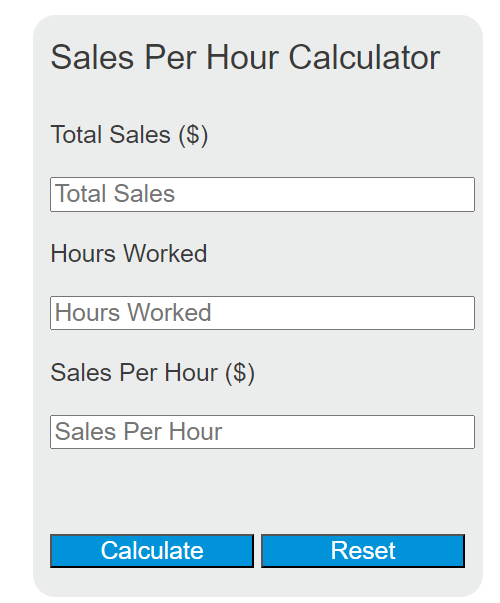
Calculate sales per labor hour, total sales, or hours worked, with target comparisons for individual, shift, and team productivity.
Sales Per Hour Formula
Sales per hour measures how much revenue is generated for each hour worked. It is commonly used to evaluate productivity, staffing efficiency, store performance, shift performance, and labor utilization.
Where:
- SPH = sales per hour
- TS = total sales
- HW = hours worked
If you know the target sales per hour or need to solve for a missing input, the formula can be rearranged:
How to Calculate Sales Per Hour
- Determine the total sales for the period you want to analyze.
- Determine the total hours worked during that same period.
- Divide total sales by hours worked.
- Interpret the result as dollars of sales generated per labor hour.
The key to getting a useful result is keeping the time period consistent. If sales are from one shift, the hours should also be from that same shift. If sales are weekly, use weekly labor hours.
Example
If a team produces $1,500 in sales over 8 hours, then:
This means the business generated $187.50 per hour.
How to Interpret the Result
| Sales Per Hour Result | What It Suggests |
|---|---|
| Higher SPH | More revenue is being generated for each hour worked, which usually indicates stronger labor efficiency. |
| Lower SPH | Sales are lower relative to time worked, which may point to slow traffic, overstaffing, weak conversion, or pricing issues. |
| Stable SPH over time | Operations and staffing are relatively consistent across comparable periods. |
| Rising SPH | Performance may be improving due to better scheduling, stronger demand, better sales execution, or higher average transaction value. |
Common Uses of Sales Per Hour
- Comparing one employee, team, location, or shift against another
- Tracking daily, weekly, or monthly productivity trends
- Setting staffing levels for peak and off-peak periods
- Evaluating whether labor costs are aligned with revenue output
- Measuring the impact of promotions, events, or seasonal changes
- Benchmarking retail, restaurant, service, or field sales performance
What Counts as “Hours Worked”?
Hours worked should represent the actual labor time tied to the sales period being analyzed. Depending on your goal, that may include:
- Total employee hours for a shift or day
- Only selling-floor or customer-facing hours
- Individual salesperson hours
- Team hours across a department or location
Be consistent with your definition. Mixing scheduled hours, paid hours, and actual clocked hours can distort the result.
What Counts as “Total Sales”?
Total sales should match the same scope as the hours worked. Businesses often choose one of the following approaches:
- Gross sales before returns, discounts, or refunds
- Net sales after returns and adjustments
- Department sales for a specific team or product line
- Location sales for one store, branch, or channel
For internal comparisons, use the same sales definition every time so trend analysis remains meaningful.
Common Mistakes to Avoid
- Using mismatched time periods: daily sales should be divided by daily hours, not weekly hours.
- Dividing by zero: if hours worked are zero, sales per hour cannot be calculated.
- Combining unrelated staff hours: including non-sales labor may lower SPH if your goal is salesperson productivity.
- Comparing different business models directly: a kiosk, full-service store, and online team may have very different normal SPH levels.
- Ignoring context: high SPH can still hide understaffing, while low SPH can occur during training, setup, or slow seasons.
Tips for Using Sales Per Hour More Effectively
- Compare SPH across the same daypart, season, and store type.
- Pair SPH with labor cost, transactions, conversion rate, and average ticket size.
- Track trends over multiple periods instead of judging one isolated result.
- Use SPH targets for scheduling, but adjust for promotions, holidays, and unusual traffic patterns.
- Review both team-level and employee-level SPH when coaching performance.
Sales Per Hour vs. Related Metrics
| Metric | Focus | Best Used For |
|---|---|---|
| Sales Per Hour | Revenue generated per labor hour | Measuring productivity over time worked |
| Sales Per Labor Hour | Revenue relative to total labor input | Staffing and operational efficiency analysis |
| Sales Per Employee | Revenue generated by each worker | Headcount productivity comparisons |
| Sales Per Square Foot | Revenue generated by floor space | Retail layout and location performance |
Frequently Asked Questions
Is a higher sales per hour always better?
Usually yes, but not always. A very high number may reflect strong efficiency, but it can also indicate understaffing, employee burnout, or missed service opportunities.
Can I use this calculator for one employee?
Yes. Enter that employee’s sales total and hours worked for the same period to estimate individual sales productivity.
Should I use gross sales or net sales?
Either can work, but use the same method consistently. Net sales is often better when returns and discounts materially affect performance.
What if my hours include non-selling tasks?
That is acceptable if your goal is total labor efficiency. If you want pure selling productivity, use only the hours directly tied to sales activity.