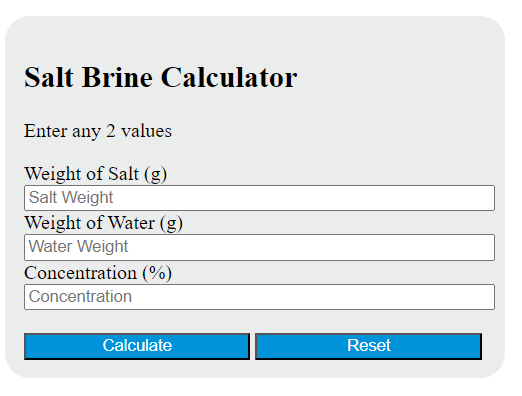
Calculate salt brine concentration by weight, salt required, water needed, and total batch mass in grams, kilograms, ounces, or pounds.
Salt Brine Formula
The salt brine calculator measures concentration as a weight-by-weight percentage. In other words, it compares the weight of salt to the total weight of the finished solution.
- C
- Salt concentration of the brine, expressed as a percentage of the total solution.
- Ws
- Weight of the salt.
- Ww
- Weight of the water.
This means the calculator is based on the final combined solution weight, not just the amount of water by itself. That distinction matters because many brine mistakes come from treating “percent salt” as salt added to the water instead of salt as a fraction of the finished mixture.
Related Equations
If you know the total solution weight, these equivalent forms are often the most useful for batching and recipe planning:
If you already know the water weight and need to determine the salt required for a target concentration, use:
If you know the salt weight and want to determine how much water is needed:
How to Calculate Salt Brine Concentration
- Measure the weight of the salt.
- Measure the weight of the water.
- Add them together to get the total solution weight.
- Divide the salt weight by the total solution weight.
- Multiply by 100 to convert the result to a percentage.
For accurate results, both inputs must use the same unit. Grams, kilograms, and pounds all work, as long as salt and water are entered in matching units.
Example
If a brine contains 10 grams of salt and 90 grams of water, the concentration is:
That result means 10% of the final brine weight is salt and 90% is water.
Common Brine Strengths
| Brine Concentration | Salt | Water | Salt:Water by Weight |
|---|---|---|---|
| 1% | 1 | 99 | 1:99 |
| 3% | 3 | 97 | 3:97 |
| 5% | 5 | 95 | 1:19 |
| 10% | 10 | 90 | 1:9 |
| 20% | 20 | 80 | 1:4 |
Each row scales proportionally. For example, a 5% brine can be made as 5 g salt and 95 g water, 50 g salt and 950 g water, or 5 lb salt and 95 lb water.
What the Percentage Really Means
- 5% brine means 5% of the finished solution weight is salt.
- 10% brine means 10% of the finished solution weight is salt.
- Higher concentration means more salt in each unit of finished brine.
A common error is to add 10 units of salt to 100 units of water and assume the result is a 10% brine. It is not. The finished solution weighs 110 units, so the true concentration is:
Practical Tips for Using the Calculator
- Weigh ingredients instead of measuring by volume whenever possible. The formula is mass-based, so scale readings are more reliable than cups or spoons.
- Convert units before calculating if your salt and water were measured differently.
- Use the target concentration carefully when scaling a batch. Small percentage changes can noticeably change the amount of salt required.
- Check whether your process uses percent by weight. This calculator is for weight-based brine concentration, not molarity, salinity in parts per thousand, or density-based readings.
When This Calculator Is Most Useful
This calculator is especially helpful when you need to:
- find the concentration of a prepared brine,
- determine how much salt to add for a target strength,
- calculate how much water is needed to dilute a known amount of salt, or
- scale a batch up or down while keeping the same salt percentage.
Because the equation is based on total solution weight, it stays consistent whether you are making a very small test batch or a large production batch.