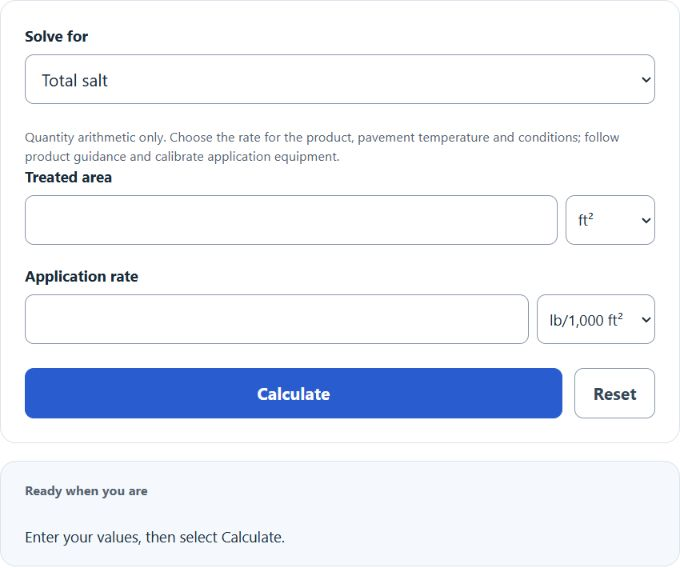
Calculate total salt needed from area and application rate, or solve for area or rate, using lbs/kg and sq ft, sq m, or sq yd units.
Related Calculators
- Parking Lot Size Calculator
- Parking Lot Salt Calculator
- Application Rate Calculator
- Coverage Area Calculator
- Salt Brine Calculator
- All Construction Calculators
Salt Coverage Formula
The salt coverage calculator estimates how much de-icing salt is needed for a single application based on the area being treated and the application rate you plan to use. It is useful for sidewalks, driveways, parking lots, loading zones, ramps, entrances, and other paved surfaces where consistent coverage matters.
Where:
- S = total salt needed for one application
- A = total area to be treated
- R = application rate per 1,000 square units
Because the calculator can solve for any missing value, the same relationship can be rearranged to find area or application rate:
Select the actual unit of each input. The calculator converts mixed imperial and metric units automatically; the rate denominator must match its selected unit, such as pounds per 1,000 square feet or kilograms per 1,000 square meters.
What Salt Coverage Means
Salt coverage is the amount of material distributed across a known surface area. In practical snow and ice control, coverage planning helps you answer a few important questions before application begins:
- How many pounds or kilograms are needed for one pass?
- How much area can a fixed amount of salt cover?
- How many bags should be stocked for a site or route?
- How much additional inventory is needed if more than one application is expected?
Estimating salt use ahead of time helps reduce under-application, which can leave slick areas untreated, and over-application, which can waste product and increase residue, cleanup, and material loss.
Measuring Area Before Using the Calculator
If the surface is not a simple rectangle, divide it into smaller shapes, calculate each area, and add them together. Common area formulas are:
- Use the first formula for rectangular walks, pads, and parking sections.
- Use the second for triangular or wedge-shaped sections.
- Use the third for circular pads, islands, or curved features.
Measure only the surfaces that will actually receive salt. Excluding medians, planters, grass strips, and untreated zones creates a much better estimate than using overall property size.
How to Use the Salt Coverage Calculator
- Choose the quantity to solve, then enter the two known values.
- Select the correct unit system for area and rate.
- Enter the application rate you plan to use.
- Select Calculate to read the total salt needed for one application.
- To find area or rate, choose that solve mode and enter the other two known values.
This makes the calculator useful for both field application and material planning. You can estimate a single treatment, check whether current inventory is enough, or determine the spread rate possible with the salt already on hand.
Example
If a property has 5,000 square feet of treatable area and the selected application rate is 20 pounds per 1,000 square feet, the total salt needed is:
At that hypothetical rate, the arithmetic gives 100 pounds. The 20-pound rate is an illustration, not a recommendation; choose a product- and condition-specific rate using pavement temperature, product guidance and calibrated equipment.
Bag and Inventory Planning
After calculating the material needed for one application, you can estimate bag count and total event demand.
- B = number of bags needed
- W = weight of each bag
- n = number of planned applications
If partial bags are impractical, round the bag count up to the next whole bag. For route planning, the total event formula is especially useful because many storms require more than one treatment cycle.
How Much Area One Bag Can Cover
If you know bag weight and application rate, you can estimate how much area one bag will treat:
This is helpful when comparing 25 lb, 50 lb, or bulk loading plans, or when checking whether a hopper load is enough for a complete route.
Factors That Affect Salt Demand
| Factor | Effect on Coverage Planning | Why It Matters |
|---|---|---|
| Light frost or thin glaze | Usually lower material demand | Minimal accumulation often requires less product than a full ice event. |
| Packed snow or refrozen areas | Usually higher material demand | More material or repeat applications may be needed to restore traction. |
| Large open lots | Spread consistency becomes more important | Even if total weight is correct, poor distribution can leave untreated strips. |
| Narrow walks, stairs, and entrances | Hand application can vary more | Smaller surfaces are easy to oversalt unless quantities are measured carefully. |
| Multiple passes during one storm | Total material increases directly | Inventory should cover the full event, not only the first application. |
| Mixed units | Creates calculation errors | Select each input’s actual unit; automatic conversion permits mixed units. |
Common Input Mistakes
- Using total property size instead of actual treated surface area.
- Forgetting separate sidewalk, entry, ramp, or apron sections.
- Ignoring the need for second or third applications.
- Selecting a rate denominator or mass unit that does not match the entered number.
- Estimating bag count without rounding up when full bags are required.
Practical Notes
Application rate is an operating decision, not a fixed constant. Surface conditions, moisture, temperature, traffic, and the type of de-icing material being used all influence how much salt is appropriate. The calculator gives you the quantity once you decide on the rate.
For the most reliable result, measure the treatable area carefully, select the correct units, use a realistic spread rate, and plan inventory around the total number of expected applications rather than a single pass alone.