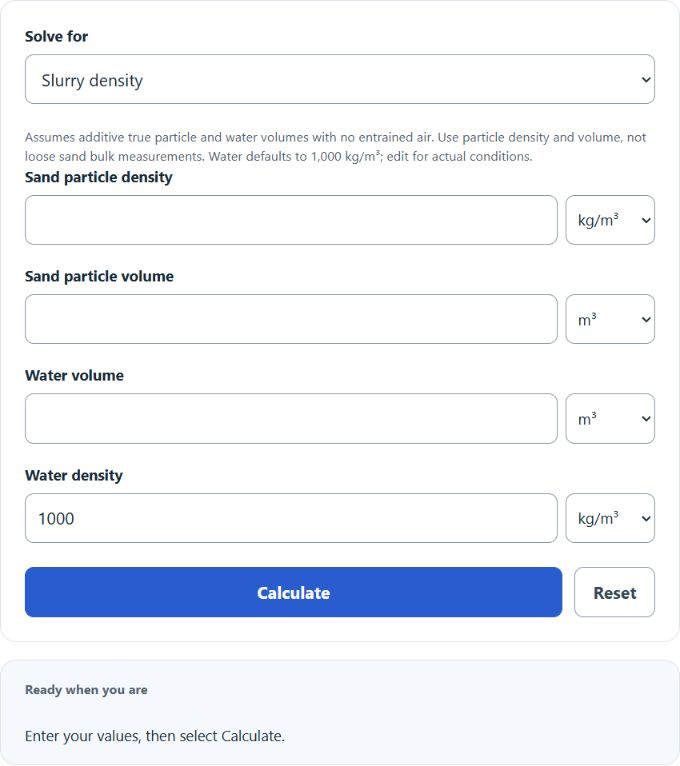
Calculate sand slurry density, solids concentration, and batch mix proportions from sand, water, density, SG, mass, or volume inputs.
Related Calculators
- Swell Factor Calculator
- Load Density Calculator
- Excavator Productivity Calculator
- Loader Bucket Capacity Calculator
- All Construction Calculators
Sand Slurry Density Formula
The following formula assumes additive true sand-particle and water volumes, with no entrained air. Use particle density and particle volume, not loose sand bulk density or bulk volume, which include voids. The water-density default of 1000 kg/m³ is an editable approximation.
Variables:
- SD is the slurry density (kg/m³)
- SM is the sand mass (kg), calculated as sand density × sand volume
- WM is the water mass (kg), calculated as water density × water volume
- SV is the sand volume (m³)
- WV is the water volume (m³)
To calculate the sand slurry density, divide the total mass (sand mass + water mass) by the total volume (sand volume + water volume).
What is Sand Slurry Density?
Sand slurry density is the mass per unit total volume of a mixture of sand and water. It is related to the sand concentration and is an important parameter in applications such as slurry transport, grouting/backfilling, and other processes where density affects flow behavior and solids-carrying capacity.
How to Calculate Sand Slurry Density?
The following steps outline how to calculate the Sand Slurry Density.
- First, determine the sand density (kg/m³).
- Next, determine the sand volume (m³).
- Next, determine the water volume (m³).
- Determine the water density (kg/m³) (fresh water is often approximated as 1000 kg/m³).
- Calculate the sand mass by multiplying the sand density by the sand volume.
- Calculate the water mass by multiplying the water density by the water volume.
- Finally, calculate the Sand Slurry Density (SD) in kg/m³ using the formula above.
- Choose the quantity to solve and select Calculate. Concentration modes convert mass and true-volume percentages; batch modes accept total mass or total volume. Density ratios use the entered water reference.
Example Problem:
Use the following variables as an example problem to test your knowledge (assume water density = 1000 kg/m³).
illustrative sand-particle density (kg/m³) = 1600 (an assumed material value, not loose sand bulk density)
true sand-particle volume (m³) = 0.5
water volume (m³) = 1.0
Solution: Sand mass = 1600 × 0.5 = 800 kg; water mass = 1000 × 1.0 = 1000 kg; total mass = 1800 kg; total volume = 0.5 + 1.0 = 1.5 m³; slurry density = 1800 ÷ 1.5 = 1200 kg/m³.