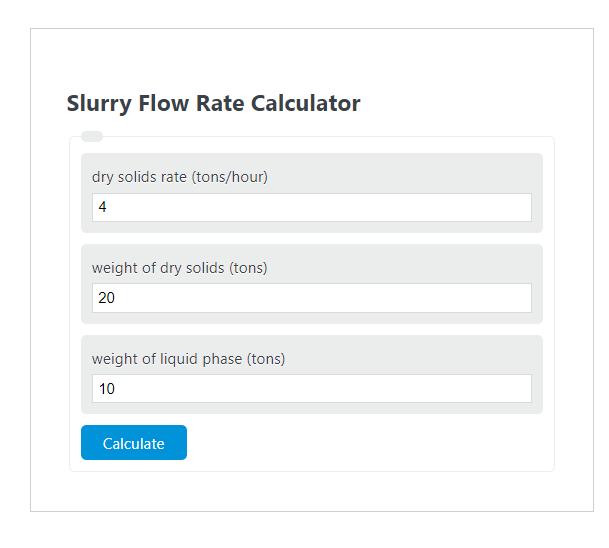
Calculate slurry flow rate, dry solids rate, or liquid phase weight from any 3 inputs using tons, kg, lb, or gallons/min with unit conversion.
- All Construction Calculators
- Slurry Density Calculator
- Slurry Volume Calculator
- Percent Solids In Slurry Calculator
Understanding the Slurry Flow Rate Calculator
The Slurry Flow Rate Calculator estimates the volumetric flow rate of a slurry from three pieces of information: the dry solids production rate, the mass of dry solids in a representative sample, and the mass of liquid in that same sample. This is useful for checking pump loading, dilution targets, line capacity, residence time, and general process balance in mixing, conveying, and dewatering systems.
The result is an approximation because the calculator assumes the slurry behaves close to water for density conversion. That assumption is often acceptable for quick checks, but it can drift when the slurry is unusually dense, highly aerated, or contains solids with a much different specific gravity.
Core Relationship
The calculator first determines the solids mass fraction of the slurry, then uses that fraction to convert dry-solids mass flow into total slurry volume flow.
Where:
| Term | Meaning | Practical Interpretation |
|---|---|---|
| Dry Solids Rate (DSR) | Mass flow rate of solids only | How many dry solids are being fed or produced per unit time |
| Weight of Dry Solids (WS) | Mass of solids in a representative slurry sample | Used to determine slurry concentration by weight |
| Weight of Liquid Phase (WL) | Mass of liquid in the same representative sample | Combined with WS to determine dilution level |
| Slurry Flow Rate (SFR) | Estimated volumetric flow rate of the full slurry stream | Total liquid-plus-solids flow expressed as volume per minute |
How to Enter the Inputs Correctly
- Use DSR for solids only. Do not enter the total slurry mass flow as the dry solids rate.
- Use WS and WL from the same sample. They must describe the same slurry mixture at the same concentration.
- Any consistent mass units can be used for WS and WL. For example, 3 tons and 5 tons gives the same solids fraction as 30 lb and 50 lb.
- The solids fraction is dimensionless. Only the ratio between WS and WL matters for concentration.
- Choose output units carefully. The calculator can display slurry flow in gallons/min, liters/min, or cubic meters/min after unit conversion.
What the Formula Is Really Doing
If a slurry contains a smaller percentage of solids by weight, more liquid is required to carry the same dry-solids rate. That means the total slurry volume rises. If the slurry is more concentrated, less liquid is needed and the flow volume drops.
- If DSR increases while concentration stays the same, SFR increases.
- If WL increases while DSR stays the same, the slurry becomes more dilute and SFR increases.
- If WS increases relative to WL, the slurry becomes more concentrated and SFR decreases for the same DSR.
Example Calculation
Suppose the dry solids rate is 4 short tons/hour, the representative sample contains 3 tons of dry solids, and the liquid phase weighs 5 tons.
This means the process would be moving approximately 42.63 gallons of slurry per minute under the water-density assumption built into the calculator.
Using Percent Solids by Weight
In many plants, concentration is reported as percent solids by weight instead of separate solid and liquid masses. You can convert that directly into the same calculation framework.
This form is especially convenient when a lab report gives moisture or solids concentration directly.
Why the Result Is Approximate
The constant 3.9967 is based on a water-equivalent conversion. In other words, it assumes the slurry density is close enough to water that the mass-to-volume conversion is nearly the same. For higher-accuracy calculations, the actual slurry density should be used.
In this more general form, ρ is slurry density in lb/gal and DSR is in short tons/hour. This shows why denser slurries usually have a lower actual volumetric flow than the water-based estimate for the same solids throughput.
When This Calculator Is Most Useful
- Pump and piping checks during slurry transport
- Dilution water adjustments in mixing tanks
- Quick process estimates when only solids rate and composition are known
- Comparing production rate changes against expected flow demand
- Screening, classification, flotation, and thickener feed evaluations
Common Input Mistakes to Avoid
- Mixing total mass flow with dry solids flow. DSR must represent solids only.
- Using unpaired sample weights. WS and WL must come from the same slurry sample.
- Ignoring density effects. Very heavy slurries can differ materially from the estimate.
- Using non-representative samples. Settling, segregation, or poor mixing can distort the solids fraction.
- Confusing weight fraction with volume fraction. This calculator uses mass-based concentration, not volumetric solids percentage.
Quick Interpretation Guide
| If this changes… | What usually happens to slurry flow rate? | Reason |
|---|---|---|
| Dry solids rate increases | Flow rate increases | More solids throughput requires more total slurry movement |
| Liquid phase increases | Flow rate increases | The slurry becomes more dilute, so more volume is needed |
| Solids concentration increases | Flow rate decreases | Each unit volume carries more solids |
| Actual slurry density is much above water | Estimated flow may be too high | The calculator uses a water-based volume conversion |
Practical Tip
If you already know the target production rate and the allowable pipe or pump flow range, this calculator can help you back-check whether your slurry concentration is realistic. A small change in solids fraction can create a large change in required volumetric flow, especially when the slurry is relatively dilute.