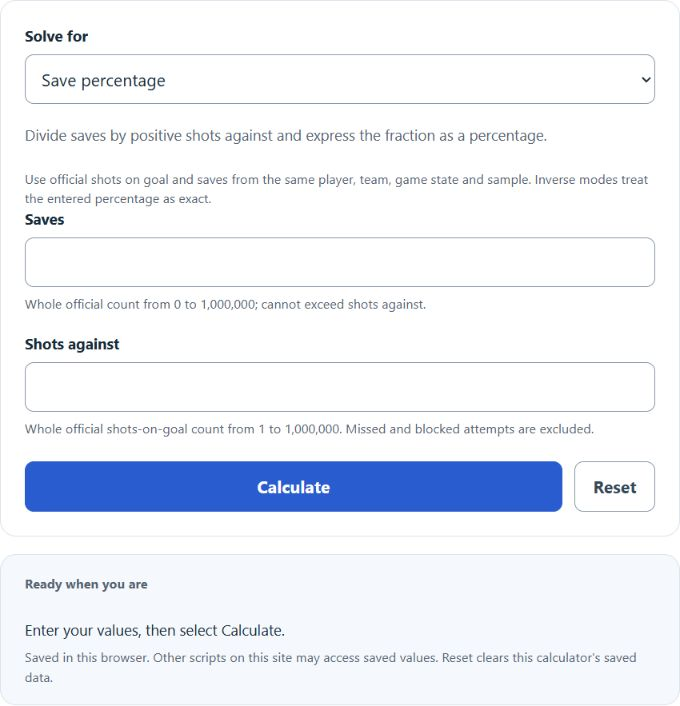
Calculate a hockey goalie save percentage from saves and shots against, or solve for saves or shots against from a save percentage and the other count.
Save Percentage Formula
Save percentage is the share of official shots on goal that the goalie stops. In the formula, S is saves and A is positive shots against. Definition reference: NHL glossary.
How to Use This Calculator
- Enter counts from one consistent player, team, game state, and sample.
- Choose the requested result when a solve-for option is shown.
- Select Calculate and review both the primary result and calculation steps.
- Use Reset before starting a different sample.
Example
A goalie with 275 saves on 300 shots has a 91.67% save percentage. The exact fraction is 11/12; 91.67% and .917 are rounded displays. Inverse mode treats an entered percentage as exact: 300 shots at exactly 91.67% gives 275.01 saves, a fractional equivalent rather than an exact real stat line.
Input and Result Guide
| Item | How to use it |
|---|---|
| Shots against | Use official shots on goal faced |
| Saves | Cannot exceed shots against |
| Typical display | Usually shown as .917 or 91.7% |
How to Interpret the Result
Use the result with counts from the same competition level, reporting provider, strength state, and date range. A single rate does not account for role, opponent quality, sample size, team system, or score effects.
Common Questions
Should I round the result?
The percentage and decimal displays are rounded; a near-perfect result that rounds to 100% is identified as below 100%. Actual saves and shots are whole counts. A fractional inverse result cannot match the entered exact rate and known count as a whole-number stat line; rounding it changes the rate. A published rounded percentage may describe several possible underlying counts, so it does not determine a unique exact inverse. For shots inversion, zero saves with 0% is underdetermined; positive saves with 0% and zero saves with a positive percentage have no positive-shots solution.
Can I compare different leagues or data providers?
You can, but definitions and recording practices can differ. Verify that both samples use the same statistic before drawing conclusions.
Does this result predict future performance?
No. It summarizes the entered sample and does not forecast future outcomes by itself.