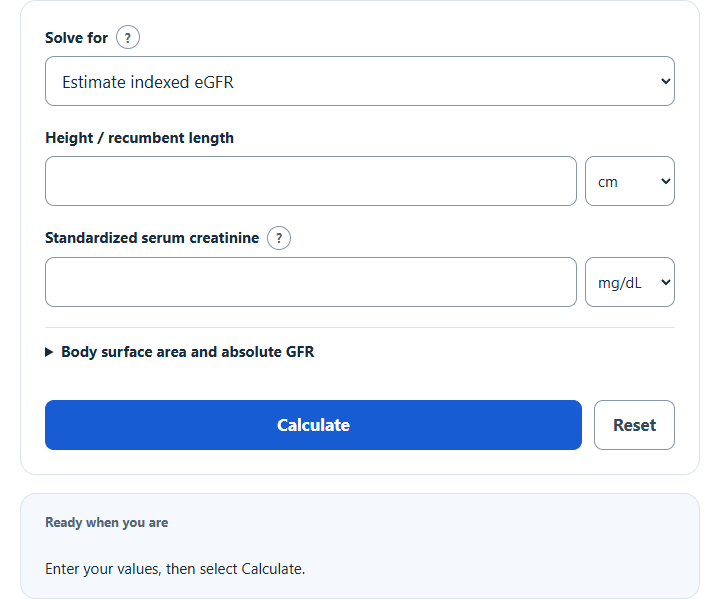
Calculate pediatric eGFR with the bedside Schwartz formula from height and serum creatinine, in cm or inches and mg/dL or µmol/L, with optional BSA.
Medical note: For informational use only—not medical advice. Rapidly changing creatinine or unusual muscle mass can make eGFR unreliable. Use standardized lab-measured creatinine and consult a pediatric clinician to choose and interpret the appropriate equation; do not diagnose, treat, or dose medicines from this calculator.
Related Calculators
- Knee Height Calculator
- Height to Forearm Length Calculator
- Clark’s Rule Calculator
- Bladder Volume Calculator
- All Health and Medical Calculators
Updated (Bedside) Schwartz Equation
This calculator uses the 2009 creatinine-based CKiD bedside Schwartz equation, k = 0.413. NIDDK describes its development mainly in children aged 8–15 with mild-to-moderate CKD. It requires standardized creatinine; enzymatic pediatric measurements are preferred where possible. It is distinct from the newer CKiD U25 equations, and mathematical computability does not establish clinical suitability. Confirm the equation and lab method with the clinician or laboratory.
Where:
- eGFR is the estimated glomerular filtration rate (mL/min/1.73 m²)
- k is a constant (0.413 in the updated/bedside Schwartz equation)
- Height is the height of the child in centimeters (cm)
- Serum Creatinine is the standardized measured blood creatinine (mg/dL). For µmol/L input, divide by 88.4 before using this 0.413 equation.
To calculate the estimated GFR, multiply 0.413 by the height of the child (cm) and divide by the serum creatinine level (mg/dL).
What is the Schwartz Formula?
The Schwartz formula refers to a family of pediatric equations used to estimate kidney function. Earlier versions (developed in the 1970s) used different constants by age/sex and older creatinine measurement methods, while the updated/bedside Schwartz equation commonly uses k = 0.413 with modern creatinine assays.
How to Calculate GFR using the Schwartz Formula?
The following steps outline how to calculate the estimated GFR using the Schwartz Formula.
- First, measure the height of the child in centimeters (cm).
- Next, obtain the serum creatinine level from a blood test (mg/dL).
- Use the constant k value of 0.413 for the updated/bedside Schwartz equation.
- Insert the values into the equation: eGFR = (0.413 * Height) / Serum Creatinine.
- Calculate the estimated GFR (eGFR) in mL/min/1.73 m².
- Compare the result with the calculator above to verify your calculation.
Example Problem:
Use the following variables as an example problem to test your knowledge.
Height of the child = 120 cm
Serum Creatinine level = 0.6 mg/dL (53.04 µmol/L). The equation gives 0.413 × 120 ÷ 0.6 = 82.6 mL/min/1.73 m². This is an illustrative indexed estimate, not a diagnosis. The optional BSA rescaling uses estimated absolute GFR = indexed eGFR × Mosteller BSA ÷ 1.73, in mL/min; it does not measure actual filtration or select a drug dose. The ±10% creatinine examples hold height fixed and are arithmetic sensitivity scenarios, not predictions or confidence intervals.