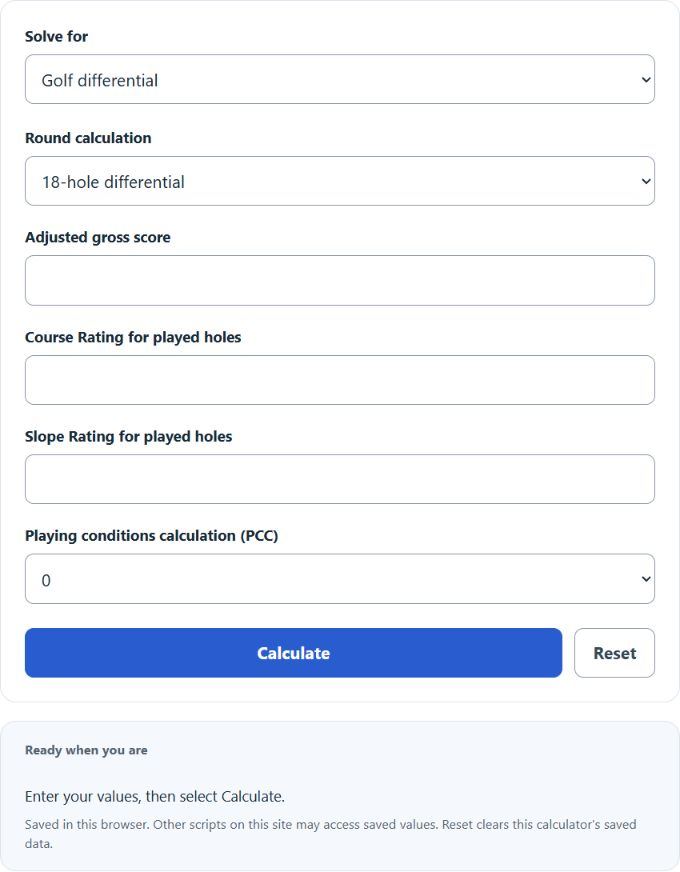
Calculate a golf score differential from your adjusted gross score, Course Rating and Slope Rating, or a point differential from team and opponent scores.
Calculator Functions
| Function | What it does | What it requires |
|---|---|---|
| Golf differential | Finds the Score Differential of a round of golf under the World Handicap System | Requires the adjusted gross score, the Course Rating, the Slope Rating and the PCC. A 9-hole round completed to 18 also requires the official expected nine-hole differential |
| Handicap Index estimate | Estimates a Handicap Index from recent Score Differentials | Requires 3 to 20 Score Differentials |
| Course / Playing Handicap | Finds the Course Handicap and Playing Handicap for one set of tees | Requires the Handicap Index, the 18-hole Course Rating, Slope Rating and par, and the handicap allowance in percent |
| Game score / point differential | Finds the margin between a team and its opponent, or the scores behind a known margin | Requires any two of team score, opponent score, difference and combined score. Games played is optional |
Golf differential works for an 18-hole round, for the nine holes played on their own, or for nine holes combined with an expected value. A plus Handicap Index is entered with a plus sign, such as +2.4. In Game score / point differential, entering the games played turns a season total into a differential per game.
Score Differential Formulas
(AGS − CR − PCC) [1]
| SD | Score Differential for an 18-hole round |
| S | Slope Rating of the tees played (55 to 155) |
| AGS | Adjusted gross score |
| CR | Course Rating of the tees played |
| PCC | Playing conditions calculation adjustment, from −1 to +3 |
Golf differential
The result is rounded to the nearest tenth, with .5 rounded upward [1]. An adjusted gross score of 85 on tees rated 71.2 with a Slope Rating of 125 and no PCC gives (113 ÷ 125) × 13.8 = 12.4752, a Score Differential of 12.5. A score below the Course Rating gives a negative differential, which rounds toward zero: −1.55 becomes −1.5 [3].
(AGS9 − CR9 − 0.5 × PCC) [2]
A nine-hole round uses the nine-hole ratings and half the PCC. The nine-hole figure stays unrounded, the player's expected score for the other nine is added, and only the 18-hole total is rounded [2]. A 44 on nine holes rated 35.4 with a Slope Rating of 121 gives 8.0314. With an expected nine-hole differential of 9.2 the round counts as 17.2. The expected value comes from the handicap service and is not half the Handicap Index.
Handicap Index estimate
The lowest Score Differentials in the record are averaged, an adjustment is applied when there are few scores, and the result is rounded to the nearest tenth [4]. The number used depends on how many are in the record:
| Score Differentials in record | Differentials used | Adjustment |
|---|---|---|
| 3 | Lowest 1 | −2.0 |
| 4 | Lowest 1 | −1.0 |
| 5 | Lowest 1 | 0 |
| 6 | Average of lowest 2 | −1.0 |
| 7 or 8 | Average of lowest 2 | 0 |
| 9 to 11 | Average of lowest 3 | 0 |
| 12 to 14 | Average of lowest 4 | 0 |
| 15 or 16 | Average of lowest 5 | 0 |
| 17 or 18 | Average of lowest 6 | 0 |
| 19 | Average of lowest 7 | 0 |
| 20 | Average of lowest 8 | 0 |
Six differentials of 15.3, 12.1, 18.4, 14.0, 16.2 and 13.3 use the lowest two: (12.1 + 13.3) ÷ 2 = 12.7, less 1.0, for an estimate of 11.7. The result is capped at 54.0, the maximum Handicap Index [4].
Course / Playing Handicap
(CR − par) [5]
CH is the Course Handicap, HI is the Handicap Index and PH is the Playing Handicap. The allowance is applied to the unrounded Course Handicap, and each figure is then rounded to the nearest whole number with .5 rounded upward [6]. A Handicap Index of 8.6 on a course rated 71.0 with a Slope Rating of 125 and a par of 71 gives 9.5133, a Course Handicap of 10. At an 85% allowance the Playing Handicap is 9.5133 × 0.85 = 8.09, which rounds to 8.
Game score / point differential
A team that wins 75 to 62 has a differential of 13, and the losing side has −13. Over a season, the differential per game is the total margin divided by the games played: 2,450 points scored and 2,310 allowed over 20 games is +140, or +7 a game. When only the combined score and the margin are known, team = (total + D) ÷ 2 and opponent = (total − D) ÷ 2.
Limits of This Estimate
- The Handicap Index estimate leaves out the soft cap and hard cap on upward movement, exceptional score reductions and committee adjustments, all of which can change an official index [4]. Only a handicap service issues an official Handicap Index.
- The golf functions need the adjusted gross score, which applies the maximum hole score, and not simply the total on the card. The PCC and the expected nine-hole differential are published by the handicap service and cannot be worked out here.
- Game score / point differential is plain subtraction. League tiebreakers often cap the margin counted per game or use a ratio, so the league's own rule decides.
Sources
- USGA, Rules of Handicapping, Rule 5.1a For an 18-hole Score: 18-hole Score Differential formula, rounding and the PCC range
- USGA, Rules of Handicapping, Rule 5.1b For a 9-hole Score: nine-hole formula and combining it with the expected score
- USGA, Rules of Handicapping, Rule 5.1c Rounding of Minus Score Differentials: negative differentials round toward zero
- USGA, Rules of Handicapping, Rule 5.2a For Fewer Than 20 Scores: number of differentials used, adjustments, rounding and the 54.0 maximum
- USGA, Rules of Handicapping, Rule 6.1a For an 18-hole Round: Course Handicap formula and rounding
- USGA, Rules of Handicapping, Rule 6.2a Standard Calculation: Playing Handicap from the unrounded Course Handicap and the allowance