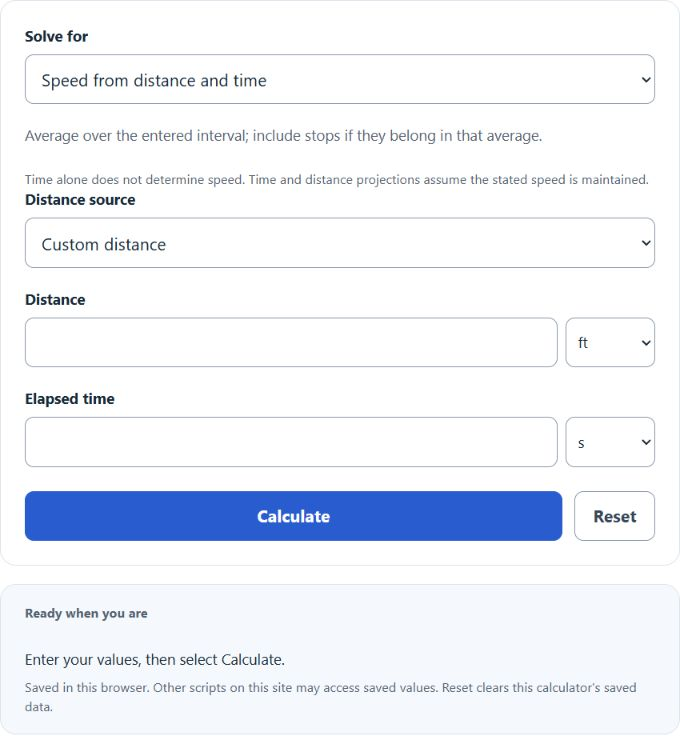
Convert seconds to mph: enter a distance and the time in seconds to get miles per hour, or pick a 40-yard dash, 100 m, quarter-mile or mile preset.
- All Unit Converters
- mph To Hours Calculator
- Seconds To Miles Calculator
- MPH To Minutes Per Mile Calculator
Seconds To Miles Per Hour Formula
Speed requires both distance and elapsed time; seconds alone do not determine miles per hour. In the following relations, D is in miles and T is in seconds.
MPH = D × 3600 ÷ T; T = D × 3600 ÷ MPH; D = MPH × T ÷ 3600. These relations calculate average speed, required seconds or covered miles. Time and distance projections assume the stated speed applies throughout.
Variables:
- MPH is average speed in miles per hour
- D is the distance covered in miles
- T is the time taken in seconds; 3600 is the number of seconds in one hour
To calculate the speed in miles per hour, divide the distance covered in miles by the elapsed time in seconds. Multiply the result by 3600 (the number of seconds in one hour) to convert the speed from miles per second to miles per hour.
Convert a speed already given per second
Choose Convert speed to mph when you already know the speed. Enter the value and select m/s, ft/s, yd/s, in/s, cm/s, km/s or mi/s. The result shows mph, km/h and m/s. You do not need a separate elapsed time.
To get mph, first express the speed in meters per second and divide by 0.44704. Multiply the same m/s value by 3.6 to get km/h. For example, enter 1 and choose mi/s. One mile per second equals 1,609.344 m/s, so 1,609.344 ÷ 0.44704 = 3,600 mph.
| Seconds (for 1 mile) | Miles per Hour (mph) |
|---|---|
| 30 | 120.000 |
| 45 | 80.000 |
| 60 | 60.000 |
| 90 | 40.000 |
| 120 | 30.000 |
| 150 | 24.000 |
| 180 | 20.000 |
| 210 | 17.143 |
| 240 | 15.000 |
| 270 | 13.333 |
| 300 | 12.000 |
| 360 | 10.000 |
| 400 | 9.000 |
| 450 | 8.000 |
| 480 | 7.500 |
| 600 | 6.000 |
| 720 | 5.000 |
| 900 | 4.000 |
| 1200 | 3.000 |
| 1800 | 2.000 |
| * Rounded to 3 decimals. For a 1-mile distance: mph = 3600 ÷ seconds. | |
What does seconds to miles per hour mean?
The calculation finds average speed from a known distance and elapsed duration. A duration alone cannot be converted to mph: traveling one mile in 60 seconds gives 60 mph, while half a mile in the same time gives 30 mph. Average speed does not show speed changes during that interval. Include stops in elapsed time when they belong in the desired average. The same distance/time relationship can solve time or distance when the other two quantities are known.
How to Calculate Seconds To Miles Per Hour?
Choose Speed from distance and time, Time from distance and mph, or Distance from mph and time. The calculator physically converts feet, meters, yards, international miles and kilometers, plus seconds, minutes and hours. All required quantities must be positive. Projections at an entered mph assume that speed is maintained; stops and acceleration are not separately modeled.
- For speed, choose Custom distance and enter its value/unit, or select 40 yards, 100 meters, a quarter mile or one mile. A preset supplies the distance and hides the unused custom field. For time, enter the known distance and its unit.
- For speed or distance, enter the elapsed time and choose seconds, minutes or hours. For time or distance, enter the known speed in mph.
- Apply the selected relation. In the mile-based formulas above, first express D in miles and T in seconds; the calculator performs native-unit conversions automatically.
- Read the primary mph, seconds or meters result and its equivalent units. Speed results also include km/h, m/s, ft/s and pace in minutes per mile.
- Expand the calculation details to check conversions and assumptions. Exact unit definitions used include 1 international mile = 1609.344 m, 1 foot = 0.3048 m, 1 yard = 0.9144 m and 1 hour = 3600 s, giving 1 mph = 0.44704 m/s.
Example Problem:
Use the following variables as an example problem to test your knowledge.
Distance covered (D) = 500 miles
Time taken (T) = 7200 seconds. Average speed = 500 × 3600 ÷ 7200 = 250 mph. Conversely, 500 miles at 250 mph takes 7200 seconds, and 250 mph maintained for 7200 seconds covers 500 miles.