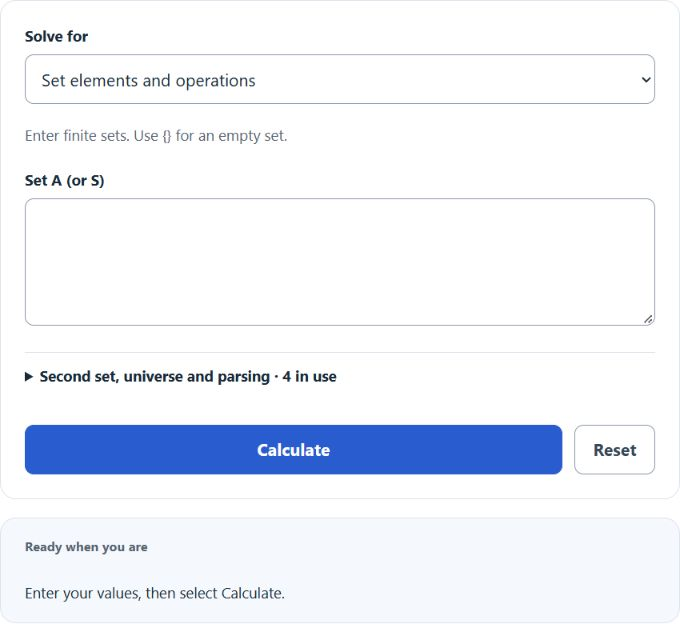
Calculate set cardinality, unions, intersections, complements, power sets, and Cartesian products from set elements or counts in one place.
- All Math and Numbers Calculators
- Jaccard Coefficient Calculator
- Binomial Coefficient Calculator
- Partition Formula Calculator
- Permutation Multiplication Calculator
- Law of Total Probability Calculator
Set Cardinality Formula
The following formula is used to calculate the cardinality of a set.
Variables:
- C is the cardinality of the set
- S is the set
To calculate the cardinality of a set, count the distinct elements in the set; repeated entries count once. The cardinality of a set is represented by the symbol “|S|”, where “S” is the set.
What is a Set Cardinality?
Set cardinality refers to the number of elements that are contained in a set. In other words, it is a measure of the “size” of a set. For finite sets, the cardinality is simply a count of all its elements. For infinite sets, the concept of cardinality becomes more complex and is defined in terms of a one-to-one correspondence between the elements of the set and the elements of other sets.
How to Calculate Set Cardinality?
The following steps outline how to calculate the Set Cardinality.
- First, determine the set (S).
- Next, count the number of elements in the set (C).
- Finally, calculate the Set Cardinality.
- After counting the elements, check your answer with the formula above.
Example Problem :
Use the following variables as an example problem to test your knowledge.
Set (S) = {1, 2, 3, 4, 5}
Cardinality of the set (C) = |S| = 5