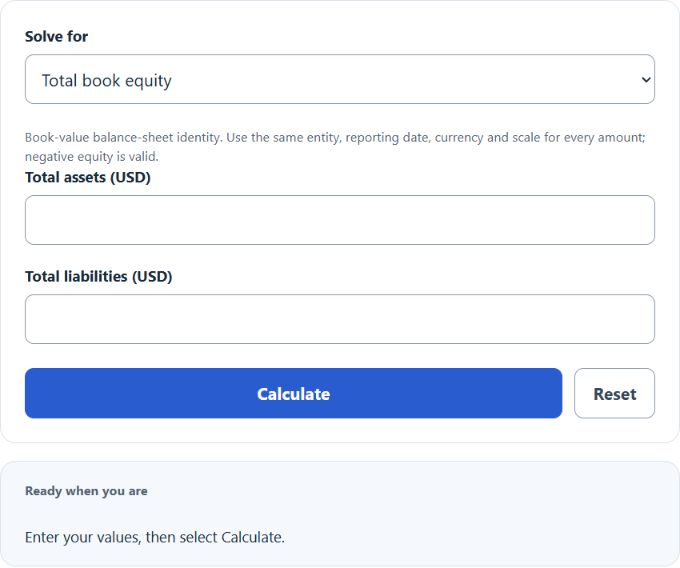
Calculate shareholders’ equity, assets or liabilities from any two values and find the missing figure using Assets = Liabilities + Equity.
Shareholders' Equity Formula
Shareholders' equity represents the residual interest in a company after subtracting all liabilities from all assets. In balance-sheet form, equity is the amount that remains for shareholders once every debt and obligation is accounted for.
The core accounting identity is:
Rearranged to solve for shareholders' equity:
- SE = shareholders' equity
- A = total assets
- L = total liabilities
If you are using the calculator to solve for a missing value other than equity, these equivalent forms are useful:
How to Calculate Shareholders' Equity
- Determine total assets, such as cash, accounts receivable, inventory, equipment, investments, and other resources owned by the business.
- Determine total liabilities, such as accounts payable, accrued expenses, loans, bonds payable, taxes owed, and other obligations.
- Subtract total liabilities from total assets to find total book equity. In consolidated statements, this includes non-controlling interests; deduct those separately to find equity attributable only to the parent’s shareholders.
This calculator can also work backward. If you already know equity and liabilities, you can solve for assets. If you know assets and equity, you can solve for liabilities.
Example Calculation
Suppose a company has total assets of $1,250,000 and total liabilities of $730,000.
The company’s shareholders' equity is $520,000.
How to Interpret the Result
| Equity Result | Meaning | Typical Interpretation |
|---|---|---|
| Positive | Assets exceed liabilities | The business has positive residual book equity; this is not a guarantee of market or liquidation value. |
| Zero | Assets equal liabilities | There is no remaining book value after obligations are covered. |
| Negative | Liabilities exceed assets | The company has a book-value deficit, which may indicate financial stress or accumulated losses. |
What Is Included in Shareholders' Equity?
On a corporate balance sheet, total shareholders' equity often includes several components, including contributed capital and accumulated earnings retained in the business. Common line items may include:
- Common stock or share capital
- Additional paid-in capital
- Retained earnings
- Accumulated other comprehensive income
- Treasury stock as a reduction
Even though those account-level details exist, the calculator uses the high-level balance-sheet relationship of assets minus liabilities, which is the fastest way to compute total equity.
Common Asset and Liability Inputs
| Assets Often Included | Liabilities Often Included |
|---|---|
| Cash, receivables, inventory, prepaid expenses, property, equipment, investments, intangible assets | Accounts payable, wages payable, taxes payable, short-term debt, long-term debt, lease obligations, accrued expenses |
Why Shareholders' Equity Matters
- It shows the book value remaining for owners after all debts are subtracted.
- It helps measure financial position and capital structure.
- It is used in ratio analysis, including debt-to-equity and return on equity.
- It helps investors and managers evaluate whether the business is building value over time.
- Changes in equity can reflect retained earnings, owner contributions, distributions and other items; use the statements of changes in equity and cash flows to assess financing sources.
Important Limitations
- Shareholders' equity is a book-value measure, not a market-value measure. A company can have high market value even if book equity is modest, and vice versa.
- Asset values may be historical, especially for long-lived assets, so equity may not reflect current resale value.
- Intangible value such as brand strength, proprietary technology, or customer loyalty may not be fully captured.
- Negative equity does not automatically mean failure, but it does require deeper analysis of losses, leverage, and cash flow.
Shareholders' Equity vs. Market Value
Shareholders' equity comes from the balance sheet and is based on recorded assets and liabilities. Market value of equity is based on what investors are willing to pay for the company’s shares. These two numbers can differ significantly, so this calculator should be used for accounting and financial statement analysis, not for estimating stock market capitalization.
Practical Tips When Using the Calculator
- Use total assets and total liabilities from the same reporting date.
- Do not mix figures from different periods.
- Make sure all values use the same unit, such as dollars, thousands, or millions.
- If you are analyzing a public company, use the balance sheet from the latest financial statement for consistency.
Frequently Asked Questions
Can shareholders' equity be negative?
Yes. If total liabilities are greater than total assets, the result is negative equity.
Is higher shareholders' equity always better?
Not always. Higher equity can indicate a stronger balance sheet, but it should be evaluated alongside profitability, liquidity, debt levels, and cash flow.
Is shareholders' equity the same as cash?
No. Equity is a residual accounting value, while cash is only one asset account.
Is shareholders' equity the same as owner's equity?
They are closely related concepts. "Shareholders' equity" is typically used for corporations, while "owner's equity" is often used for sole proprietorships and some small businesses.
SE = A − L, where A is the company’s total recorded assets, L is its total recorded liabilities, and SE is total book equity.