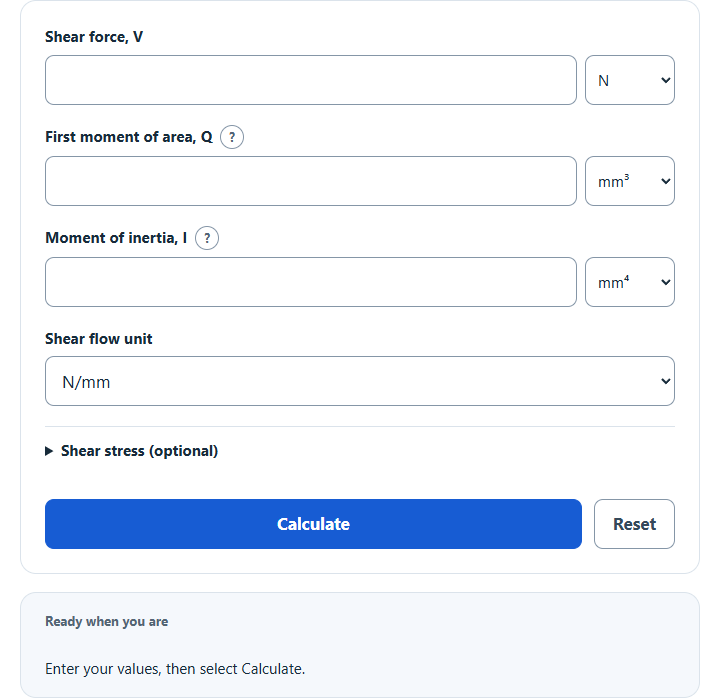
Calculate shear flow q = VQ/I from shear force, first moment of area and moment of inertia in metric or US units, plus shear stress if you add thickness.
Related Calculators
- Wind Loading Calculator
- Thread Pull-Out Force Calculator
- Riveting Force Calculator
- Compressive Strength Calculator
- All Construction Calculators
Calculator Functions
| Function | What it does | What it requires |
|---|---|---|
| Shear flow q = VQ/I | Finds the shear force carried per unit length along a beam at a chosen cut through its cross-section | Requires the shear force, the first moment of area beyond the cut and the moment of inertia of the whole section |
Shear force can be entered in N, kN, lbf or kip, the first moment of area in mm³ to ft³ and the moment of inertia in mm⁴ to ft⁴. Shear flow is shown in N/mm, N/m, kN/m, lbf/in, lbf/ft or kip/in, with the result repeated in the other unit system. An optional thickness at the cut adds the shear stress in MPa and psi.
Shear Flow Formulas
| q | Shear flow, a force per unit length (N/m, N/mm, lbf/in) |
| V | Shear force on the section (N, lbf) |
| Q | First moment of area of the part of the section beyond the cut, about the neutral axis (m³, mm³, in³) |
| I | Second moment of area of the whole cross-section about the neutral axis (m⁴, mm⁴, in⁴) |
Q is the area of the piece beyond the cut multiplied by the distance from the neutral axis to that piece’s centroid [1]. A 5,000 N shear force with Q = 200 mm³ and I = 10,000 mm⁴ gives q = 5,000 × 200 ÷ 10,000 = 100 N/mm. In US units, 2 kip with Q = 10 in³ and I = 100 in⁴ gives 200 lbf/in.
t is the width or wall thickness of the section at the cut. The 100 N/mm above across a 5 mm web is a shear stress of 20 MPa.
Shear flow is the working number for built-up beams. For fasteners at an even spacing Δs, each one carries F = q × Δs [1], so 100 N/mm with nails every 50 mm puts 5,000 N on each nail when a single row carries the joint.
Limits of This Estimate
- V, Q and I have to describe the same cross-section, with Q and I taken about the same neutral axis. Q changes with where the cut is made, and it is largest at the neutral axis.
- The formula comes from elastic beam bending. It does not cover torsion, sections that have yielded, or the closed thin-walled cells of a torque box.
- A negative result only means the shear acts opposite to the sign convention used for the inputs.
Sources
- University of Illinois Urbana-Champaign, Mechanics Reference: Transverse Shear: the shear flow formula, the definition of Q, shear stress from shear flow and the fastener force relation