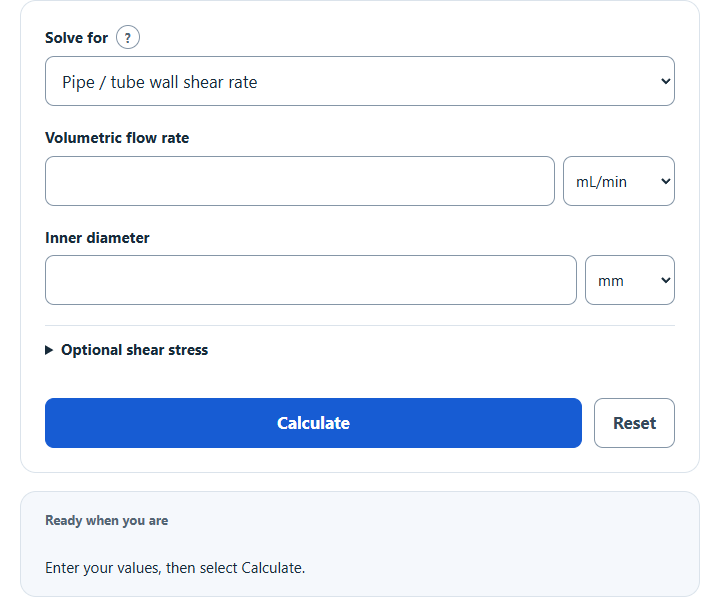
Calculate shear rate (1/s) for laminar pipe flow from flow rate and diameter, or between parallel plates from speed and gap, with optional shear stress.
Related Calculators
- Specific Volume Calculator
- Flow Ratio Calculator
- Stagnation Pressure Calculator
- Velocity To Pressure Calculator
- All Physics Calculators
Calculator Functions
| Function | What it does | What it requires |
|---|---|---|
| Pipe / tube wall shear rate | Finds the shear rate at the inner wall of a round pipe or tube | Requires the volumetric flow rate and the inner diameter |
| Parallel plates shear rate | Finds the shear rate in a fluid between two parallel plates | Requires the relative plate speed and the gap thickness |
Both functions take an optional dynamic viscosity in mPa·s (cP) or Pa·s, which adds the shear stress in Pa and dyn/cm². The viscosity list offers typical values for water, blood, blood plasma, glycerol and air. Every result is in s⁻¹, with the same rate per minute.
Shear Rate Formulas
| γ̇ | Shear rate at the wall (s⁻¹) |
| Q | Volumetric flow rate (m³/s) |
| D | Inner diameter (m) |
Shear rate is the velocity gradient in the fluid: how fast the speed changes with distance across the flow. Its unit is the reciprocal second, s⁻¹.
Pipe / tube wall shear rate
The formula above gives the wall shear rate for steady laminar flow of a Newtonian fluid [1]. Because Q = π × D² × v ÷ 4, it is the same as 8 × v ÷ D, where v is the mean velocity. A flow of 100 mL/min through a 2 mm tube is 1.6667 × 10⁻⁶ m³/s, which gives 32 × 1.6667 × 10−6 ÷ (π × 0.002³) = 2,122.07 s⁻¹.
Parallel plates shear rate
v is the speed of one plate relative to the other in m/s and h is the gap between them in m. With one surface fixed and the other moving parallel to it, the fluid in between is sheared, and the gradient is taken across the distance between the surfaces [2]. Plates moving at 0.5 m/s across a 1 mm gap give 0.5 ÷ 0.001 = 500 s⁻¹.
Shear stress
τ is the shear stress in Pa and μ is the dynamic viscosity in Pa·s. Shear stress is proportional to the velocity gradient in fluids that follow this rule [2]. At 2,122.07 s⁻¹ and 3.5 mPa·s, the wall shear stress is 7.427 Pa, or 74.27 dyn/cm².
Limits of This Estimate
- The pipe formula assumes fully developed laminar flow of a Newtonian fluid. Turbulence, wall slip and the entrance length of a tube all change the wall shear rate.
- Fluids whose viscosity changes with shear rate need another model. Blood in small vessels does not follow the parabolic profile behind this formula, which biases wall shear estimates made with it [3]. Some polymers and paints are also non-linear [2].
- The parallel plates formula assumes the speed changes in a straight line across the gap.
- Viscosity changes with temperature and composition. The listed viscosities are typical round figures that can be overwritten. These estimates are based on the best available data and estimations.
Sources
- Lakshmanan et al., Modeling the effect of blood vessel bifurcation ratio on occlusive thrombus formation, Computer Methods in Biomechanics and Biomedical Engineering, 2019: wall shear rate in a tube
- NASA Glenn Research Center, Viscosity: velocity gradient between surfaces and shear stress
- Sriram, Intaglietta and Tartakovsky, Non-Newtonian Flow of Blood in Arterioles: Consequences for Wall Shear Stress Measurements, Microcirculation, 2014: blood in small vessels