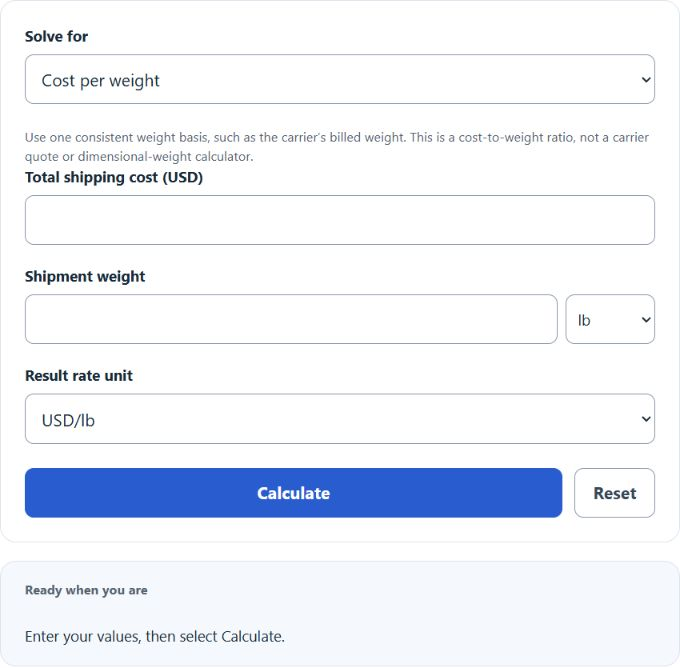
Select cost per weight, total shipping cost or shipment weight, then enter the two displayed values. Pounds, kilograms, grams and ounces can be mixed with independently selected rate units.
- All Business Calculators
- Cost Per Pound Calculator
- Cost Per Ounce Calculator
- Price Per Pound Calculator
- Pallet Volume Calculator
Shipping Cost Per Pound Formula
Shipping cost per pound tells you how much you are paying for each billed pound of a shipment. It is a useful metric for comparing carriers, service levels, package sizes, and packaging decisions.
- SCP = shipping cost per pound
- SC = total shipping cost
- SW = shipping weight in pounds
If you need to solve for a different variable, the same relationship can be rearranged as follows:
Select the value to solve and enter the other two. For a rate or weight result, choose its output unit. A cost-per-weight rate uses its own denominator unit; it need not match the entered weight unit.
How to Calculate Shipping Cost Per Pound
- Determine the total shipping cost for the shipment.
- Determine the weight used for billing.
- Divide the total shipping cost by the billed weight.
This gives the effective rate you are paying for each pound shipped. The result is especially useful when comparing one shipment to another, even when the total package sizes are different.
Example Calculations
If a shipment costs $24 and the billed weight is 12 lb:
The shipping cost per pound is $2.00/lb.
If you know the rate is $1.60 per pound and the shipment weighs 35 lb, then the total shipping cost is:
The total shipping cost is $56.00.
If the total shipping cost is $48 and the effective rate is $3.00 per pound, then the billed weight is:
The billed weight is 16 lb.
What Weight Should Be Used?
The most important input is the billed weight, not always the scale weight. In many shipping situations, carriers charge based on the greater of actual weight and dimensional weight.
- BW = billed weight
- AW = actual weight
- DW = dimensional weight
Dimensional weight is commonly based on package volume, which means a large but light box can still be expensive to ship.
- L = package length
- W = package width
- H = package height
- D = dimensional divisor used by the carrier
For cost per billed pound, use the invoice’s final billed weight, including applicable rounding or minimums. Using a smaller actual weight makes cost per pound higher, not lower. Cost per actual pound is a different metric; keep the basis consistent.
How to Use This Calculator Effectively
- Use total landed shipping charge if you want a realistic cost metric, not just the base transportation fee.
- Include common add-ons such as fuel surcharges, residential fees, delivery-area fees, oversize fees, or signature charges when they apply.
- Use the same weight basis when comparing shipments so your $/lb figures are comparable.
- Compare multiple packaging options by recalculating with different box sizes and billed weights.
- Track results over time to identify lanes, package types, or services that have unusually high cost per pound.
What Changes Shipping Cost Per Pound?
| Factor | Impact on Cost Per Pound |
|---|---|
| Shipment weight | Lighter shipments often show a higher $/lb because fixed handling costs are spread across fewer pounds. |
| Package dimensions | Large cartons may trigger dimensional billing and increase the total charge. The effect on cost per pound depends on the charge and whether the denominator is actual or billed weight. |
| Distance or zone | Longer shipping routes usually increase the total charge. |
| Service level | Express and time-definite services typically cost more per pound than economy or ground options. |
| Surcharges | Fuel, residential delivery, remote-area delivery, address correction, and special handling can materially raise the result. |
| Packaging efficiency | Smaller, better-fitted packages may reduce dimensional charges. Compare total cost and a consistent weight basis; a lower billed weight alone does not guarantee a lower cost per billed pound. |
| Order mix | Single-item and low-weight orders often have a worse shipping cost profile than consolidated shipments. |
Interpreting the Result
A lower shipping cost per pound generally means you are moving weight more efficiently, but it should not be the only metric you use. Two shipments can have the same $/lb while still differing in speed, damage risk, service quality, or total delivered cost.
- Low $/lb often indicates efficient packaging, heavier shipments, or lower-cost service.
- High $/lb may signal small parcel inefficiency, dimensional billing, premium service, or surcharge-heavy deliveries.
- Sudden changes in $/lb may reveal packaging issues, carrier rule changes, or lane-specific cost problems.
Tips to Reduce Shipping Cost Per Pound
- Use smaller cartons when possible to reduce dimensional weight exposure.
- Eliminate unnecessary void fill and heavy packaging materials.
- Consolidate orders when service commitments allow.
- Choose the lowest service level that still meets delivery requirements.
- Audit invoices for avoidable accessorial charges.
- Compare costs across carriers using the same billed weight basis.
- Review products with unusually high shipping cost per pound and adjust packaging or fulfillment strategy.
Common Unit Variations
Although this page focuses on pounds, the same idea works with other weight units. The calculator can return:
- $/lb for pounds
- $/kg for kilograms
- $/g for grams
- $/oz for ounces
Use the unit that matches your shipment records and stay consistent across all comparisons.
Frequently Asked Questions
Why does shipping cost per pound usually look high on small packages?
Small shipments still carry fixed processing, pickup, sorting, and delivery costs. Because those costs are spread across very little weight, the effective cost per pound can look disproportionately high.
Can shipping cost per pound decrease as weight increases?
Yes. As shipment weight increases, fixed charges are often spread over more pounds. That can reduce the effective $/lb, although large dimensions, surcharges, and service changes can offset the savings.
Should I use actual weight or dimensional weight?
Use whichever weight the carrier uses for billing. If the invoice is based on dimensional weight, that is the weight that should be entered for an accurate result.
Is this metric useful for freight shipments too?
Yes, but it should be used with caution. Freight pricing can involve pallets, freight class, minimums, and accessorial fees, so cost per pound is helpful for comparison but may not capture the full pricing logic by itself.
What does a high shipping cost per pound tell me?
It usually suggests one or more of the following: low shipment density, inefficient packaging, premium service selection, dimensional billing, or heavy surcharges. It is often a good starting point for cost optimization.