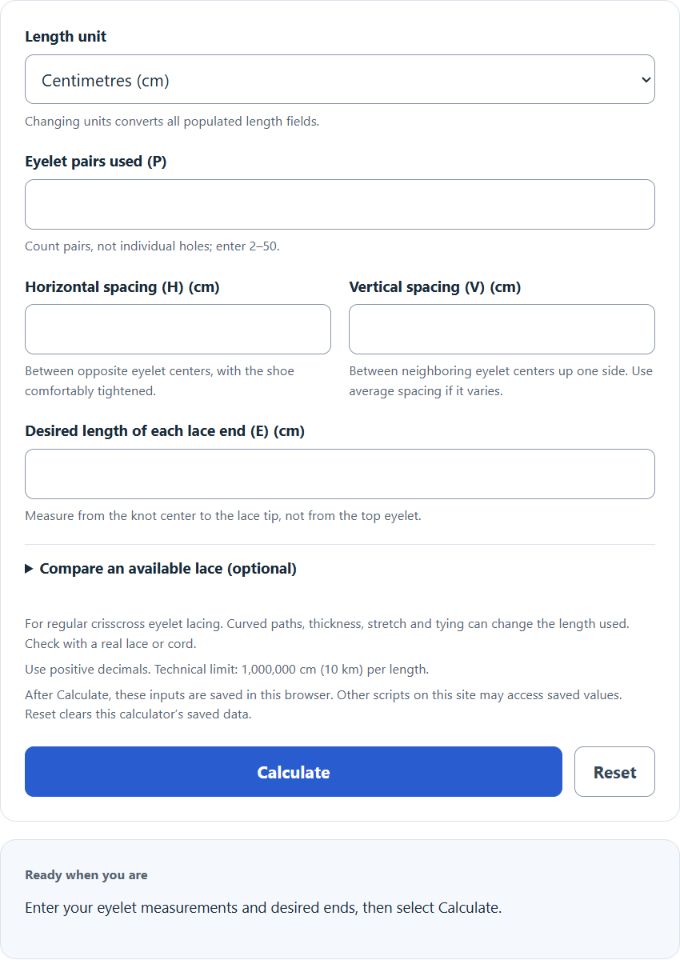
Estimate the lace length for regular crisscross lacing from your eyelet spacing and desired ends. You can also compare a lace you already have.
- Shoe Size Calculator (inches to shoe size)
- Everyday Life and Education Calculators
- Foot Width Calculator
- All Length Calculators
Shoelace length formula
B = 2H + 2(P − 1)√(H² + V²)
T = B + 2E
P is the number of eyelet pairs used. H is the spacing across opposite eyelet centers, V is the spacing between adjacent eyelets up one side, and E is the desired length of each end measured from the knot center. B is the modeled path to that center; T is the total lace estimate. All lengths use the selected unit.
How to measure
- Count the eyelet pairs you will use with regular crisscross lacing.
- Measure H and V with the shoe comfortably tightened. If spacing varies, use averages; irregular eyelet spacing makes the geometric estimate less precise.
- Enter your desired end allowance E using the knot-center convention. Measuring from the top eyelet would use a different reference point.
- Optionally enter the length of your whole available lace, then select Calculate.
This model is for eyelets, not hooks or lugs, and does not include a heel-lock loop or another lacing pattern. Lace thickness, eyelet curvature, stretch and tying can affect the amount used. Test the route with a lace or cord before choosing a replacement.
Example
For 6 pairs, H = 5 cm, V = 2 cm and E = 15 cm, each diagonal is √29 cm. The modeled path B is about 63.8516 cm, and the total T is about 93.8516 cm.
An available 90 cm lace has a margin of about −3.8516 cm against that estimate. Under the same geometry, its equal ends would be (90 − 63.8516) ÷ 2 ≈ 13.0742 cm each.
Available-lace comparison
The signed margin is A − T, where A is the whole available lace length. If A is at least B, the modeled length of each equal end is (A − B) ÷ 2. If A is below B, the tool reports the shortfall before the knot center and leaves equal ends unavailable. Blank A omits this comparison.
FAQ
Does this select a lace to buy?
No. It estimates one geometric route using your measurements and end allowance; it does not choose a stocked length, predict bow size or guarantee suitability.
Can I change units?
Yes. Populated length fields convert together between centimetres, millimetres and inches. The conversion uses 1 in = 2.54 cm and 1 cm = 10 mm, retaining up to 15 significant digits. Select Calculate again to update the result.
What does a negative margin mean?
The available lace is shorter than the estimate for your entered end allowance. Comparisons use unrounded calculations; small differences use scientific notation so their direction remains visible.
Sources