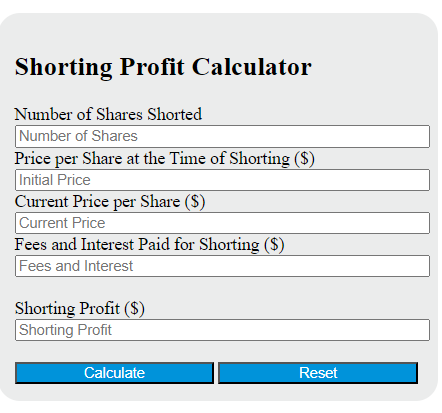
Calculate net short-selling profit after commissions, borrow fees, and dividends, compare return on margin, or solve break-even and target cover prices.
Shorting Profit Formula
Shorting profit is the net dollar gain or loss from selling borrowed shares first and buying them back later. The calculator measures how much the share price moved in your favor or against you, then subtracts the total fees and interest associated with the short position.
In this formula:
| Variable | Meaning |
|---|---|
| SP | Net shorting profit or loss in dollars |
| N | Number of shares sold short |
| PP | Price per share when the short position was opened |
| CP | Current price per share or buy-to-cover price |
| F | Total fees, borrow costs, interest, commissions, and similar charges |
A short position is profitable when the stock is repurchased for less than it was originally sold for and the total price advantage is greater than the fees. If the stock rises instead of falls, the result becomes a loss.
Useful Short Selling Formulas
These additional formulas help interpret the calculator result and understand break-even conditions.
- PPS is the gross profit or loss per share before fees.
- CPBE is the break-even cover price. If the current price is above this level, the position loses money after costs.
- SPmax is the maximum possible dollar profit if the stock falls to zero before covering.
How to Calculate Shorting Profit
- Enter the number of shares shorted.
- Enter the original short sale price per share.
- Enter the current price per share, or the price you expect to pay to cover the position.
- Enter all fees and interest tied to the trade.
- Calculate the result to find the net dollar profit or loss.
If your calculator allows solving for a missing field, enter any three known values to estimate the fourth.
Example
Assume 100 shares were shorted at $50 per share, the current cover price is $45, and total shorting costs are $10.
The net shorting profit is $490. The price drop created a gross gain of $500, and the $10 of fees reduced the final result to $490.
How to Interpret the Result
| Scenario | Meaning for the Short Seller | Typical Outcome |
|---|---|---|
| Current price is below the short sale price | The shares can be repurchased for less than they were sold for | Profit, subject to fees |
| Current price equals the short sale price | No gain from price movement | Loss equal to total fees and interest |
| Current price is above the short sale price | The shares cost more to buy back than the amount originally received | Loss, which grows as price rises |
What to Include in the Fee Input
For a realistic estimate, the fee field should include all direct costs tied to maintaining the short position, such as:
- Stock borrow fees
- Margin interest
- Trading commissions
- Locate fees
- Regulatory or exchange charges
- Dividend payments owed while the position is open
Leaving out these costs can make a trade appear more profitable than it actually is.
Important Short Selling Notes
- Profit is capped. The best-case outcome happens if the stock falls to zero, so the maximum gain is limited.
- Loss is not capped. A stock can keep rising, which means short-selling losses can continue to expand.
- Time matters. The longer a short position stays open, the more borrow fees and interest can erode profits.
- Fees can change the outcome. A trade with a favorable price move can still produce a net loss if carrying costs are high enough.
- This calculator returns dollars, not return percentage. If you want to compare one short trade to another, consider both the dollar profit and the capital required to hold the position.
When a Short Trade Becomes Profitable
A short trade becomes net profitable only when the decline in the stock price is large enough to exceed total costs. Small price drops may still result in a loss if the borrow rate, interest, or other charges are high. That is why accurate fee inputs are just as important as the share prices when using a shorting profit calculator.