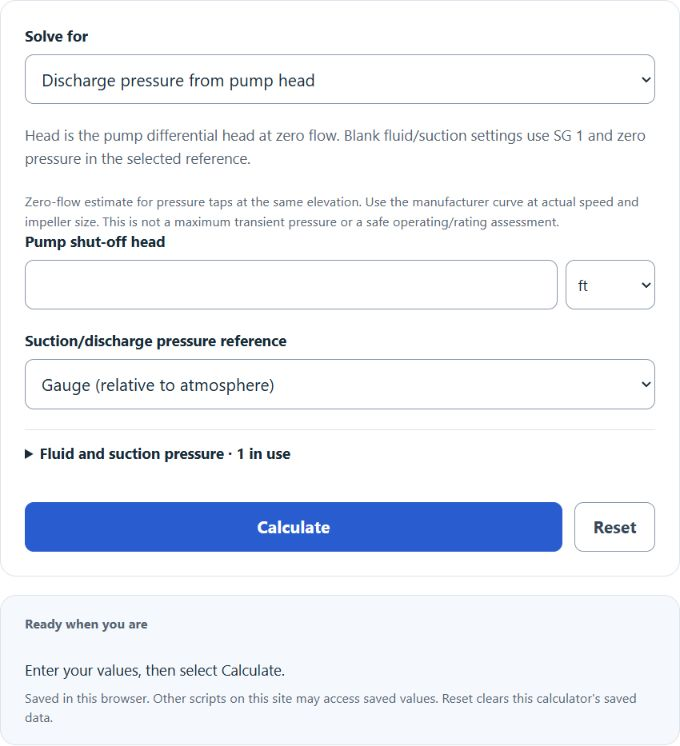
Calculate centrifugal pump shut-off discharge pressure from shut-off head or differential pressure, with suction pressure and specific gravity.
- All Construction Calculators
- Pump Pressure Calculator
- Nip Pressure Calculator
- Burst Value Calculator
Shut-Off Pressure Formula
Shut-off discharge pressure is the pressure at the pump discharge when the flow rate is zero. In pump terminology, this is the shut-off or dead-head condition. For this calculator, shut-off discharge pressure equals suction pressure plus the pump differential pressure at shut-off, assuming pressure taps at the same elevation. In head mode, ΔP = ρgH with ρ = 1000 × SG kg/m³ and g = 9.80665 m/s². Confirm actual fluid density, speed and impeller size; this calculation does not establish a safe equipment rating.
| Variable | Meaning | Typical Units |
|---|---|---|
| PSO | Shut-off discharge pressure | psi, kPa, bar, atm |
| Psuc | Suction pressure at the pump inlet | psi, kPa, bar, atm |
| ΔPSO | Pump differential pressure at shut-off | psi, kPa, bar, atm |
This means the calculator is combining:
- the pressure already present at the suction side, and
- the pressure rise the pump can generate at zero flow.
Rearranged Forms
If you know any two values, you can solve for the third.
How to Use the Calculator
- Enter the pump differential pressure at shut-off.
- Enter the suction pressure.
- Make sure both values use the same pressure basis and compatible units.
- Calculate the result to find the shut-off discharge pressure.
If you are solving for suction pressure or differential pressure instead, enter the other two known values and let the calculator back-calculate the missing variable.
Example
If the suction pressure is 30 psi and the pump differential pressure at shut-off is 50 psi, then the shut-off discharge pressure is:
So the pump discharge pressure at zero flow would be 80 psi.
Why Shut-Off Pressure Matters
Knowing the shut-off pressure is useful for pump selection, system protection, and troubleshooting. It estimates the zero-flow discharge pressure at the specified suction pressure and pump condition. Shut-off is not necessarily the maximum on every pump curve, and surge or thermal pressure can be higher.
- Pump curve interpretation: Shut-off occurs at the zero-flow end of the curve.
- Equipment protection: It helps check whether piping, seals, gauges, and casings are exposed to acceptable pressure levels.
- Relief and safety review: It is often compared against design limits and protection settings.
- Startup diagnostics: A measured shut-off pressure that differs greatly from expectation may indicate wear, incorrect rotation, air entrainment, or instrumentation issues.
Important Notes
- Use consistent units: Do not add psi to kPa or bar unless the values are converted first.
- Use the same pressure reference: Do not mix gauge pressure with absolute pressure.
- Add algebraically: If suction pressure is negative, include the sign in the calculation.
- Use shut-off differential pressure: The differential value should come from the zero-flow condition, not from a normal operating point on the pump curve.
Negative Suction Pressure Case
If the pump suction is under vacuum relative to atmosphere, the suction pressure may be negative on a gauge basis. In that case, still use the same equation and keep the negative sign.
This is a common point of confusion. The shut-off discharge pressure is not always equal to the differential pressure alone; it depends on the suction pressure entering the pump.
Common Mistakes
- Using operating differential pressure instead of shut-off differential pressure.
- Ignoring a negative suction pressure value.
- Mixing gauge and absolute readings.
- Comparing a calculated result to field data taken at non-zero flow.
Frequently Asked Questions
Is shut-off pressure the same as normal discharge pressure?
No. Shut-off pressure is the discharge pressure at zero flow. Normal discharge pressure is measured while the pump is actually moving fluid through the system.
Where does the shut-off differential pressure come from?
It is typically taken from the pump curve at the zero-flow point or from manufacturer performance data.
Can I use any pressure unit?
Yes, as long as all entered pressures use compatible units and the same reference basis.
What does a high shut-off pressure indicate?
It indicates the pump can generate a large pressure rise at zero flow, which may be important when checking component pressure ratings and control settings.