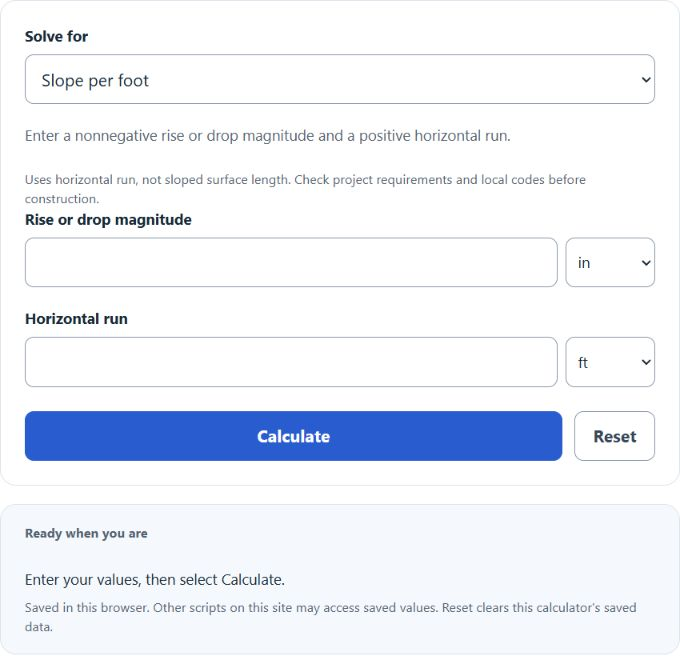
Calculate slope per foot in inches from rise and run, convert percent slope or degrees to inches per foot, or solve for total drop or horizontal run.
Calculator Functions
| Function | What it does | What it requires |
|---|---|---|
| Slope per foot | Finds the slope in inches per foot from a measured rise and run | Requires the rise or drop and the horizontal run |
| Total rise or drop | Finds how many inches a surface rises or falls over a run at a set rate | Requires the horizontal run and a slope rate in inches per foot |
| Horizontal run | Finds the run needed to gain or lose a set height at a set rate | Requires the rise or drop and a slope rate in inches per foot |
| Convert percent, degrees or in/ft | Converts a slope between percent, degrees and inches per foot | Requires one slope value as a percent, an angle in degrees or inches per foot |
Rise and run can each be entered in inches, feet, centimeters or meters, and fractions such as 1/4 are accepted. The two functions that take a slope rate offer common rates of 1/16, 1/8, 1/4, 1/2 and 1 inch per foot, or a custom rate. Results also show the grade in percent, the angle from horizontal, the slope ratio, the sloped length and the nearest 1/16 inch per foot.
Slope Per Foot Formula
| S | Slope per foot (inches per foot) |
| R | Rise or drop, the vertical change (inches) |
| L | Horizontal run (feet) |
Slope is the proportion of vertical rise to horizontal length, and the same slope can be written as a ratio, a percentage or an angle [1]. The run is the level distance, not the length measured along the sloped surface.
Slope per foot
The main formula applies directly. A rise of 6 inches over a run of 12 feet is 6 ÷ 12 = 0.5 inch per foot, which is a 4.1667% grade and an angle of 2.3859°. When rise and run are in the same unit, S = 12 × rise ÷ run.
Total rise or drop
The run in feet is multiplied by the rate in inches per foot. A 40 ft run at 0.24 inch per foot, a 2% slope, drops 9.6 inches. At 1/4 inch per foot the same run drops 10 inches.
Horizontal run
The rise in inches is divided by the rate in inches per foot. A 6 inch drop at 1/4 inch per foot needs a run of 24 feet. The rate and the rise must both be above zero, because a level surface never reaches a height.
Convert percent, degrees or in/ft
P = 100 × tan(A)
P is the percent slope and A is the angle from horizontal. A percent slope is the rise per 100 units of run, and a foot has 12 inches, so each 1% is 0.12 inch per foot. A 2% slope is 0.24 inch per foot, just under 1/4 inch, and a 1% slope is 0.12 inch per foot, just under 1/8 inch. Going the other way, 1/4 inch per foot is 2.0833% and 1/8 inch per foot is 1.0417%. A 12° angle is a 21.2557% slope, or 2.5507 inches per foot.
| Slope | Inches per foot | Percent | Angle | Ratio |
|---|---|---|---|---|
| 1/16 in per ft | 0.0625 | 0.5208% | 0.2984° | 1:192 |
| 1% | 0.12 | 1% | 0.5729° | 1:100 |
| 1/8 in per ft | 0.125 | 1.0417% | 0.5968° | 1:96 |
| 1.5% | 0.18 | 1.5% | 0.8594° | 1:66.67 |
| 2% | 0.24 | 2% | 1.1458° | 1:50 |
| 1/4 in per ft | 0.25 | 2.0833% | 1.1935° | 1:48 |
| 3% | 0.36 | 3% | 1.7184° | 1:33.33 |
| 4% | 0.48 | 4% | 2.2906° | 1:25 |
| 1/2 in per ft | 0.5 | 4.1667% | 2.3859° | 1:24 |
| 5% | 0.6 | 5% | 2.8624° | 1:20 |
| 1 in per ft | 1 | 8.3333% | 4.7636° | 1:12 |
| 10% | 1.2 | 10% | 5.7106° | 1:10 |
| 12% | 1.44 | 12% | 6.8428° | 1:8.33 |
The ratio column is rise to run. The 1 : 12 row is the steepest running slope the ADA Standards allow for a ramp, and 1 : 48 is their limit for cross slope [1].
Limits of This Estimate
- The result describes one straight, even slope between two points. Uneven ground, a crowned surface or a pipe with sags will differ from point to point.
- Results are magnitudes. The calculator does not say whether the surface runs uphill or downhill.
- The nearest 1/16 inch per foot is rounded and can differ from the decimal rate. A 2% slope shows as 1/4 inch per foot although it is 0.24.
- The common rates are examples, not code requirements. Drainage, plumbing and accessibility rules set their own minimum and maximum slopes.
Sources
- U.S. Access Board, Guide to the ADA Accessibility Standards, Chapter 4: Ramps and Curb Ramps: slope as the proportion of vertical rise to horizontal length, its ratio and percent forms, and the 1:12 and 1:48 limits