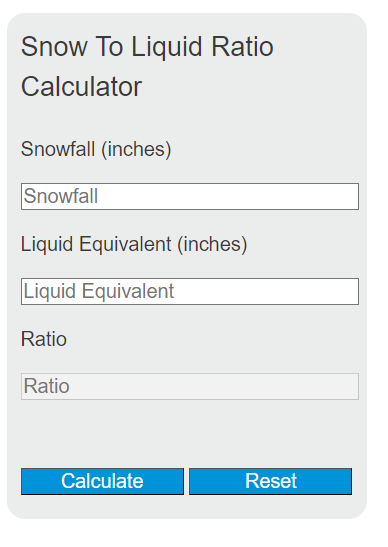
Calculate the snow-to-liquid ratio by entering snow depth and liquid equivalent in cm, inches, or meters for a clear ratio result.
Snow to Liquid Ratio Formula
The snow-to-liquid ratio compares the depth of fallen snow to the depth of water it contains after melting.
- SLR = snow-to-liquid ratio
- D_s = snow depth
- D_l = liquid equivalent depth
Both depths must use the same unit before dividing. The result is usually written as a ratio, such as 10:1. A 10:1 ratio means 10 inches of snow contains about 1 inch of liquid water.
- D_cm = depth converted to centimeters
- D = entered depth
- C = unit conversion factor
The calculator converts snow depth and liquid equivalent to centimeters, then divides snow depth by liquid equivalent. Liquid equivalent must be greater than zero.
Useful Snow to Liquid Ratio Tables
Common snow-to-liquid ratios vary with temperature, crystal type, wind, and compaction.
| Snow Type | Typical Ratio | Meaning |
|---|---|---|
| Wet, heavy snow | 5:1 to 8:1 | High water content, packs easily |
| Average snow | 10:1 | Common rule of thumb |
| Dry, fluffy snow | 15:1 to 20:1 | Lower water content, more air space |
| Very light powder | 20:1 or higher | Cold, dry snow with very low density |
| Unit | Conversion to cm |
|---|---|
| 1 centimeter | 1 cm |
| 1 inch | 2.54 cm |
| 1 meter | 100 cm |
Example and Notes
Example: If 12 inches of snow melts down to 1 inch of water, the ratio is:
The snow-to-liquid ratio is 12:1.
Use fresh, undrifted snow measurements when possible. Wind, settling, melting, and snow compaction can change the measured depth and affect the ratio.