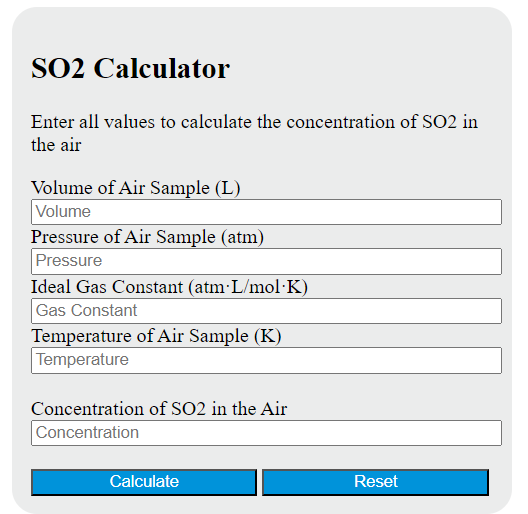
Calculate the missing SO₂ gas volume, partial pressure, temperature, amount, or gas constant from four known ideal gas law values.
SO₂ Formula
The following formula is used to calculate the amount of SO₂ (sulfur dioxide) in a gas sample using the ideal gas law:
Variables:
- n is the amount of SO₂ (in moles, mol)
- V is the volume of the gas sample
- P is the partial pressure of SO₂ in the sample (if the sample is pure SO₂, this equals the total pressure)
- R is the ideal gas constant
- T is the absolute temperature of the gas sample (K)
To calculate the amount of SO₂, multiply the SO₂ partial pressure by the sample volume. Divide the result by the product of the ideal gas constant and the absolute temperature. If you need molar concentration (mol/L), you can then compute n/V (equivalently, for an ideal gas, C = P/(R·T) using SO₂ partial pressure).
What is SO₂?
SO2, or sulfur dioxide, is a colorless gas with a strong, pungent odor. It is released naturally by volcanic activity and is also a by-product of various industrial processes such as the burning of fossil fuels like coal and oil, and the smelting of mineral ores that contain sulfur. SO2 is a significant air pollutant and has harmful effects on the environment and human health. It can react with other substances in the atmosphere to form harmful compounds such as sulfuric acid, sulfurous acid and sulfate particles. These can lead to respiratory problems in humans and animals, and can also lead to acid rain which can harm vegetation and aquatic life. In addition, SO2 can react with other gases in the atmosphere to form aerosols that can reflect sunlight and contribute to climate change.
How to Calculate SO₂?
The following steps outline how to calculate the amount of SO₂ (in moles) in a gas sample using the ideal gas law:
- Determine the volume of the gas sample (V).
- Determine the SO₂ partial pressure in the sample (P).
- Determine the temperature of the gas sample and convert to Kelvin (T).
- Select a consistent value/unit for the ideal gas constant (R).
- Calculate the amount of SO₂ using n = (P·V)/(R·T), or verify your result with the calculator above.
Example Problem:
Use the following variables as an example problem to test your knowledge (leave “Amount of SO₂” blank in the calculator):
Volume (L) = 10
SO₂ partial pressure (atm) = 0.020
Temperature (°C) = 25
Ideal gas constant (atm·L/(mol·K)) = 0.082057 (calculated amount ≈ 0.0082 mol)