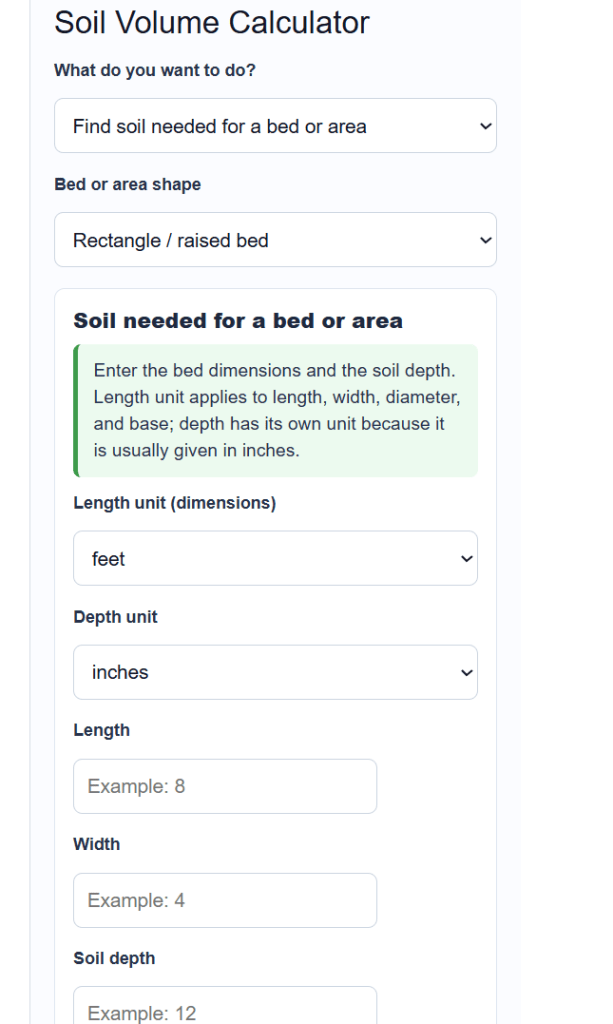
Calculate how much soil you need for any garden bed or area, then find the cubic yards, number of bags, total weight, and cost.
Soil Volume Formula
The soil volume depends on the shape of the area you are filling. Each shape multiplies its surface area by the soil depth to give a volume.
Rectangle: V = L * W * D
Circle: V = pi * (Dia/2)^2 * D
Triangle: V = (1/2) * B * H * D
Known area: V = A * D
Once the volume is known, it is converted into the units you order in and used to find bags, weight, and cost.
Cubic yards = V(cu ft) / 27
Bags = roundup( V(cu ft) / Bag size )
Weight = V(cu ft) * Density
Cost = V(cu yd) * Price per yard or Bags * Price per bag
- V: soil volume.
- L, W: length and width of a rectangle or raised bed.
- Dia: diameter of a round planter or circular bed.
- B, H: base and height of a triangular bed.
- A: area, when you already know it.
- D: soil depth.
- Bag size: the volume in one bag, usually in cubic feet.
- Density: weight of the soil per cubic foot.
Pick the shape that matches your space, enter the dimensions and the depth, and the calculator returns the volume. The bag count is always rounded up because you cannot buy part of a bag. Weight uses the density of the soil type you select, and cost is figured either from a bulk price per cubic yard or a price per bag. A waste or extra allowance increases the volume by a set percentage to cover settling and spillage.
Soil Density and Bag Coverage
Soil weight changes with moisture and material. Use these typical densities to estimate weight, and the bag table to convert a volume into a bag count.
| Soil type | Density (lb/cu ft) | Weight per cubic yard |
|---|---|---|
| Compost | 50 | 1,350 lb |
| Dry topsoil | 75 | 2,025 lb |
| Garden / potting mix | 90 | 2,430 lb |
| Damp topsoil | 100 | 2,700 lb |
| Bag size | Bags per cubic foot | Bags per cubic yard |
|---|---|---|
| 0.75 cu ft (40 lb) | 1.34 | 36 |
| 1 cu ft | 1.00 | 27 |
| 1.5 cu ft | 0.67 | 18 |
| 2 cu ft | 0.50 | 14 |
Example Problems
Example 1: Rectangular raised bed. You have a bed that is 8 ft long and 4 ft wide, and you want 10 inches of soil. Convert the depth to feet: 10 / 12 = 0.833 ft. The volume is 8 * 4 * 0.833 = 26.67 cubic feet, which is 26.67 / 27 = 0.99 cubic yards. Using 1.5 cu ft bags, you need roundup(26.67 / 1.5) = 18 bags. With a garden mix at 90 lb/cu ft, the soil weighs 26.67 * 90 = 2,400 lb.
Example 2: Round planter. A round planter is 3 ft across and 12 inches deep. The radius is 3 / 2 = 1.5 ft and the depth is 1 ft. The volume is pi * 1.5^2 * 1 = 7.07 cubic feet. Filled with compost at 50 lb/cu ft, that is 7.07 * 50 = 354 lb, or about 5 bags at 1.5 cu ft each.
Frequently Asked Questions
How deep should the soil be? It depends on what you are growing. Raised vegetable beds usually need 10 to 12 inches, flower beds and borders do well with 6 to 8 inches, and topdressing or leveling a lawn often needs only 1 to 3 inches. Enter the depth that matches your project so the volume is accurate.
Should I order extra soil? Yes. Soil settles after it is watered and some is always lost to spillage, so adding a 5 to 10 percent extra allowance is a safe margin. The calculator can apply this automatically with the waste or extra allowance field.
How many bags make a cubic yard? A cubic yard is 27 cubic feet, so the number of bags depends on bag size. It takes 18 of the common 1.5 cubic foot bags, 27 of the 1 cubic foot bags, or 36 of the 0.75 cubic foot bags to equal one cubic yard. Buying in bulk by the cubic yard is usually cheaper for large projects.