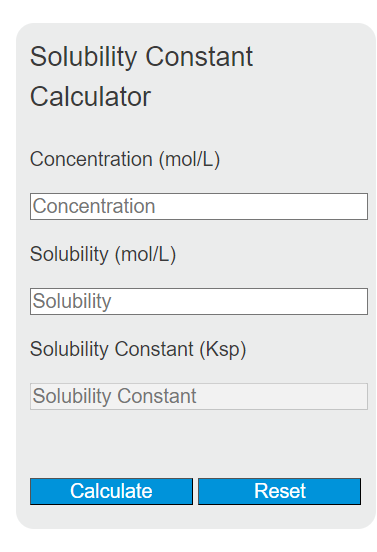
Calculate Ksp, ion concentrations, or molar solubility for salts from concentration values, stoichiometric coefficients, and common Ksp data.
Solubility Constant Formula
The solubility product constant is written from the balanced dissolution reaction. For a salt that dissolves as:
The Ksp expression is:
For a 1:1 salt AB(s) ⇌ A + B, this becomes Ksp = [A][B]. In pure water (no added common ions) the molar solubility is S and [A]=[B]=S, so Ksp = S² (ignoring activity effects).
Variables:
- Ksp is the solubility product constant (defined for a specific dissolution reaction and temperature).
- [A] and [B] are the equilibrium molar concentrations of the dissolved ions (mol/L).
- a and b are the stoichiometric coefficients from the balanced dissolution equation (and also the exponents in the Ksp expression).
- S is the molar solubility (mol/L) of the solid in pure water (when applicable).
What is a Solubility Constant?
The solubility constant, also known as the solubility product constant (Ksp), describes the equilibrium between a sparingly soluble ionic solid and its dissolved ions. It is a constant for a given substance at a specific temperature and is used to estimate solubility and predict whether a precipitate will form (via comparison of the ion product Q to Ksp).
How to Calculate Solubility Constant?
The following steps outline how to calculate the Solubility Product Constant (Ksp).
- Write the balanced dissolution reaction for the solid (for example, AaBb(s) ⇌ aA + bB).
- Write the Ksp expression using the stoichiometric coefficients as exponents: Ksp = [A]a[B]b.
- Determine the equilibrium ion concentrations. In pure water, these can often be written in terms of molar solubility S (e.g., [A]=aS and [B]=bS).
- Substitute the equilibrium concentrations into the Ksp expression and solve for Ksp (or solve for S if Ksp is known).
Example Problem :
Silver chloride dissolves as AgCl(s) ⇌ Ag+ + Cl−. If its molar solubility in pure water is S = 1.33×10⁻⁵ mol/L, then:
Ksp = S² = (1.33×10⁻⁵)² ≈ 1.77×10⁻¹⁰