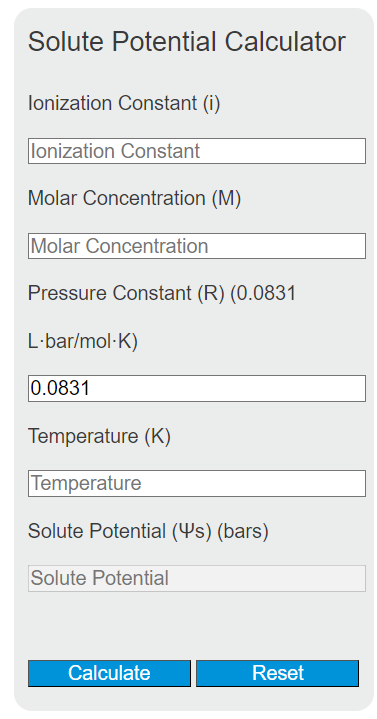
Calculate solute potential, ionization constant, molar concentration, pressure constant, or temperature from the Ψs = -iMRT formula.
Related Calculators
- Water Potential Calculator
- Percent Germination Calculator
- Thousand Seed Weight Calculator
- Stems Per Hectare Calculator
- All Biology Calculators
Solute Potential Formula
Solute potential, also called osmotic potential, describes how dissolved particles lower the water potential of a solution. In ideal dilute solutions, it is calculated with the van’t Hoff relationship:
A higher solute concentration, a larger ionization constant, or a higher absolute temperature makes Ψs more negative.
Variable Definitions
| Symbol | Meaning | Typical Units | Key Detail |
|---|---|---|---|
| Ψs | Solute potential | bar, atm, or Pa | For solutions, this value is typically zero or negative. |
| i | Ionization constant (van’t Hoff factor) | Unitless | Approximate number of dissolved particles formed per solute unit. |
| M | Molar concentration | mol/L or mol/m3 | Must match the volume basis used by R. |
| R | Pressure/gas constant | L·bar/mol·K, L·atm/mol·K, or m3·Pa/mol·K | Choose the form that matches your desired output units. |
| T | Absolute temperature | K | Always convert from °C or °F to Kelvin before calculating. |
Rearranged Forms
If you are solving for a missing variable, these equivalent forms are useful:
Unit Matching
To avoid conversion errors, keep M, R, and Ψs in one consistent unit system:
| Molar Concentration | Use This R Value | Resulting Ψs Unit |
|---|---|---|
| mol/L | 0.08314 L·bar/mol·K | bar |
| mol/L | 0.08206 L·atm/mol·K | atm |
| mol/m3 | 8.314 m3·Pa/mol·K | Pa |
How to Use the Calculator
- Choose a consistent unit set for concentration, constant, and output pressure.
- Convert temperature to Kelvin.
- Enter the ionization constant i for the solute.
- Enter the known values and leave the unknown field blank.
- Interpret the result: a more negative Ψs means a stronger osmotic effect.
How to Interpret Solute Potential
- Ψs = 0 corresponds to pure water with no dissolved solute.
- More negative Ψs means the solution contains more effective solute particles and has a greater tendency to draw water in by osmosis.
- Less negative Ψs means fewer effective dissolved particles or a lower concentration.
In many biology and plant physiology problems, solute potential is only one part of total water potential:
Here, Ψ is total water potential and Ψp is pressure potential. Water movement depends on total water potential, not solute potential alone.
Examples
Example 1: Non-ionizing solute
For sucrose, use i = 1. If M = 0.50 mol/L, R = 0.08314 L·bar/mol·K, and T = 298 K:
The solution has a solute potential of -12.39 bar.
Example 2: Dissociating solute
For an idealized NaCl solution, a common classroom approximation is i = 2. If M = 0.30 mol/L, R = 0.08314 L·bar/mol·K, and T = 293.15 K:
This result is more negative because dissociation increases the number of effective particles in solution.
Quick Notes on the Ionization Constant
- Non-ionizing solutes such as sucrose or glucose often use i ≈ 1.
- NaCl is often approximated as i ≈ 2.
- CaCl2 is often approximated as i ≈ 3.
These values are most useful for dilute, ideal solutions. Real solutions can deviate from ideal behavior, so i should be treated as an effective or approximate value in many practical cases.
Common Mistakes
- Entering temperature in °C or °F instead of K.
- Mixing mol/L with m3·Pa/mol·K, or mixing mol/m3 with L·bar/mol·K.
- Forgetting the negative sign when calculating manually.
- Using an exact dissociation assumption for concentrated or non-ideal solutions.
This calculator is most helpful for biology, plant physiology, chemistry, and osmosis problems where you need a fast way to estimate how solute concentration affects water movement.