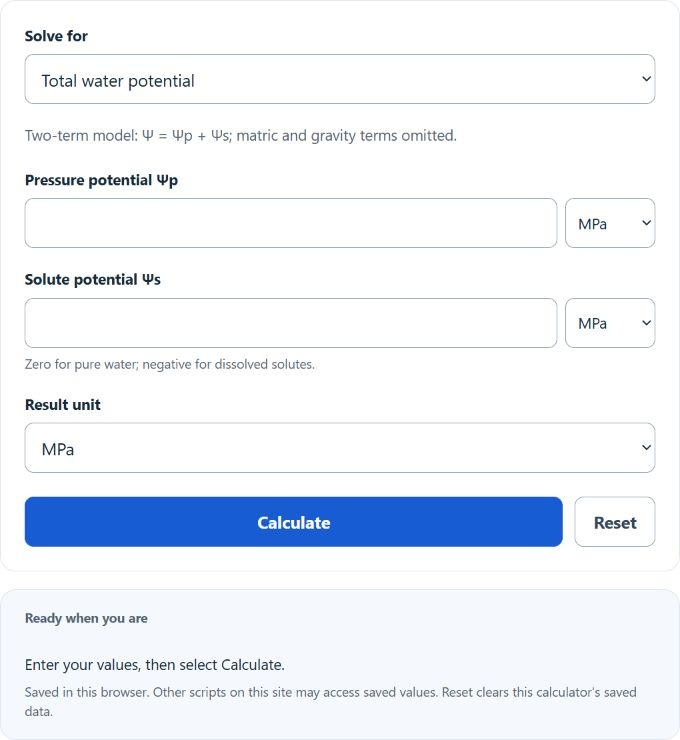
Calculate water potential from pressure and solute potential, or solute potential from molarity, temperature, and ionization constant.
- All Biology Calculators
- Solute Potential Calculator
- Water Vapor Pressure Calculator
- Water Flow Rate Calculator
- Driving Force Calculator
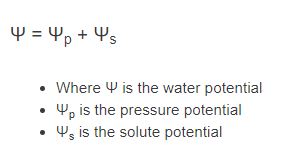
Water Potential Formula
Water potential describes how strongly water tends to move in a system. In biology, it is used to predict osmosis, compare cells and solutions, and understand water movement across membranes. Net water movement occurs from the region with higher water potential to the region with lower water potential.
For this calculator:
- Ψ = total water potential
- Ψp = pressure potential, often called hydrostatic or turgor pressure
- Ψs = solute potential, also called osmotic potential
This two-term equation is the standard simplified model used for many cell transport and plant physiology problems. Positive pressure potential raises total water potential; negative pressure lowers it, and dissolved solutes lower it. That is why solute potential is typically zero for pure water and negative for solutions.
Rearranged Equations
If you know any two values, you can solve for the third:
This makes the calculator useful for finding total water potential, backing out pressure potential from lab data, or estimating solute potential when the overall water potential is known.
What the Calculator Assumes
The sign of one potential alone does not establish water-flow direction or equilibrium; compare both regions at the same reference state. In a more complete treatment, water potential can include additional terms:
Here, Ψm is matric potential and Ψg is gravitational potential. For many introductory biology problems and many cell-level calculations, those extra terms are small enough to ignore, so the simplified equation used by this calculator is appropriate.
How to Interpret the Result
- Higher Ψ means water is less restricted and more likely to move out toward a lower Ψ region.
- Lower Ψ means water is more strongly attracted into that region.
- More positive pressure potential increases total Ψ.
- More dissolved solute makes Ψs more negative and lowers total Ψ.
- Pure water at the reference state has zero solute potential and zero pressure potential, so total water potential is zero.
When comparing two compartments, remember that a value such as −0.2 MPa is higher than −0.8 MPa because it is less negative.
How to Use the Water Potential Calculator
- Choose the value to solve for, or choose Solute potential · molarity.
- Enter the requested known values and their units. For molarity, enter concentration, temperature, and the solute or a supported van’t Hoff factor.
- Select Calculate to show the result; calculation details include the formula and conversions.
- Check the sign of each entry, especially solute potential.
- Interpret the result in terms of water movement from higher Ψ to lower Ψ.
In most biology problems, pressure potential may be positive inside a turgid cell, zero in an open solution, or negative under tension. Solute potential is usually zero for pure water and negative whenever solutes are present.
Examples
If pressure potential is 0.50 MPa and solute potential is −0.20 MPa, the total water potential is:
If total water potential is −0.70 MPa and solute potential is −1.10 MPa, then the pressure potential is:
If total water potential is −1.20 MPa and pressure potential is 0.30 MPa, then the solute potential is:
Estimating Solute Potential from Concentration
If a problem gives solute concentration instead of solute potential directly, the van’t Hoff relation is often used to estimate osmotic potential:
Where:
- i = van’t Hoff particle factor (ideal complete-dissociation presets; an effective factor may differ)
- C = molar concentration
- R = gas constant, 0.00831446261815324 MPa·L/(mol·K)
- T = absolute temperature in kelvin
Once Ψs is calculated, it can be entered into this calculator together with Ψp to find the total water potential.
Common Input Mistakes
- Entering solute potential as a positive value when it should be negative.
- Mixing units such as MPa and kPa without converting first.
- Ignoring the negative sign on the final answer.
- Confusing higher water potential with a numerically larger negative number.
- Using the simplified equation when matric or gravitational effects are important.
Why Water Potential Matters
Water potential is central to understanding plant water uptake, cell turgor, wilting, osmosis experiments, seed imbibition, and water movement through tissues. It helps explain why water enters root cells, how guard cells change during stomatal opening, and why solutions with more dissolved solute pull water more strongly.
FAQ
Is solute potential always negative?
For ordinary aqueous solutions, solute potential is typically zero for pure water and negative when solutes are dissolved because solutes reduce the free energy of water.
Can pressure potential be negative?
Yes. Although pressure potential is often positive in living cells with turgor pressure, it can become negative in systems under tension.
What unit should I use?
Select the correct unit beside each input; the calculator converts MPa, kPa, bar, and atm before combining values. Choose the result unit separately.
What does a more negative water potential mean?
A more negative water potential means water is held more tightly and that region will tend to draw water from a region with a higher water potential.