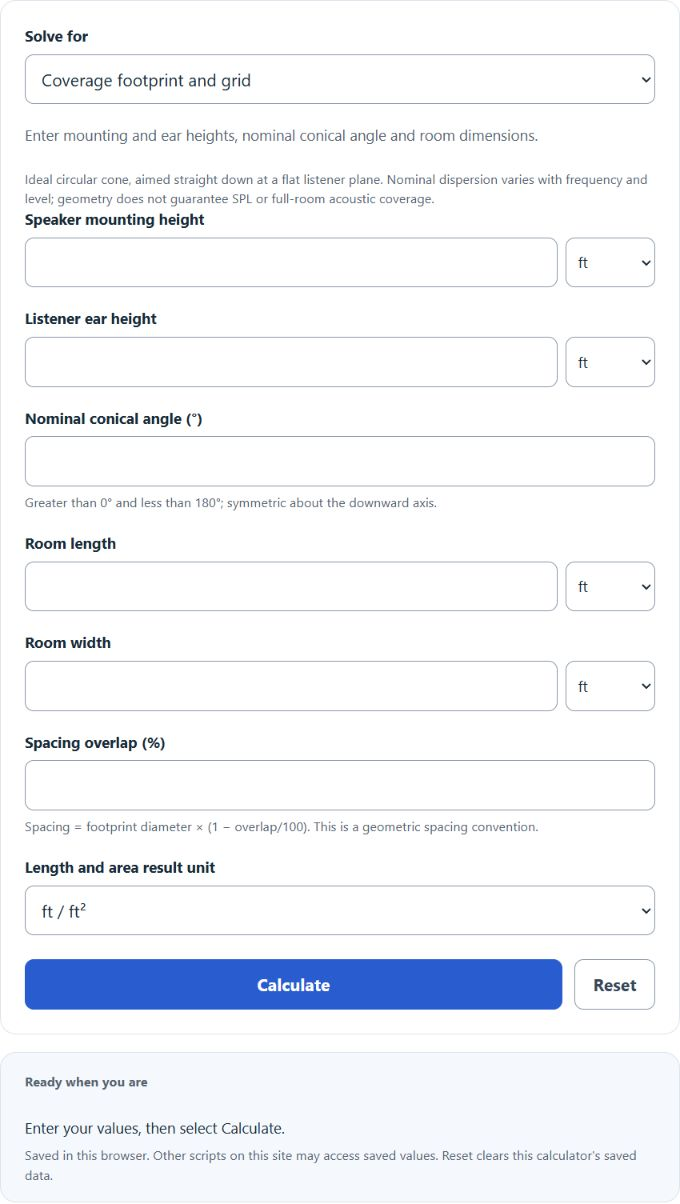
Calculate speaker coverage diameter, area, overlap spacing, and room count from mounting height and dispersion, or reverse-solve the required angle.
Related Calculators
- Crossover Frequency Calculator
- Solid Angle Calculator
- Normalized Intensity Calculator
- Pressure Ratio Calculator
- All Physics Calculators
Speaker Coverage Formula
For a circularly symmetric loudspeaker cone aimed perpendicular to a flat listener plane, the footprint is a circle. Its radius follows a right triangle using the perpendicular speaker-to-plane throw and half the full conical angle. Here hm is mounting height and he is listener ear height, measured from the same reference. A circular-sector formula does not describe this projection.
Where:
| Variable | Meaning | Calculator units |
|---|---|---|
| A | Circular footprint area πr² | m² or ft² |
| T | Perpendicular speaker-to-listener-plane throw; mounting height minus ear height in coverage mode | m or ft |
| θ | Full symmetric conical angle; 0° < θ < 180° | degrees |
Important relationship: A = πT²tan²(θ/2). At a fixed angle, doubling perpendicular throw makes the ideal area four times as large. Angle dependence is nonlinear: it is not proportional to θ, and the projection has no finite 180° or 360° case.
Rearranged Forms
If the perpendicular throw T and required footprint diameter D are known, reverse mode finds the full angle. Coverage mode also uses a chosen overlap percentage o to form a geometric room grid:
How to Use the Speaker Coverage Calculator
- Choose footprint/grid mode and enter mounting height, listener ear height, nominal full conical angle, room length/width and overlap. Mounting height must exceed ear height.
- For inverse mode, enter the perpendicular speaker-to-listener-plane throw and target footprint diameter; this is not a slanted distance to an outer listener.
- Choose ft or m for each length input and choose the displayed length/area result unit independently.
- Read the circle dimensions, 10/20/30% overlap spacing alternatives, and geometric planning count, or the inverse 80/100/120% target-diameter angles.
These are ideal geometric planning comparisons. They do not guarantee level uniformity, intelligibility or complete room coverage. Your last successful inputs are saved in this browser; other scripts on this site may access them, and Reset clears this calculator’s saved data.
Example
For a perpendicular throw of 10 m and a full conical angle of 120°, the radius is 10tan60° = 10√3 m and the diameter is 20√3 ≈ 34.6410 m. The circular footprint area is:
The ideal circular footprint is about 942.4778 m²; it is not a guaranteed uniform acoustic coverage area. Conversely, a 20 m target diameter at 10 m perpendicular throw requires 2atan(20/20) = 90°.
Quick Angle Reference
| Full conical angle | Diameter / throw D/T | Area / throw² A/T² |
|---|---|---|
| 60° | 1.1547 | 1.0472 |
| 90° | 2.0000 | 3.1416 |
| 120° | 3.4641 | 9.4248 |
| 150° | 7.4641 | 43.7567 |
| 170° | 22.8601 | 410.4368 |
How to Interpret the Result
- Angle dependence is nonlinear. Diameter scales with tan(θ/2), and area with tan²(θ/2). Very wide nominal angles can create very large geometric projections without useful uniform SPL.
- Throw is perpendicular distance. At fixed angle, area scales with throw squared; mounting and ear heights determine that throw in coverage mode.
- Grid count is a planning quantity. Spacing S > D/√2 can leave gaps between diagonal circular footprints even when they overlap along rows. Overlap below about 29.2893% has this property under the stated spacing convention.
- No audience-capacity or sound-level conclusion follows. Grid positioning, room edges, seating layout, reflections and SPL targets require separate assessment.
Assumptions and Limitations
- The listener surface is flat, and the speaker axis is perpendicular to it; the model assumes a circularly symmetric cone. Tilted axes or separate horizontal/vertical beamwidths require another projection.
- Manufacturer dispersion is nominal and frequency/level dependent. HARMAN explains conical coverage and level boundaries; this is not a hard sound/no-sound edge.
- Coverage mode accounts for mounting-minus-ear height, but it does not calculate aiming, acoustic interaction, reflections, obstructions, room response, SPL or intelligibility.
- Check actual manufacturer polar/listening-plane data. For example, QSC’s nominal coverage specification states a frequency averaging band and −6 dB criterion; no product-specific pattern is simulated here.
Practical Planning Notes
- Use this calculator for a first geometric layout, then verify placement and coverage with suitable manufacturer data or acoustic modeling.
- The spacing percentage is a chosen geometric overlap convention, not an acoustic standard or a guarantee. Even 30% overlap passing the square-grid diagonal condition does not establish room-edge or SPL coverage.
- For long rooms or high mounting positions, check whether listener positions meet the required sound level and intelligibility; those quantities are not calculated.
- If a loudspeaker has different horizontal and vertical beamwidths, asymmetric coverage or electronic steering, do not interpret this circular footprint as its actual listening-plane pattern.