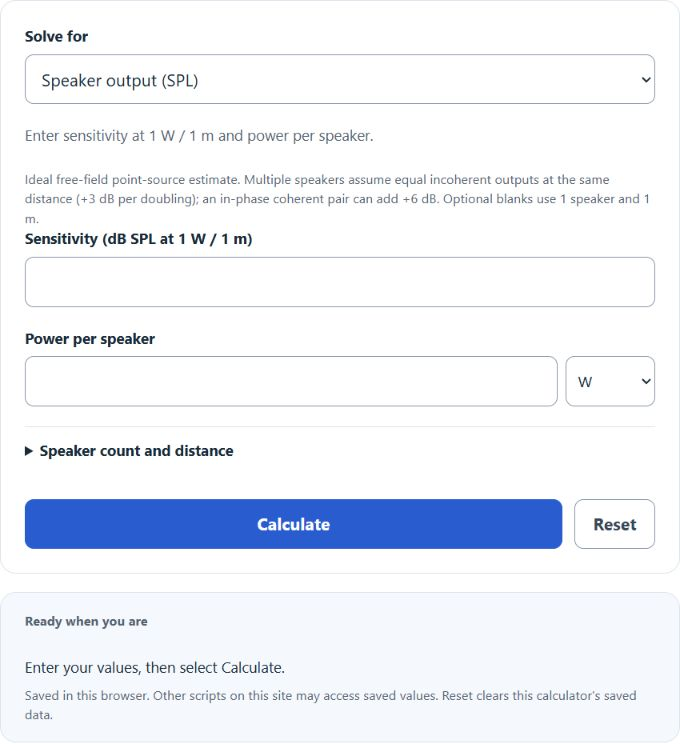
Calculate speaker output, sensitivity, or power from any two inputs using dB/W/m and W or kW to find the missing value for sound systems.
Related Calculators
- Load to Voltage Calculator
- Power Dissipation Calculator
- Wave Speed Calculator
- Peak Voltage Calculator
- All Physics Calculators
Speaker Output Formula
The speaker output calculator estimates the sound pressure level (SPL) from sensitivity and electrical power under an ideal linear-speaker model. For one speaker at 1 meter, with sensitivity expressed as dB SPL at 1 W/1 m, the core relationship is:
- O = estimated speaker output in decibels (dB SPL)
- S = speaker sensitivity in dB/W/m
- P = amplifier power delivered to the speaker in watts
This equation is logarithmic, not linear. That means output increases more slowly than wattage. A big jump in amplifier power usually produces a much smaller increase in SPL than people expect.
Rearranged Forms
For one speaker at 1 m, knowing any two values gives these equivalent forms. The calculator also includes optional speaker-count and distance terms described below:
How to Use the Calculator
- Choose output, power per speaker, or sensitivity, and enter the two known primary values. Sensitivity must use the 1 W/1 m reference under the relevant manufacturer test conditions.
- Choose W or kW for entered power, or for the power result when solving the inverse.
- Optionally enter the integer speaker count and listener distance in m or ft. Blank options use one speaker at 1 m; all counted speakers share the same sensitivity, power and listener distance in this model.
- Read the ideal SPL, power or sensitivity plus power gain, incoherent count gain and distance loss. Check actual output against manufacturer data and measurements.
What Speaker Sensitivity Means
Sensitivity specifies an SPL reference under stated measurement conditions; it is not an acoustic-efficiency percentage. For example, a rating of 90 dB SPL at 1 W/1 m means about 90 dB SPL at 1 meter with 1 watt under the specified frequency, axis and test conditions.
At comparable measurement conditions, a higher sensitivity requires less ideal electrical power to reach the same SPL. SPL is a physical level, not a direct measure of perceived loudness; frequency, program content and listening conditions matter.
Example
If a speaker has a sensitivity of 88 dB/W/m and receives 50 W of power, the estimated output is:
The estimated output is about 105 dB SPL at 1 meter.
Power Increase vs Output Increase
In the ideal linear-speaker model, equal power ratios give equal SPL increments: the change is 10log10(P2/P1). For example, each doubling adds about 3.0103 dB, whether the power goes from 1 W to 2 W or from 50 W to 100 W. Equal absolute watt increases generally do not give equal dB increments.
| Power Change | Approximate SPL Change | Practical Meaning |
|---|---|---|
| 2x power | +3 dB | Double the electrical input |
| 4x power | +6 dB | Four times the electrical input |
| 10x power | +10 dB | Ten times the input; not a fixed perceived-loudness ratio |
| 1/2 power | -3 dB | Half the electrical input |
| 1/10 power | -10 dB | One tenth of the electrical input |
Quick Output Reference for an 88 dB/W/m Speaker
| Power | Estimated Output at 1 m |
|---|---|
| 1 W | 88 dB |
| 2 W | 91 dB |
| 4 W | 94 dB |
| 8 W | 97 dB |
| 16 W | 100 dB |
| 32 W | 103 dB |
| 50 W | 105 dB |
| 100 W | 108 dB |
Distance Changes the Real Listening Level
The basic sensitivity reference is one speaker at 1 meter. The optional distance term is a free-field point-source/far-field approximation, not a guarantee for arbitrary rooms or near-field listening. For N equal speakers with incoherent powers summed at the same listener distance, the model is:
- Ld = estimated SPL at distance d
- d = distance from each speaker to the listener in meters
- N = number of equal, incoherent speaker outputs at that distance; P is watts per speaker
The ideal distance term reduces SPL by about 6.0206 dB per doubling of distance. The count term adds about 3.0103 dB per doubling of equal incoherent powers. Identical signals are not automatically incoherent: a perfectly in-phase equal pair can add about 6.0206 dB, and other phases can produce cancellation. Reflections, directivity and frequency-dependent interference require separate data or measurements.
| Distance from Speaker | Approximate Change vs 1 m |
|---|---|
| 1 m | 0 dB |
| 2 m | -6 dB |
| 4 m | -12 dB |
| 8 m | -18 dB |
Why Sensitivity Often Matters More Than Wattage
A higher-sensitivity speaker can outperform a lower-sensitivity speaker even with the same amplifier. For example, a speaker rated at 91 dB/W/m produces about 3 dB more output than one rated at 88 dB/W/m with the same power. That is roughly the same SPL advantage you would get by doubling amplifier power.
As a practical rule:
- +3 dB sensitivity is similar to 2x amplifier power
- +6 dB sensitivity is similar to 4x amplifier power
- +10 dB sensitivity is similar to 10x amplifier power
Important Assumptions and Limits
- Use a sensitivity rating measured at the relevant frequency, axis, input reference and boundary conditions; comparisons require matching conditions.
- Blank options mean one speaker at 1 m. Multiple-speaker results are conditional equal-power, same-distance incoherent sums; no program-peak headroom is added.
- Actual output depends on enclosure design, crossover losses, room acoustics, EQ, and placement near walls or corners.
- Amplifier clipping can occur before the stated wattage is usefully delivered, which increases distortion and may damage drivers.
- At high power, speakers can experience thermal compression, meaning real output rises less than the ideal formula predicts.
- Maximum clean SPL also depends on driver excursion limits and continuous power handling, not just the math of wattage.
Be Careful with 2.83 V Sensitivity Ratings
Some manufacturers publish sensitivity as dB at 2.83 V/1 m instead of a 1 W/1 m reference. For an ideal resistive load, P = V²/R: 2.83 V gives 1.0011125 W into 8 Ω and 2.002225 W into 4 Ω. Thus the 8 Ω equivalence is approximate; exactly 1 W into an ideal 8 Ω resistor uses √8 V, about 2.828427 V. The 4 Ω voltage-reference level is about 3.0151 dB above the corresponding 1 W reference under the ideal linear assumption.
Check the manufacturer’s measurement method before using a voltage-based rating in a watt-based calculator. Real loudspeaker impedance is frequency dependent; nominal impedance alone does not fully define the power in an actual sensitivity measurement.
When This Calculator Is Most Useful
- Comparing two speakers with different sensitivity ratings
- Estimating how much amplifier power is needed to reach a target SPL
- Checking whether a low-power amplifier is sufficient for efficient speakers
- Making ideal far-field/free-field comparisons before checking the actual room and loudspeaker response
- Understanding why higher wattage alone does not guarantee a much louder system