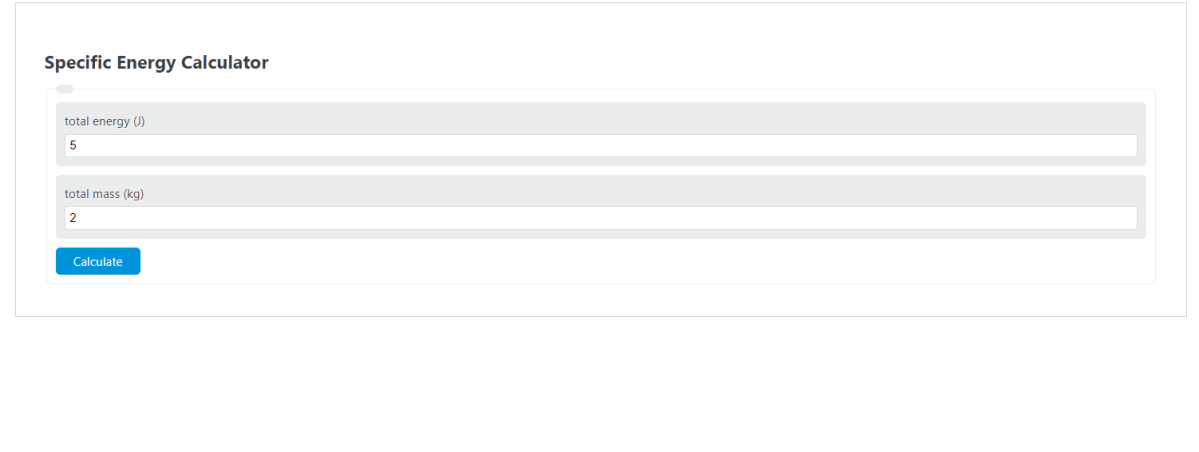
Calculate specific energy, total energy, or mass from any two values with unit conversions for J, kJ, cal, kcal, kWh, kg, g, lb, and oz.
- All Energy Calculators
- All Physics Calculators
- Change in Internal Energy Calculator
- Laser Pulse Energy Calculator
- Energy To Power Conversion Calculator
Specific Energy Formula
Specific energy measures how much energy is available per unit mass. It is commonly used to compare fuels, batteries, propellants, and other energy-storage systems where weight matters. The calculator can solve for specific energy, total energy, or total mass when any two values are known.
Where:
| Symbol | Meaning | Common SI Unit |
|---|---|---|
| SE | Specific energy | J/kg |
| E | Total energy | J |
| m | Total mass | kg |
Rearranged Forms
If you need to solve for a different variable, use the equivalent forms below.
How to Calculate Specific Energy
- Determine the total energy of the system.
- Determine the total mass associated with that energy.
- Divide the energy by the mass.
- Express the result in a consistent unit such as joules per kilogram.
A larger result means more energy is available for each kilogram of material or system mass.
Unit Notes
Consistent units are critical. If energy is entered in joules and mass in kilograms, the result is in J/kg. If you use watt-hours or grams, convert first or make sure the calculator’s unit selections match your inputs.
Examples
Example 1: Solving for Specific Energy
A device stores 6 J of energy and has a mass of 8 kg.
Example 2: Solving for Total Energy
A material has a specific energy of 250,000 J/kg and a mass of 2 kg.
Example 3: Solving for Mass
A sample contains 900 J of energy and its specific energy is 300 J/kg.
What the Result Means
- Higher specific energy means more energy per unit mass.
- Lower specific energy means less energy per unit mass.
- This metric is especially important in weight-sensitive applications such as vehicles, aircraft, portable electronics, and energy storage design.
- Specific energy does not indicate how fast energy can be delivered. That is a power-related question.
Specific Energy vs. Energy Density
Specific energy is based on mass, while energy density is based on volume. They are related but not interchangeable. A system may have strong performance by mass but not by volume, or the reverse.
Use specific energy when comparing weight efficiency. Use energy density when space or packaging volume is the limiting factor.
Common Mistakes
- Mixing grams and kilograms without converting.
- Confusing energy with power.
- Using the mass of only one component when the full system mass should be included.
- Entering zero or negative mass values, which are not physically meaningful in this context.
Common Applications
- Comparing battery chemistries by mass.
- Evaluating fuels for transportation and aerospace systems.
- Studying thermodynamic systems and material performance.
- Estimating how much total energy is stored in a known mass.
- Determining the required mass to achieve a target energy level.
Quick Interpretation Guide
| If you know… | You can find… | Use this relation |
|---|---|---|
| Total energy and mass | Specific energy | Divide energy by mass |
| Specific energy and mass | Total energy | Multiply specific energy by mass |
| Total energy and specific energy | Mass | Divide energy by specific energy |