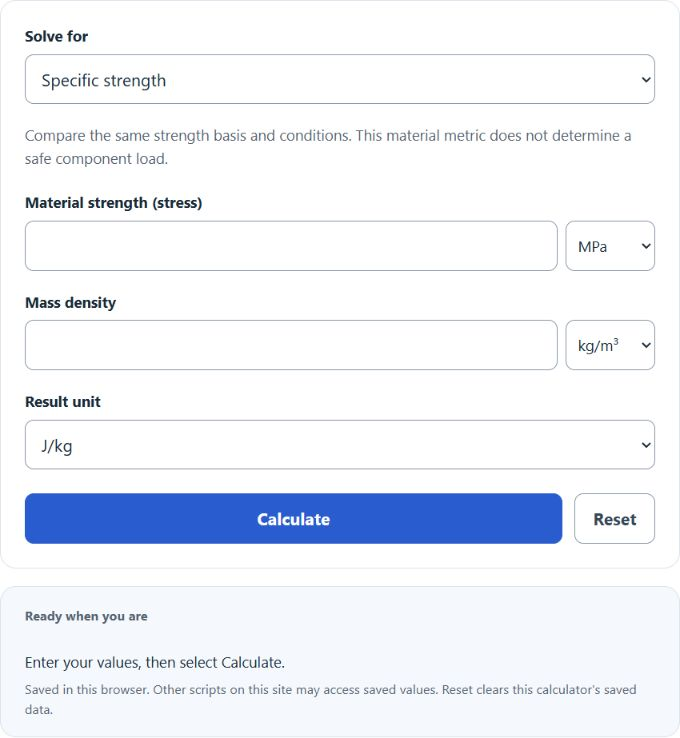
Select specific strength, material strength or density, then enter the two displayed known quantities. Strength is a stress value; unit conversions include Pa, psi, kg/m³ and J/kg.
Related Calculators
- Fiber Resin Ratio Calculator
- Moment Of Resistance Calculator
- Plate Deflection Calculator
- Truss Efficiency Calculator
- All Construction Calculators
Specific Strength Formula
Specific strength measures how much strength a material provides relative to its density. It is one of the quickest ways to compare materials when low weight matters, because it combines load capacity and mass efficiency into a single value.
Where:
- SS = specific strength
- S = material strength as a stress value
- D = material density
In most engineering use, S is entered as yield strength, tensile strength, or another relevant stress limit. The most important rule is consistency: compare materials using the same type of strength.
Variables and Units
| Variable | Meaning | Common Units |
|---|---|---|
| SS | Specific strength | J/kg, kJ/kg, N·m/kg, ft·lbf/lbm |
| S | Strength as stress | Pa, kPa, MPa, GPa, psi, ksi |
| D | Density | kg/m³, g/cm³, lb/ft³ |
If strength is in pascals and density is in kilograms per cubic meter, the result simplifies naturally to joules per kilogram.
Rearranged Forms
The calculator can also be used to solve for strength or density when the other two values are known.
How to Calculate Specific Strength
- Select the strength basis you want to use, such as yield strength or ultimate tensile strength.
- Convert the strength to a consistent stress unit if needed.
- Enter the material density in a consistent density unit.
- Divide strength by density.
- Interpret the result as strength available per unit mass.
A higher value means the material delivers more strength for the same weight. That makes specific strength especially useful in applications where every kilogram matters.
Example Calculation
If a material has a strength of 500 MPa and a density of 1600 kg/m³, its specific strength is:
This can also be written as:
Why Specific Strength Matters
Specific strength is valuable whenever a design must balance structural performance and low mass. Typical use cases include:
- aerospace structures
- automotive parts and lightweight frames
- bicycles, sporting goods, and protective equipment
- robotics and drones
- portable or weight-limited mechanical systems
If two materials can carry the same stress, the lower-density material will have the higher specific strength. If two materials have the same density, the stronger one will have the higher specific strength.
How to Interpret the Result
| Result Pattern | What It Means |
|---|---|
| Higher specific strength | More strength is available for each unit of mass. |
| Lower specific strength | More mass is required to achieve the same strength level. |
| Same density, higher strength | Specific strength increases. |
| Same strength, lower density | Specific strength increases. |
Unit Conversion Reminders
Many input errors come from mixing units. These quick conversions help keep the calculation consistent:
If you use imperial units, match each unit selection to its input. lb/ft³ uses mass density, and 1 ft·lbf/lbm = 2.98906692 J/kg.
Common Mistakes
- Mixing strength definitions: do not compare one material using yield strength and another using ultimate tensile strength unless that difference is intentional.
- Ignoring unit conversions: MPa and GPa must be converted correctly when density is entered in SI units.
- Using the wrong density basis: make sure the density matches the actual material form being evaluated.
- Using specific strength alone: it does not replace checks for stiffness, fatigue, toughness, temperature performance, corrosion resistance, or cost.
Specific Strength vs. Other Material Metrics
| Metric | What It Emphasizes |
|---|---|
| Strength | Maximum stress a material can withstand |
| Density | Mass per unit volume |
| Specific Strength | Strength relative to weight |
| Stiffness | Resistance to elastic deformation |
| Toughness | Ability to absorb energy before failure |
That means a material with excellent specific strength is not automatically the best design choice. It may still need to be checked for deflection, impact resistance, manufacturability, and service environment.
Quick FAQ
What kind of strength should be used in the formula?
Use the stress value that matches your design objective, commonly yield strength for permanent deformation limits or tensile strength for ultimate failure comparisons.
Is specific strength the same as strength-to-weight ratio?
Yes. In material selection, those terms are often used interchangeably.
Can two materials have the same strength but very different specific strengths?
Yes. If one material is much lighter, it will have a higher specific strength even when the stress capacity is similar.
Does a higher specific strength always mean a better material?
No. It only means the material is more efficient in strength per unit mass. Final selection still depends on stiffness, durability, temperature limits, cost, and manufacturing constraints.