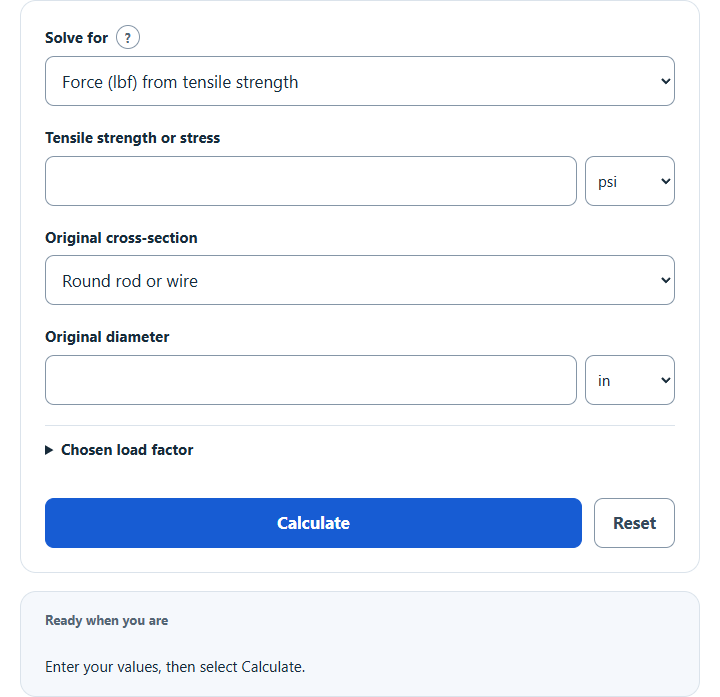
Convert tensile strength in psi to pounds of force (lbf) from a rod diameter, bar size or known area, or find tensile strength from a measured load.
- All Unit Converters
- Materials Properties Unit Converters
- Tensile Strength Calculator
- Compressive Strength Calculator
- Bending Stress Calculator
Tensile Strength To Lbs Formula
To find nominal force in lbf, multiply the entered stress in psi by the original cross-sectional area in in². Reverse mode divides measured force by original area to find engineering stress in psi.
Variables:
- σ is the entered tensile stress or strength in psi (lbf/in²)
- F is force in lbf; the peak tensile-test force is required when reverse solving for UTS
- A is the original cross-sectional area in square inches (in²)
For the load goal, Flbf = σpsi × Ain². For the reverse goal, σpsi = Flbf / Ain². Stress and force are different quantities, so a stress value cannot be converted to lbf without an area. A peak tensile-test force divided by original area gives UTS; an arbitrary applied force gives engineering stress, and a final fracture force can differ from the peak.
| Tensile Strength (psi) | Force (lbf) on 1 in² |
|---|---|
| 100 | 100.000 |
| 250 | 250.000 |
| 500 | 500.000 |
| 1,000 | 1000.000 |
| 2,000 | 2000.000 |
| 3,000 | 3000.000 |
| 5,000 | 5000.000 |
| 10,000 | 10000.000 |
| 15,000 | 15000.000 |
| 20,000 | 20000.000 |
| 30,000 | 30000.000 |
| 36,000 | 36000.000 |
| 40,000 | 40000.000 |
| 50,000 | 50000.000 |
| 60,000 | 60000.000 |
| 70,000 | 70000.000 |
| 80,000 | 80000.000 |
| 90,000 | 90000.000 |
| 100,000 | 100000.000 |
| 120,000 | 120000.000 |
| * Rounded to 3 decimals. Assumes area = 1.00 in². By definition, 1 psi = 1 lbf per square inch. | |
What is Tensile Strength To Lbs?
Tensile strength is a stress property, commonly reported in psi, ksi, or MPa. A corresponding force depends on cross-sectional area and can be expressed in lbf or newtons; lbf is force, not pound mass. UTS is based on the peak tensile-test load and original section. The calculator’s chosen factor gives a reduced nominal load F/n in load mode, not a certified allowable capacity. Actual member design also requires the applicable material, connection, service, and code checks.
How to Calculate Tensile Strength To Lbs?
The following steps find nominal force in lbf from entered stress and original area. To calculate stress from a measured force, use the calculator’s reverse mode instead.
- First, determine the justified stress or strength value σ in psi.
- Next, determine the original cross-sectional area A in square inches.
- Use Flbf = σpsi × Ain².
- Calculate the nominal force in lbf. An optional chosen factor n reduces the separate load estimate to F/n; it does not establish a certified working load.
- After inserting the variables and calculating the result, check your answer with the calculator above.
Example Problem:
Use the following variables as an example problem to test your knowledge.
Measured force F = 500 lbf.
Original cross-sectional area A = 10 in². The reverse result is σ = 500 lbf ÷ 10 in² = 50 psi. Forward mode with 50 psi and 10 in² returns 500 lbf. Interpret the 50 psi value as UTS only if 500 lbf was the measured peak tensile-test force.