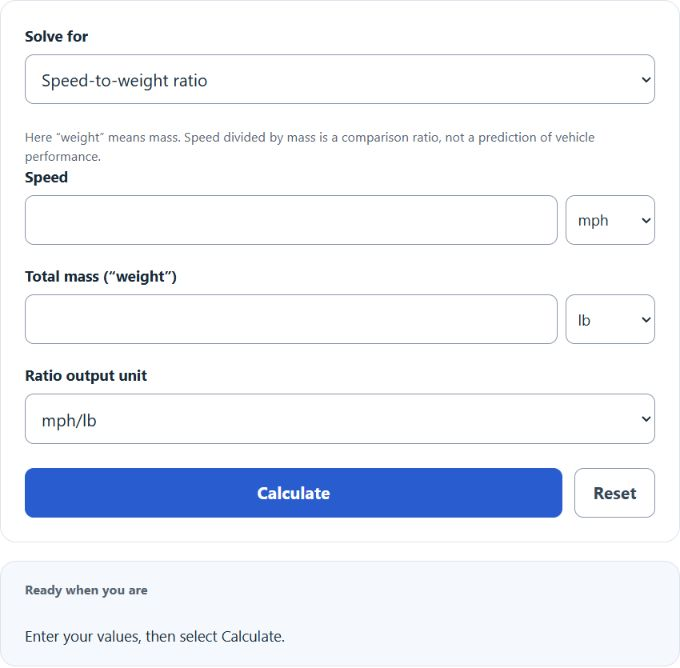
Select the value to solve for, then enter the displayed inputs. Calculate speed-to-weight ratio, speed or mass, or use the average speed, distance and time modes with unit conversions.
- All Automotive Calculators
- Torque to Weight Ratio Calculator
- Breakaway Torque Calculator
- Speed Ratio Calculator
Speed To Weight Ratio Formula
Variables:
- SWR is the Speed To Weight Ratio (a speed per unit of mass/“weight”, e.g., mph/lb or m/s per kg)
- V is the total velocity (speed)
- W is the total mass (often informally called “weight”, e.g., lb or kg)
To calculate Speed To Weight Ratio, divide the total speed by the weight (mass).
How to Calculate Speed To Weight Ratio?
The following steps outline how to calculate the Speed To Weight Ratio.
- First, determine the total velocity (speed).
- Next, determine the total weight (mass).
- Next, gather the formula from above = SWR = V / W.
- Finally, calculate the Speed To Weight Ratio using consistent units (or use the unit selectors in the calculator above).
- After inserting the variables and calculating the result, check your answer with the calculator above.
Example Problem :
Use the following variables as an example problem to test your knowledge.
total velocity (mph) = 60
total weight (lb) = 3000 → SWR = 60 / 3000 = 0.020 mph/lb
FAQs
What is the significance of the Speed to Weight Ratio in vehicles?
On this page, “Speed to Weight Ratio (SWR)” is defined as speed divided by weight (mass). It can be a simple way to normalize a measured speed by how heavy something is, but it is not a standard vehicle engineering performance metric. For vehicle performance, metrics like power-to-weight (hp/lb or kW/kg) and torque-to-weight are more directly related to acceleration, while top speed depends strongly on aerodynamics, gearing, and available power.
How can improving the Speed to Weight Ratio benefit a vehicle?
Mathematically, SWR increases if the vehicle’s measured speed increases, the vehicle’s weight (mass) decreases, or both. In practice, reducing mass or increasing available power can improve performance for many reasons, but SWR by itself does not guarantee better acceleration, handling, or fuel economy unless the speed being compared comes from the same test conditions.
Are there any limitations when trying to improve a vehicle’s Speed to Weight Ratio?
Yes. SWR is only meaningful when you compare speeds measured under similar conditions (same route, grade, wind, traction, etc.). Also note that “weight” is often used informally to mean mass (lb or kg); if you mix units, convert them (or use the calculator’s unit selectors) so the ratio is consistent.
Can the Speed to Weight Ratio be applied to other fields besides automotive?
You can compute speed divided by mass for any moving object, but other fields usually use ratios that more directly relate to performance. For example, aerospace commonly uses thrust-to-weight, and sports science often uses power-to-weight, because those relate more directly to acceleration and climbing ability than speed alone.