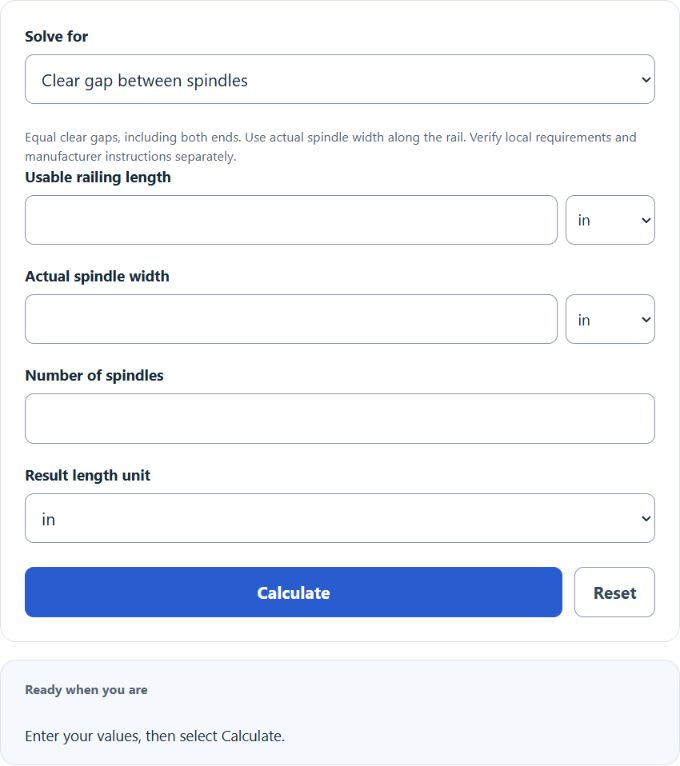
Calculate railing length, spindle diameter, total spindles, or spindle spacing for railings by selecting the unknown and entering the three displayed values, with unit conversions.
Spindle Spacing Formula
For this calculator, spindle spacing means the clear gap between railing spindles or balusters. When the gaps are laid out evenly across the rail, including the two end gaps, the spacing is calculated with the formula below.
This relationship works because the total railing length is made up of two parts: the space occupied by all spindles and the clear openings between them. With N spindles, there are N + 1 equal gaps if both end gaps match the interior gaps.
Variable Definitions
| Symbol | Meaning | Practical interpretation |
|---|---|---|
| SS | Spindle spacing | The clear opening between adjacent spindle edges |
| RL | Railing length | The usable horizontal distance between the two end constraints |
| D | Diameter or thickness of one spindle | The spindle width measured along the rail, using the widest controlling dimension |
| N | Total number of spindles | The count of installed spindles across the opening |
Equivalent Forms
If you know any three values, you can rearrange the same relationship to solve for the fourth.
| Unknown | Formula | Use case |
|---|---|---|
| Spacing | SS = (RL - N × D) / (N + 1) |
Find the clear gap for a planned spindle count |
| Railing length | RL = N × D + (N + 1) × SS |
Find how much run is required for a chosen layout |
| Spindle width | D = (RL - (N + 1) × SS) / (N) |
Find the maximum spindle width that fits a target spacing |
| Spindle count | N = (RL - SS) / (D + SS) |
Estimate how many spindles fit a given rail length and gap target |
Spindle count must be a whole number. A fractional theoretical value means the exact entered gap cannot be achieved; choose a whole count and recalculate its actual spacing. For a maximum-gap target, round upward and verify fit.
How to Use the Calculator Correctly
- Measure the usable railing length between the two end points where the spindles actually fit.
- Measure the actual spindle width, not the nominal size listed on packaging.
- Enter the total spindle count you want to test.
- Calculate the resulting clear spacing.
- Verify that the spacing and end conditions satisfy your design and local code requirements.
Example
Suppose a rail section has a usable length of 120 inches, each spindle is 1.5 inches wide, and you plan to use 30 spindles.
That means each clear opening is about 2.42 inches. If your design goal is to keep openings small, this layout would be relatively tight and visually uniform.
Choosing the Minimum Number of Spindles for a Maximum Allowed Gap
If you already know the largest clear spacing you want to allow, you can estimate the minimum spindle count directly.
Round up because using fewer spindles increases the clear opening. After selecting the count, recalculate the final spacing to confirm the layout.
Center-to-Center Layout Spacing
Installers often mark spindle locations by centerline rather than by clear gap alone. The center-to-center pitch is the spindle width plus the clear spacing.
This is useful when creating layout marks on a rail, story pole, or jig.
Important Assumptions
- All gaps are assumed to be equal.
- The two end gaps are assumed to match the interior gaps.
- All dimensions must use the same unit system.
- The spindle width is measured in the direction of the rail, not diagonally.
- The result is a clear opening, not an on-center measurement.
If End Gaps Are Different
Some layouts use fixed offsets at the ends instead of making every gap identical. In that case, subtract the two end gaps first, then divide the remaining interior space by the number of interior openings.
Use this version only when the left and right end clearances are intentionally set to specific values.
Common Mistakes
- Using the overall rail section length instead of the actual space between the inside faces of the end constraints.
- Using nominal spindle size instead of the finished installed width.
- Forgetting that the formula includes both end gaps when the layout is fully symmetric.
- Mixing units, such as entering rail length in feet and spindle width in inches.
- Ignoring the fact that a negative result means the chosen spindle count or spindle width does not physically fit.
Quick Interpretation Guide
- Larger railing length increases spacing if spindle count stays the same.
- More spindles decrease spacing.
- Wider spindles decrease the remaining clear opening.
- Very small spacing affects appearance, cost and installation time; spacing alone does not establish safety or code compliance.
Practical Design Notes
For railing applications, it is usually best to calculate spacing only after the final post positions and usable rail length are known. Decorative profiles, brackets, trim, and mounting hardware can all reduce the true available distance. For turned or shaped spindles, measure the dimension that creates the controlling opening rather than the thinnest part of the piece.
Use this calculator to test layout options quickly, compare different spindle counts, and arrive at a consistent spacing pattern before cutting or installing material.