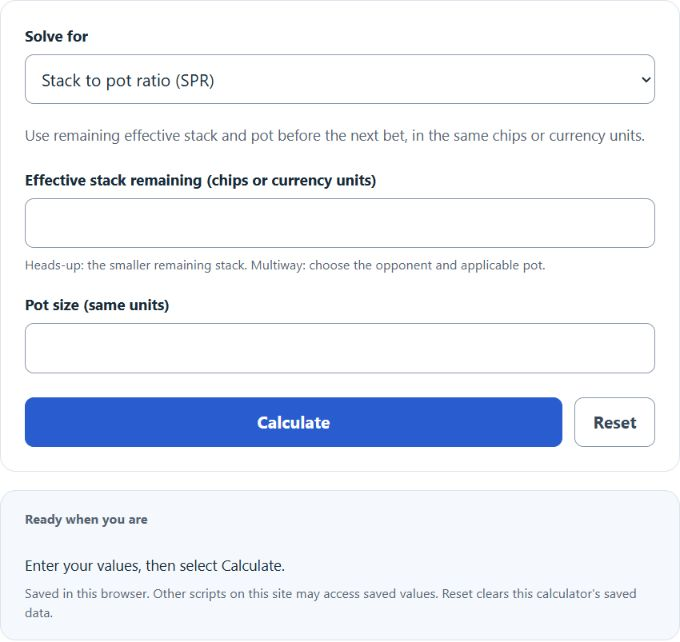
Select SPR, effective stack or pot size, then enter the two displayed known values. Use the same chips or currency units for both amounts; no currency conversion is applied.
SPR Formula
Variables:
- SPR is the Stack to Pot Ratio (unitless)
- ESS is the effective stack remaining (chips or currency units)
- FPS is the pot size in the same units, before the next bet
What SPR Measures at the Poker Table
SPR quantifies the relationship between risk and reward at the start of a post-flop street. The pot is what you stand to win; the effective stack is what you may need to invest to win it. A low SPR compresses remaining action into fewer decision points, while a high SPR leaves room for multiple streets of betting and more complex strategy.
SPR uses the remaining effective stack, which is the smaller of the two remaining stacks in a heads-up pot. In multiway pots, assess the effective stack against each relevant opponent and the pot that player can contest; a single smallest-stack ratio does not describe every main-pot and side-pot situation.
The concept was formalized by Ed Miller, Sunny Mehta, and Matt Flynn in Professional No-Limit Hold’em: Volume I (2007). SPR describes the remaining stack relative to the pot before the next bet. It helps analyze pot geometry, but does not by itself establish how strong a hand must be to commit.
SPR Zones and Commitment Thresholds
Players sometimes use broad SPR zones as strategic heuristics. They are not mathematical hand-strength thresholds or recommendations produced by this calculator; decisions depend on ranges, board, position, action and game format.
| SPR Range | Category | Illustrative hand-strength heuristic (not a rule) | Typical Pre-Flop Setup |
|---|---|---|---|
| 0 to 2 | Very Low | Any pair, strong draw | All-in pre-flop or shove-or-fold spots |
| 2 to 4 | Low | Top pair top kicker, overpair | 3-bet pots at 25 to 40bb effective |
| 4 to 9 | Medium-Low | Two pair, strong top pair on dry boards | 3-bet pots at 100bb, or single raised at 30 to 40bb |
| 9 to 13 | Medium-High | Two pair minimum, sets preferred | Single raised pots at 60 to 100bb |
| 13 to 20 | High | Set or better on most boards | Deep-stack cash games, limped pots |
| 20+ | Very High | Nutted hands only; implied-odds hands gain significant value | Very deep stack play at 200bb or more |
These heuristics are context-dependent. Dry and wet boards change available ranges and draw equity in different ways; SPR alone cannot determine whether one pair, a draw or a stronger hand should commit. On a board such as K-Q-J two-suit, a low SPR does not automatically justify stacking off with one pair.
How Pre-Flop Action Determines SPR
Pre-flop contributions affect both the pot and remaining stack. The table illustrates heads-up flop pots with no rake or antes; where stated, 1.5bb of blinds are dead money. It does not prescribe pre-flop action.
| Scenario (100bb effective) | Pot at Flop (BB) | Stack Remaining (BB) | Approx. SPR |
|---|---|---|---|
| Single raised: BTN 3x open, BB calls | 6.5 | 97 | 14.9 |
| 2.5bb open and caller, 1.5bb dead blinds | 6.5 | 97.5 | 15.0 |
| 3-bet to 9bb and call, 1.5bb dead blinds | 19.5 | 91 | 4.7 |
| 4-bet to 22bb and call, 1.5bb dead blinds | 45.5 | 78 | 1.7 |
| Two 1bb limpers, 0.5bb dead blind | 2.5 | 99 | 39.6 |
| BTN raise to 4bb, BB calls, 0.5bb dead blind | 8.5 | 96 | 11.3 |
Larger pre-flop pots generally reduce SPR for a given remaining stack. This changes the later bet sizes needed to put stacks in, but does not make any holding an automatic commit: profitability still depends on the opponent’s range, board and price.
Hand Types and Their Preferred SPR Ranges
Hand types interact with SPR because remaining stack depth changes possible future bets. The quoted ranges are broad heuristics, not universal profitable ranges: premium pairs, medium pairs and top-pair hands still need to be assessed against the board, opponent ranges and action.
Small pairs, suited connectors and suited aces may benefit from deeper stacks when future winnings compensate for the price of continuing. Neither SPR 15–30 for small pairs nor SPR 10–20 for suited hands guarantees profitability; position, ranges, realization and reverse implied odds also matter. A pocket pair flops at least a set about 11.8% of the time, but that probability alone does not determine a profitable call.
SPR and Continuation Bet Strategy
SPR affects feasible continuation-bet sizing, but does not uniquely determine an optimal size or frequency. Range advantage, board texture, position and previous action matter alongside remaining stack depth.
A solver comparison needs the exact ranges, board, stacks, rake and available bet sizes. The calculator does not run a solver or establish the previously stated 25–33% continuation-bet prescription from SPR alone.
Multiway Pots and SPR Adjustments
Multiway decisions require separate consideration of each opponent’s range, effective stack and eligible pot. More opponents can change equity and realization, but there is no universal two-pair minimum for commitment that follows from SPR alone.
For example, heads-up and three-way hands can both have an SPR of 4 while presenting different profitable decisions. Board A-7-2 and top pair top kicker do not determine a stack-off or cautious line without the players’ ranges and action.
SPR in Tournaments vs. Cash Games
In cash games, SPR is shaped by buy-in conventions and pre-flop action. Most online cash games run at 100 big blinds, producing typical single raised pot SPRs of 14 to 17. High-stakes live games often allow 200- to 300-big-blind stacks, pushing single raised pot SPRs to 30 or higher and significantly increasing the value of implied-odds hands such as suited connectors and small pairs.
In tournaments, effective stack depth changes as blinds and stacks change. In an illustrative pot with 1.5bb dead blinds, a 2.5bb open and call make a 6.5bb flop pot: starting stacks of 10bb, 40bb and 100bb leave 7.5bb, 37.5bb and 97.5bb, giving SPRs of about 1.15, 5.77 and 15. A different blind or ante setup changes those numbers. Tournament payouts can also affect decisions independently of SPR.
Pot Geometry and SPR
Pot geometry describes how the pot grows after bets and calls. Heads-up with no rake, two full pot-sized bets, each called, invest P + 3P = 4P per player; they therefore use an initial effective stack of 4P (SPR 4). Three such bets invest P + 3P + 9P = 13P; SPR 16 requires larger sizing or another betting opportunity.
For n equal fractions b of the current pot, each bet called heads-up with no rake, the initial SPR used is [(1 + 2b)^n − 1] / 2. Thus b = [(1 + 2SPR)^(1/n) − 1] / 2. At SPR 4, equal sizing is 100% pot over two bets or about 54.0% over three; 40% and 27% are not universal sizes. These are geometric identities, not betting recommendations.