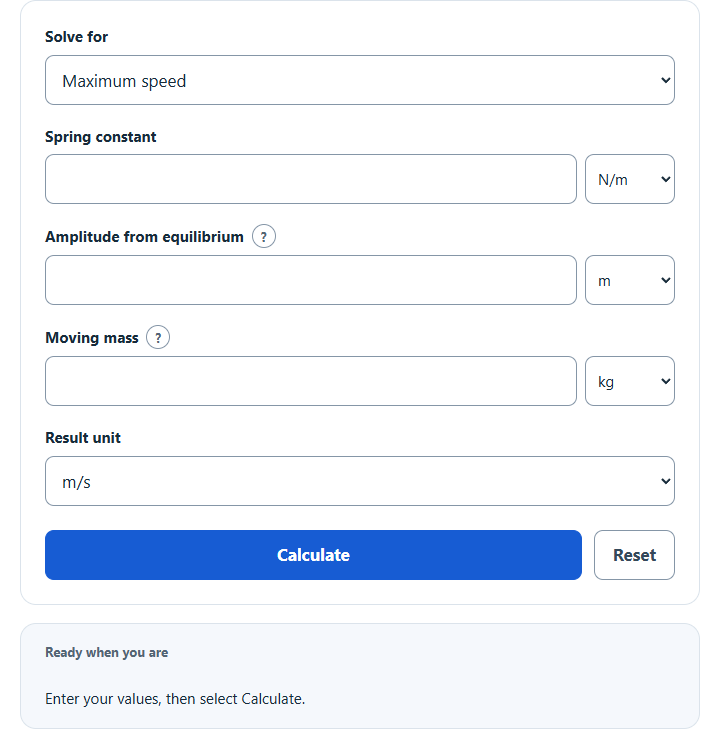
Calculate spring velocity from spring constant, displacement, and mass, plus find spring rate from wire diameter, coil diameter, material, and coils.
- All Physics Calculators
- All Velocity Calculators
- Velocity Calculator
- Maximum Velocity Calculator
- Spring Pressure Calculator
Spring Velocity Formula
For an ideal undamped linear spring and point mass, the following equation gives the maximum speed at equilibrium. The displacement x is amplitude measured from equilibrium, and spring mass is neglected.
- Where Vs is the spring velocity (m/s)
- k is the spring constant (N/m)
- x is the maximum displacement (m)
- m is the mass (kg)
Use v = A√(k/m), with positive spring constant and moving mass. The calculator also solves its inverses and estimates close-coiled compression spring rate from k = Gd⁴/(8D³Na), using mean coil diameter and active turns. Material modulus presets are approximate; choose Custom for a measured or specified modulus.
What is a Spring Velocity?
Definition:
Spring velocity here means the maximum speed of the attached mass as it passes through equilibrium after release from rest at its maximum displacement. For a vertical spring, use amplitude about the loaded equilibrium, not the unloaded spring length.
How to Calculate Spring Velocity?
Example Problem:
The following example outlines the steps and information needed to calculate velocity from redshift.
First, determine the spring constant (N/m). In this example, the spring constant (N/m) is found to be 5 N/m.
Next, determine the maximum displacement. For this problem, the maximum displacement is found to be 3 m.
Next, determine the mass. In this case, the mass is measured to be 2 kg.
Finally, calculate the Spring Velocity using the formula above:
Vs = SQRT ( k*x^2 / m)
Vs = SQRT ( 5*3^2 / 2)
Vs = 4.74 m/s