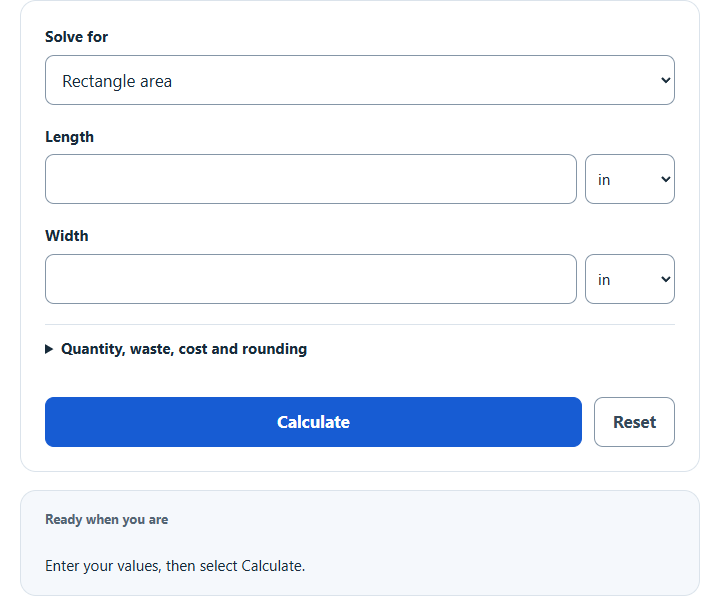
Calculate square inches from length and width, or for a circle, triangle or other shape, and convert square feet, cm² or other area units to in².
Square Inch Formula
The number of square inches depends on what you start with. If you have measurements of a shape, the calculator applies the area formula for that shape and converts every length input to inches before applying the area formula, so the result comes out in square inches. The main shape formulas are below.
Rectangle: A = L * W
Square: A = s^2
Circle: A = pi * r^2
Triangle (base and height): A = 0.5 * b * h
Triangle (three sides): A = sqrt( s*(s-a)*(s-b)*(s-c) ), s = (a+b+c)/2
Parallelogram: A = b * h
Trapezoid: A = 0.5 * (b1 + b2) * h
Ellipse: A = pi * (major/2) * (minor/2)
If you already know an area in another unit, the calculator converts it to square inches by multiplying by the square of the length conversion factor:
Convert: A(in^2) = A(unit) * (inches per unit)^2
If you know a target area and one side of a rectangle, the calculator solves for the missing side:
Missing length: L = A / known side
- A is the area in square inches (in^2).
- L and W are the length and width of a rectangle.
- s is the side of a square, or the semiperimeter in the three sided triangle formula.
- r is the radius of a circle; if you enter a diameter the calculator uses r = D / 2.
- b and h are the base and height of a triangle, parallelogram, or trapezoid.
- a, b, c are the three side lengths of a triangle.
- b1 and b2 are the two parallel sides of a trapezoid.
- major and minor are the full width and full height of an ellipse.
The Solve for menu offers eight shape calculations, known-area conversion and a missing rectangle side. Each measurement has its own unit menu. Shape options use a positive whole number of identical pieces, defaulting to one. Waste is optional and blank means 0%; an optional USD price per square inch, square foot or square meter applies to the total including waste. Decimal places default to 2 and must be 0–10; very small nonzero results use scientific notation. Missing-side mode uses only the rounding option.
Square Inch Conversions and Typical Values
One square inch is the area of a square that is one inch on every side. Because area scales with the square of length, larger units hold many square inches. Use this table to convert by hand or to check the calculator.
| Area Unit | Square Inches (in^2) |
|---|---|
| 1 square foot (ft^2) | 144 |
| 1 square yard (yd^2) | 1,296 |
| 1 square meter (m^2) | ≈ 1,550.0031 |
| 1 square centimeter (cm^2) | ≈ 0.15500031 |
| 1 square millimeter (mm^2) | ≈ 0.0015500031 |
The next table shows the area of a few common rectangles so you can sanity-check a result quickly.
| Size (inches) | Area (in^2) |
|---|---|
| 4 x 6 | 24 |
| 8.5 x 11 | 93.5 |
| 12 x 12 | 144 |
| 24 x 36 | 864 |
Example Problems
Example 1: Rectangle. You have a panel that measures 18 inches by 24 inches and you want its area in square inches. Multiply length by width: A = 18 * 24 = 432 square inches. If you set the quantity to 3 identical panels, the calculator reports 1,296 square inches total.
Example 2: Circle from a diameter. A round table top has a diameter of 30 inches. The radius is r = 30 / 2 = 15 inches. Apply the circle formula: A = pi * 15^2 = pi * 225, which is about 706.86 square inches.
Frequently Asked Questions
How many square inches are in a square foot? There are 144 square inches in one square foot, because a foot is 12 inches and 12 * 12 = 144. To convert square feet to square inches, multiply by 144. To go the other way, divide square inches by 144.
Can I mix units in the same calculation? Yes. Each measurement field has its own unit menu. The calculator converts every length to inches before it applies the area formula, so you can enter one side in feet and another in centimeters and still get a result in square inches.
How do I find a missing side from a known area? Choose the missing length mode, enter the target area in square inches and the side you already know, and the calculator divides the area by the known side. For a rectangle with an area of 200 square inches and a known side of 10 inches, the missing side is 200 / 10 = 20 inches.