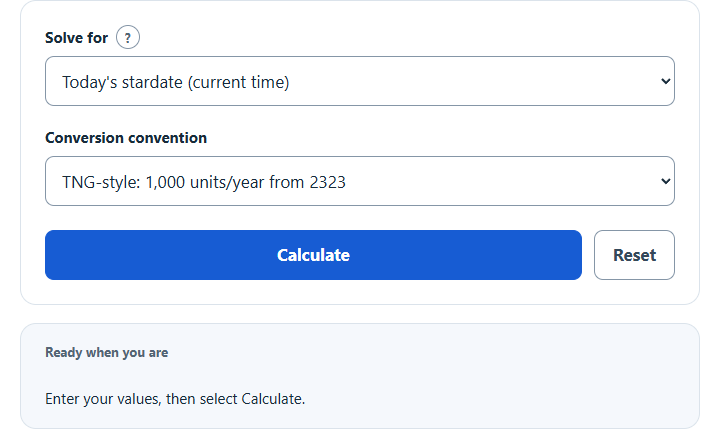
Find today’s stardate, or convert any Earth date to a Star Trek stardate and back, using the TNG-style scale of 1,000 units per year from 2323.
Stardate Formula
This calculator retains two numerical conventions. Let Y be the UTC Gregorian year and f the fraction of that UTC year elapsed. The TNG-style approximation uses the following equation; the decimal-year method uses Y + f.
- Where SD is the stardate
- Y is the Gregorian year; all dates and times use UTC
- f is elapsed UTC milliseconds since January 1 divided by the UTC length of that year; leap years are included
TNG-style inverse: Y = floor(SD / 1000) + 2323 and f = [SD − 1000 × (Y − 2323)] / 1000. Decimal-year inverse: Y = floor(SD), f = SD − Y. In either case, add f times the year length to January 1 UTC. The 1987 TNG writer’s guide describes season-based digits with uneven progression; it does not specify this exact Gregorian mapping.
What is a Stardate?
Definition:
A stardate is a fictional time measurement used in science fiction to represent dates in a futuristic context. It is designed to give an otherworldly feel to the concept of time.
How to Calculate a Stardate?
Example Problem:
The following example outlines the steps and information needed to calculate a stardate.
First, record the UTC Earth date and time. For example, 2364-07-02T00:00:00 is exactly halfway through the leap year 2364.
Here Y = 2364 and f = 183 / 366 = 0.5.
Finally, calculate the stardate using the formula above:
SD = 1000 * (Y – 2323 + f)
The TNG-style result is 1000 × (2364 − 2323 + 0.5) = 41500.00. The decimal-year result is 2364.500000. The latter is a year fraction, not day 500. Inverse dates are rounded to the nearest millisecond; rounded Stardates cannot recover every original instant exactly.
FAQ
How accurate is the stardate conversion?
Both methods are mathematical conventions for entertainment. Screen chronology can differ, and decimal-year notation must not be confused with a year-and-ordinal-day film convention.
Can the stardate be applied to real-world events?
No, the stardate is a fictional timekeeping system created for science fiction narratives and therefore is not suitable for real-world applications.
What should I do if the stardate calculation seems incorrect?
Double-check the Earth date and time input to ensure it follows the correct format. Remember that the formula is fictional and may not align with traditional calendrical calculations.