Calculate how many bundles of starter shingles you need for your eaves and rakes, using real product coverage, a waste factor, and cost estimate.
Starter Shingle Formula
Starter shingles run a continuous, sealed strip along the eaves and rakes so the first course of field shingles bonds down and resists wind uplift. The calculator sizes that strip in three ways, so it uses three arrangements of the same idea.
To find the bundles you need from a known edge length:
B = ceil( (E + R) * (1 + W) / C )
To estimate the edge length from your building size when you have not measured the roof yet:
Gable: Eaves = 2 * L, Rakes = 2 * Wd * PF
 Hip: Eaves = 2 * L + 2 * Wd, Rakes = 0
 Shed: Eaves = L, Rakes = 2 * Wd * PF
 PF = sqrt(1 + (rise/12)^2)
To find how much edge a set number of bundles will cover:
Coverage = N * C
Variables:
- B is the number of starter bundles, rounded up to the next whole bundle
- E is the total eave length in linear feet (the horizontal bottom edges of the roof)
- R is the total rake length in linear feet (the sloped gable edges, measured along the slope)
- W is the waste allowance written as a decimal, so 10 percent is 0.10
- C is the coverage of one bundle in linear feet
- N is a number of bundles you already have
- L is the building length that runs along the eaves, and Wd is the building width from gable to gable
- PF is the pitch factor that stretches the horizontal width into the true sloped rake length
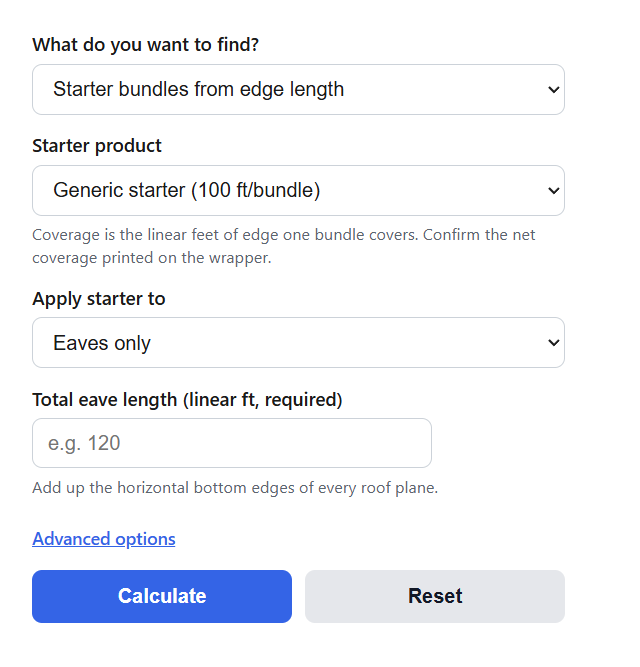
Pick what you want to find at the top of the calculator. In "Starter bundles from edge length" you enter your measured eave length, add rake length if you are starting the gable edges too, choose a product, and the tool rounds up to whole bundles. In "Estimate from roof size" you enter the building footprint and roof style, and the tool works out the eave and rake length for you before sizing the bundles. In "Coverage from a bundle count" you enter a number of bundles and see how much edge they cover. The product menu sets the coverage per bundle to the real net coverage of common starter products, and the advanced options add a waste allowance and an optional price per bundle for a cost estimate.
Starter Strip Coverage by Brand
Coverage per bundle is the single number that drives the count, and it is not the same across products. A bundle that covers 105 feet forces more bundles on a long roof than one that covers 123 feet. The table below lists the published net coverage for common pre-cut starter products so you can match the calculator to whatever you actually buy. Confirm the figure on the wrapper, since manufacturers revise packaging.
| Starter product | Coverage per bundle | Pieces per bundle |
|---|---|---|
| GAF Pro-Start | 120.33 ft | 38 |
| IKO Leading Edge Plus | 123 ft | pre-cut strips |
| CertainTeed SwiftStart | 116 ft | 18 |
| Owens Corning Starter Strip Plus | 105 ft | 16 shingles (32 pieces) |
| Generic pre-cut starter | 100 to 110 ft | varies |
| Cut 3-tab shingles (DIY) | about 78 ft | 26 shingles per bundle |
The last row is the do-it-yourself option. A standard three-tab shingle is 36 inches long, and cutting the tabs off leaves a solid strip about 3 feet long, so one bundle of 26 three-tab shingles yields roughly 78 feet of starter. It is cheaper, but the factory adhesive on a pre-cut starter sits right at the eave edge where it seals the first course, which a cut shingle does not always match.
This second table is a quick sanity check. It shows how many bundles a generic 100 foot per bundle starter needs for a range of total edge lengths, including a 10 percent waste allowance.
| Total edge (eaves + rakes) | Bundles at 100 ft, plus 10% waste |
|---|---|
| 80 ft | 1 |
| 120 ft | 2 |
| 160 ft | 2 |
| 200 ft | 3 |
| 240 ft | 3 |
| 300 ft | 4 |
| 400 ft | 5 |
Example Problems
Example 1: Bundles from a measured edge length.
A house has 120 feet of eaves, and you also run starter up the two gable rakes at 34 feet each for 68 feet of rake, so the total edge is 188 feet. Using GAF Pro-Start at 120.33 feet per bundle with a 10 percent waste allowance:
B = ceil( 188 * 1.10 / 120.33 ) = ceil( 206.8 / 120.33 ) = ceil( 1.72 ) = 2 bundles. Two bundles cover 240.66 feet, which leaves about 53 feet of buffer.
Example 2: Edge length from a roof footprint.
A gable garage is 40 feet long and 24 feet wide with a 6 in 12 pitch, and you want starter on the eaves and the rakes. The eaves are 2 times 40, which is 80 feet. The pitch factor is sqrt(1 + (6/12)^2) = sqrt(1.25) = 1.118, so the rakes are 2 times 24 times 1.118, which is 53.7 feet. The total edge is 133.7 feet. With generic 100 foot starter and 10 percent waste, B = ceil( 133.7 * 1.10 / 100 ) = ceil( 1.47 ) = 2 bundles.
Frequently Asked Questions
How many bundles of starter shingles do I need?
Divide your total edge length by the coverage printed on the bundle, then round up. A common pre-cut starter covers about 100 linear feet, so a roof with 120 feet of eaves needs 2 bundles once you add a small waste allowance. The coverage figure matters more than most people expect: the same roof can need one fewer bundle if you switch from a 105-foot product to a 123-foot product, so match the calculator to the exact product you plan to buy.
Do you put starter shingles on the rakes too?
On modern installs, yes. Starter along the eaves seals the first course against wind lifting it from below, and starter up the rakes seals the gable edges against wind lifting them from the side. Many shingle warranties for high wind coverage require starter on both the eaves and the rakes. If you only plan to do the eaves, choose "Eaves only" in the calculator so you are not buying extra bundles you will not use.
Can I use regular shingles as starter instead of a starter strip?
You can, and it is a long-standing method. You cut the tabs off a three-tab shingle, or trim an architectural shingle down, and lay the solid strip with the adhesive toward the eave. The catch is placement of the sealant. A pre-cut starter puts a bead of factory adhesive right at the edge where it grabs the first course, while a cut field shingle often has its sealant line in the wrong spot, which weakens the wind seal. For a small shed the cut method is fine; on a full house the pre-cut product is worth the small extra cost.