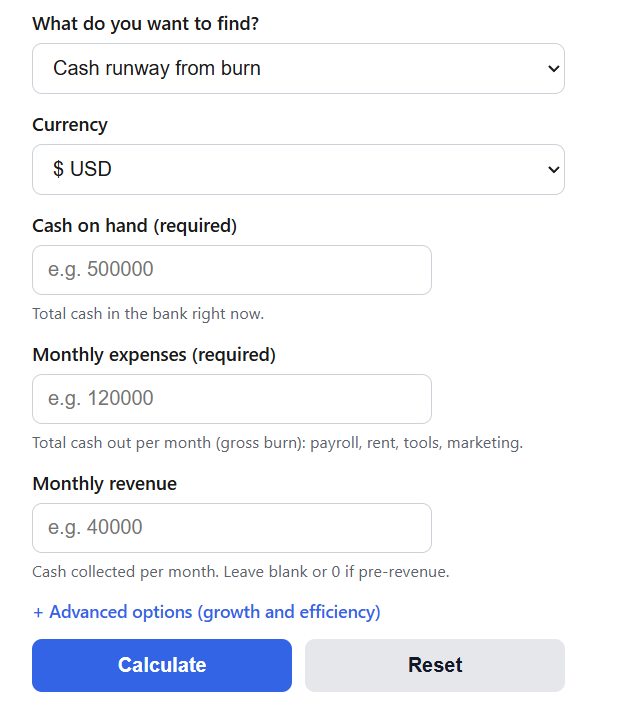
Calculate your startup’s gross and net burn rate, cash runway in months, and zero-cash date, then solve for the max burn or cash needed to hit a target runway.
Startup Burn Rate and Runway Formula
The calculator is built around three numbers: your burn rate, your cash on hand, and your runway. Gross burn is everything you spend in a month. Net burn subtracts revenue from that. Runway divides your cash by net burn to tell you how many months you have left.
Gross Burn = E
 Net Burn = E - R
 Runway = C / Net Burn
Variables:
- E is your total monthly expenses, the cash that leaves the business each month. This is the same as gross burn
- R is your monthly revenue, the cash you collect each month
- Net Burn is your monthly cash loss, expenses minus revenue. When revenue is higher than expenses, net burn is negative and you are cash-flow positive
- C is your current cash on hand
- Runway is the number of months before your cash reaches zero at the current net burn
The same relationships rearrange when you want to solve for a target instead of a result. If you fix a target runway in months, you can solve for the largest burn you can afford or the amount of cash you need to fund it:
Max Monthly Burn = C / T
 Cash Needed = Net Burn * T
 Burn Multiple = Net Burn / Net New ARR
- T is your target runway in months
- Max Monthly Burn is the highest net spend that still leaves T months of runway from cash C
- Cash Needed is how much money must be in the bank to fund T months at the current net burn
- Net New ARR is the annual recurring revenue you add over a period. Burn multiple measures how many dollars you burn for each dollar of new recurring revenue, so a lower number means more efficient growth
The calculator has three solve-for modes. “Cash runway from burn” takes cash, expenses, and revenue and returns your gross burn, net burn, runway in months, and a zero-cash date. “Max monthly burn for a target runway” reverses that to show the spending ceiling that protects a runway you choose. “Cash needed for a target runway” tells you how much to hold, or raise, to reach a target. The advanced panel adds two extras most simple calculators skip: monthly revenue and expense growth rates that produce a dynamic, month-by-month runway, and a net new ARR input that grades your burn multiple.
Runway and Burn Multiple Benchmarks
The first table turns a runway figure into a decision. The second table grades capital efficiency using the burn multiple, a metric that plain cash-divided-by-burn calculators leave out.
| Runway remaining | What it signals | Typical action |
|---|---|---|
| Under 6 months | Danger zone | Cut costs or close a raise now |
| 6 to 12 months | Time to act | Open fundraising conversations |
| 12 to 18 months | Comfortable | Hit milestones, plan the next round |
| 18 months or more | Healthy | Invest in growth with margin to spare |
Investors and CFOs commonly suggest keeping at least 12 to 18 months of runway and starting a raise while 6 to 12 months remain, since seed and Series A rounds often take three to six months to close.
| Burn multiple | Capital efficiency | Read |
|---|---|---|
| Under 1.0x | Exceptional | Top quartile, strong product-market fit |
| 1.0x to 1.5x | Strong | The broad investor benchmark |
| 1.5x to 2.0x | Fair | Acceptable at seed, watch it closely |
| Over 2.0x | Inefficient | Growth is expensive; tighten spend |
Stage matters when you read the burn multiple. An early seed company can defend a higher multiple while it finds its footing, and the bar tightens as annual recurring revenue grows. Later-stage companies past a few million in ARR are usually expected to run near or below 1.0x.
Example Problems
Example 1: cash runway from burn.
Your startup holds $500,000. Monthly expenses are $120,000 and revenue is $40,000. Net burn is 120,000 minus 40,000, or $80,000 per month. Runway is 500,000 divided by 80,000, which is 6.25 months. That lands you in the 6 to 12 month band, so this is the point to start fundraising rather than wait.
Example 2: burn multiple.
Your net burn is $80,000 per month and you add $20,000 of net new ARR each month. Burn multiple is 80,000 divided by 20,000, which is 4.0x. That is above 2.0x, so each dollar of new recurring revenue is costing four dollars of cash. Growth is running inefficiently and spending needs a closer look before you scale it further.
Frequently Asked Questions
What is the difference between gross burn and net burn?
Gross burn is your total monthly cash outflow, every dollar you spend on payroll, rent, software, and marketing, with no credit for income. Net burn subtracts revenue from that number, so it shows how fast your bank balance is actually shrinking. Gross burn tells you what the business costs to run. Net burn is the figure you divide into your cash to get runway, because it reflects the money you truly lose each month.
How many months of runway should a startup keep?
A common target is 12 to 18 months, with many investors preferring closer to 18 to 24 months after a round. The reason is timing. Raising a new round usually takes three to six months, and it can take longer in a slow market, so you want to start the process with 6 to 12 months still in the bank. If your runway drops below 6 months, treat it as urgent and either cut spending or move quickly on financing.
What is a good burn multiple?
Below 1.5x is the broad benchmark investors look for, and below 1.0x is considered top tier, meaning you add more than a dollar of recurring revenue for every dollar burned. Early-stage companies are given more room, so a seed startup running 1.5x to 2.5x while it proves demand is not alarming on its own. As your ARR climbs, the expectation tightens toward 1.0x or lower, and a multiple above 2.0x at any stage is a signal that growth is costing too much cash.