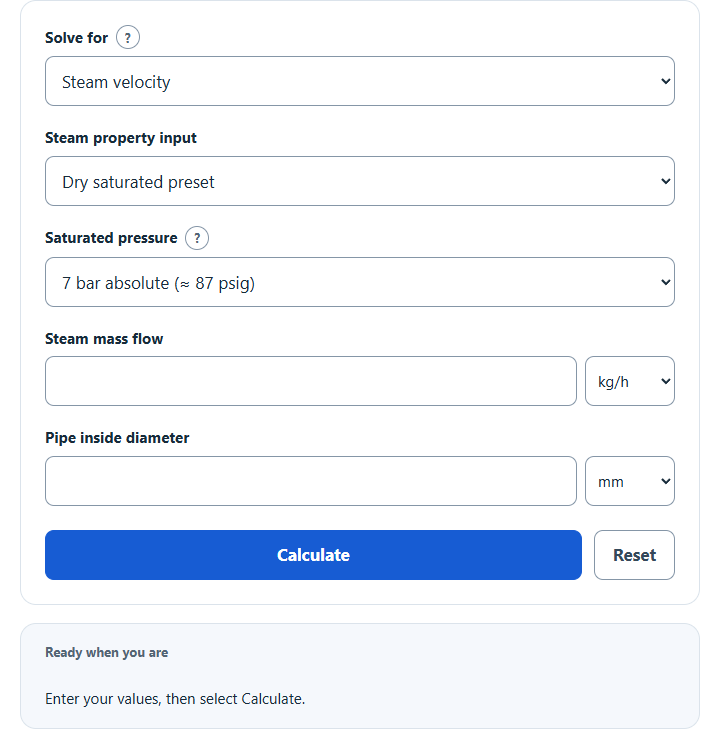
Calculate steam velocity in a pipe from mass flow, saturated steam pressure and inside diameter, or find the pipe ID needed for a target velocity.
Steam Velocity Formula
The following equation is used to calculate the Steam Velocity.
- Where Vs is the steam velocity (ft/s)
- QV is the steam volume flow rate (ft^3/s)
- FA is the flow area (ft^2)
To calculate steam velocity, divide volumetric flow by flow area. The widget obtains volumetric flow from mass flow and specific volume: Q = ṁvg, then uses A = πD²/4 and u = Q/A. Its inverse is D = √(4ṁvg/(πu)) for positive mass flow and target velocity. The bounded eleven-size Schedule 40 table uses nominal inside diameters; a listed comparison is not a pressure-drop check or pipe design recommendation.
What is a Steam Velocity?
Definition:
Steam velocity is the bulk linear speed through a flow area. At a given mass flow, it depends on pipe inside diameter and the steam specific volume at the operating pressure, temperature and steam condition. Dry-saturated presets assume saturated vapor; known superheated conditions require an appropriate directly entered specific volume. Relative humidity is not the steam property used by this model.
How to Calculate Steam Velocity?
Example Problem:
The following example outlines the steps and information needed to calculate Steam Velocity.
First, determine the steam volume flow rate. In this example, the steam volume flow rate is found to be 55 ft^3/s.
Next, determine the flow area. For this problem, the flow area is found to be 10 ft^2.
Finally, calculate the Steam Velocity using the formula above:
Vs = QV / FA
Vs = 55 / 10
Vs = 5.5 ft/s