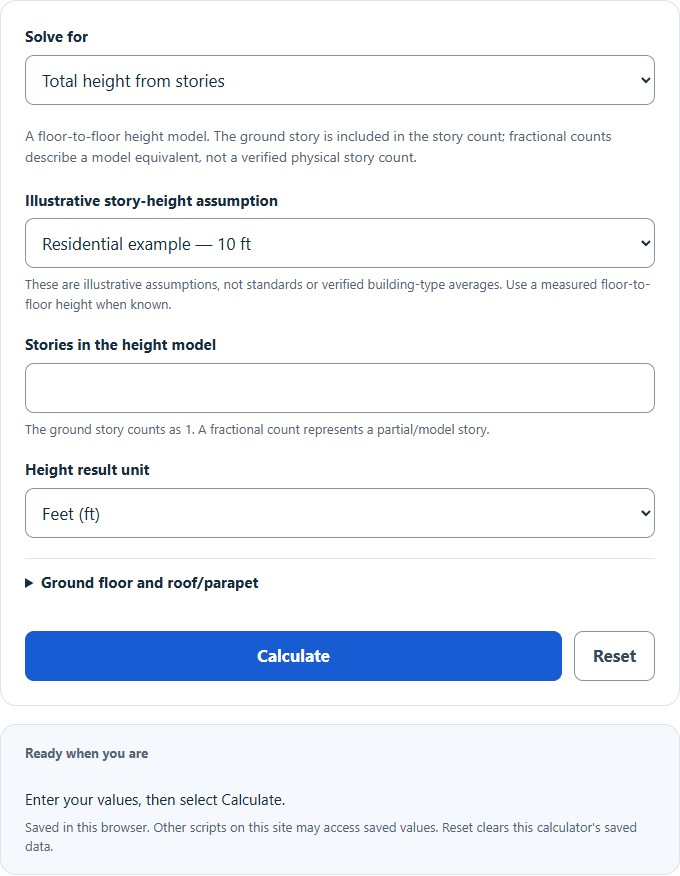
Estimate total height from a floor-to-floor story model, solve its story equivalent or typical story pitch, and inspect modeled floor elevations. Fractional story equivalents are not verified physical story counts.
Related Calculators
- Feet to Stories Calculator
- Ceiling Height Clearance Calculator
- Floor Space Index Calculator
- Floor to Area Ratio Calculator
- Gross Floor Area Calculator
- All Unit Converters
Stories To Feet Formula
For S stories including the ground story, the general model below uses ground-story height G, typical upper-story pitch F, and extra roof/parapet/mechanical height E. If the ground story has the same pitch as the others and E = 0, it reduces to H = S × F. This is estimated geometry, not a legal building-height definition.
Variables:
- H is total modeled height, including the roof/parapet/mechanical extra; use a common length unit in the formula
- S is the modeled story count, including the ground story as 1; this model requires S ≥ 1
- F is typical upper-story floor-to-floor height, not ceiling height; 10 ft is an illustrative assumption, not a standard or verified building-type average
With ground height blank, G = F: story equivalent S = (H − E)/F, and solved pitch F = (H − E)/S. With an explicit G: S = 1 + (H − E − G)/F, and F = (H − E − G)/(S − 1). At S = 1 with a separate G, upper-story pitch is nonunique if H = G + E and otherwise the inputs are inconsistent. Results retain fractional model counts; sampled elevation rows use the true full count and roof height.
How to Calculate Stories To Feet?
The following steps outline how to calculate the height in feet (H) using the Stories To Feet formula.
- Choose the solve mode. Enter modeled stories S for a height/pitch solve, or measured total height H for a story-equivalent/pitch solve.
- For height or story-equivalent mode, choose an illustrative pitch preset or supply a custom floor-to-floor height F. The 3.3 m option is an example, not a standard metric story.
- Set optional ground height G and extra height E if known. Blank ground height means G = F; blank extra height means E = 0. Entered options remain active when their section is collapsed.
- Select Calculate to solve the chosen equation. A fractional result describes a model equivalent; it is not silently rounded into an actual story count.
- Check units and the stated model origin. The elevation table may sample large story counts but retains their actual roof/total height; legal grade and building-height rules may use different measurement bases.
Example Problem:
Use the following variables as an example problem to test your knowledge.
Number of stories (S) = 5
Illustrative floor-to-floor pitch F = 10 feet, with ground story the same height and no extra roof/parapet height. The example gives H = 5 × 10 = 50 ft = 15.24 m.