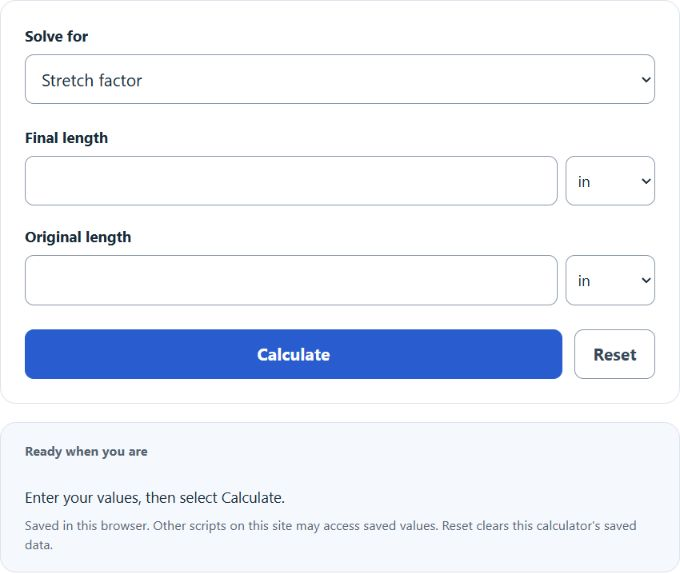
Choose stretch factor, final length, or original length, then enter the two known values with inch, foot, cm, meter, or yard units.
Note: This calculator is intended for mathematical/engineering length changes of objects/materials (not for medical or fitness use).
- All Math and Numbers Calculators
- Pipe Stretch Calculator
- Mold Shrinkage Calculator
- Shrink Percentage Calculator
Stretch Factor Formula
The stretch factor measures how much a length changes relative to its original size. It compares the final length after stretching to the original length before stretching. Because it is a ratio of two lengths in the same unit, the result is unitless.
- SF — stretch factor
- L — final length after stretching
- L0 — original length before stretching
This calculator is useful any time you know any two of the three values and want to solve for the third. In engineering and materials contexts, this ratio is often used to describe elongation. In geometry, the same idea is closely related to a scale factor.
Rearranged Forms
If you need to solve for a different variable, rearrange the relationship as follows:
These forms are helpful when:
- you know the original length and stretch factor and need the final length, or
- you know the final length and stretch factor and need the original length.
How to Interpret the Result
The numeric value of the stretch factor tells you immediately whether an object got longer, stayed the same, or became shorter.
| Stretch Factor | Meaning | Interpretation |
|---|---|---|
| Less than 1 | Contraction | The final length is shorter than the original length. |
| 1 | No change | The length stayed the same. |
| Greater than 1 | Stretching | The final length is longer than the original length. |
Some common interpretations:
| Value | Meaning |
|---|---|
| 0.80 | 20% shorter than the original |
| 1.00 | No change in length |
| 1.10 | 10% longer than the original |
| 1.25 | 25% longer than the original |
| 1.50 | 50% longer than the original |
| 2.00 | The final length is double the original |
Stretch Factor vs. Strain
Stretch factor and strain are closely related, but they are not the same quantity. Stretch factor tells you the total multiplicative change in length, while strain tells you the relative change from the original length.
For example, a stretch factor of 1.25 means:
- the object is 1.25 times its original length, and
- the elongation is 25%.
How to Use the Calculator
- Enter the final length and original length to find the stretch factor.
- Or enter the stretch factor and original length to find the final length.
- Or enter the stretch factor and final length to find the original length.
- Select the unit for each length; the calculator converts them to the same unit before calculating.
The calculator accepts common length units such as inches, feet, centimeters, meters, and yards. Since the ratio compares like units, unit consistency matters more than the specific unit chosen.
Example Calculations
If a band stretches from 8 inches to 10 inches, the stretch factor is:
This means the band is 25% longer than its original length.
If the original length is 2 meters and the stretch factor is 1.10, then the final length is:
So the stretched length is 2.2 meters.
If the final length is 15 centimeters and the stretch factor is 1.50, then the original length is:
So the original length was 10 centimeters.
Common Mistakes to Avoid
- Mixing units: select the correct unit for each measurement; the calculator converts them automatically.
- Confusing factor with percent: a stretch factor of 1.20 does not mean a 120% increase; it means a 20% increase.
- Using an original length of zero: the original length must be greater than zero for the ratio to be defined.
- Assuming it measures force: stretch factor only describes length change, not stress, force, or stiffness.
Where Stretch Factor Is Used
- Materials testing: describing how much a specimen elongates under load
- Rubber and elastomers: tracking deformation in highly stretchable materials
- Textiles and fabrics: evaluating extension during pull or tension
- Pipes, cables, and bands: checking change in installed or loaded length
- Geometry and transformations: representing scaling along a direction
Quick FAQ
Is stretch factor ever negative?
For ordinary physical lengths, no. This calculator requires both lengths and the stretch factor to be positive.
Can the stretch factor be less than 1?
Yes. A value below 1 indicates contraction rather than stretching.
Does the unit matter?
Select the correct unit for each length; conversions are automatic. The stretch factor is dimensionless.
What does a stretch factor of 1 mean?
It means the final and original lengths are equal, so there was no change in length.