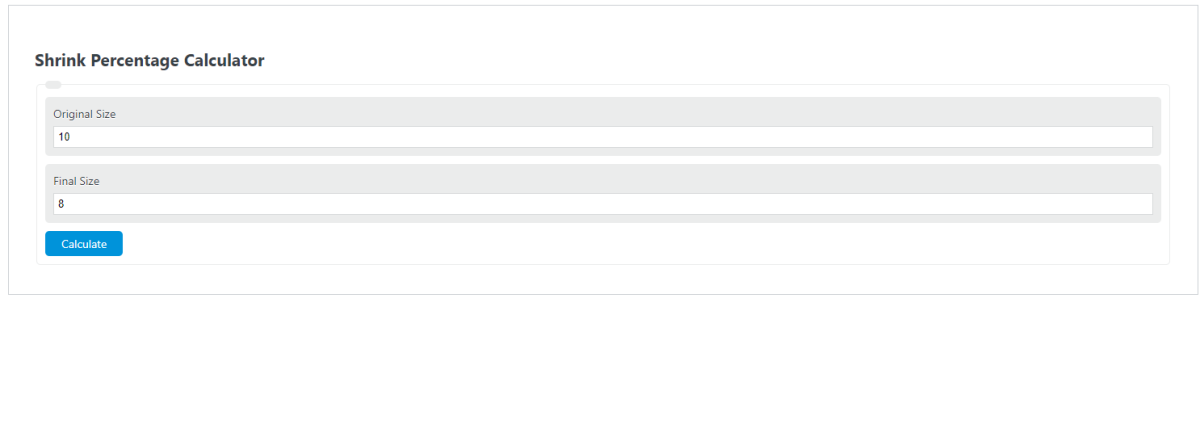
Calculate shrink percentage from original and final measurements, or solve for starting or finished size with optional area and volume effects.
Related Calculators
- Time Decrease Calculator
- Percentage Points Calculator
- Improvement Percentage Calculator
- Percentage Difference Calculator
- All Math and Numbers Calculators
Shrink Percentage Formula
The following equation is used to calculate the Shrink Percentage.
- Where S is the shrink percentage (%)
- OS is the original size
- FS is the final size after shrinking
To calculate the shrink percentage, subtract the final size from the original size, divide by the original size, then multiply by 100.
What is a Shrink Percentage?
Definition:
Shrink percentage measures how much change in size occurred on an object that shrunk in size relative to the original size of that object.
How to Calculate Shrink Percentage?
Example Problem:
The following example outlines the steps and information needed to calculate Shrink Percentage.
First, determine the original size of the object. In this example, we are looking at the change in size of the length of a rod. For this example, the original length was 10 inches.
Next, determine the final size after shrinking. After shrinking the final size is measured to be 8 inches.
Finally, calculate the shrink percentage using the formula above:
S% = (OS-FS) / OS * 100
S% = (10-8) / 10 * 100
S% = 20%