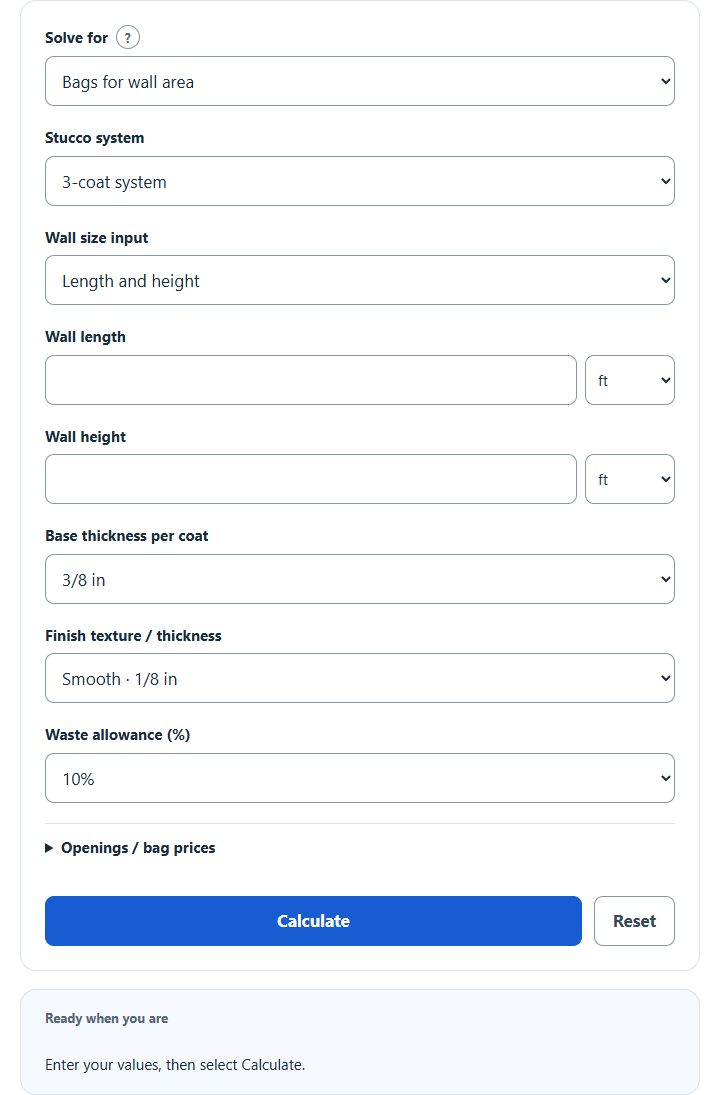
Estimate how many 80 lb stucco bags you need for scratch, brown and finish coats from wall size and waste, or find the area a set of bags will cover.
Stucco Coverage Formula
The calculator first finds the net wall area, then converts that area into 80 lb bags for each coat:
A = (L * H) - O
Bags = ceiling((A * (1 + W/100)) / C)
Reverse mode gives nominal coverage of one selected coat before waste or reserve, using whole or partial bag equivalents:
A = Bags * C
Variables:
- A is the net wall area to be stuccoed (square feet)
- L and H are the wall length and height (feet)
- O is the total area of doors, windows, and other openings (square feet)
- W is the waste allowance as a percent (10% is typical)
- C is the coverage of one 80 lb bag at the chosen coat thickness (square feet per bag)
- Bags is the number of 80 lb bags required for that coat
In the default mode you enter the wall size, pick a stucco system, and the tool applies the bag formula once per coat. A 3-coat estimate counts scratch, brown and finish; a 2-coat estimate counts one base coat plus finish; finish-only counts the finish coat. Mixing-water allowance uses rounded purchased bags at 1.4 US gallons per base bag and 2 US gallons per finish bag; actual mixing instructions and curing water are separate. Optional bag prices give a complete active-coat material estimate only when all needed coat prices are entered; otherwise the result is a known-price subtotal. Reverse mode estimates single-coat area from available bags.
Bag Coverage, Mixing Water, and Curing Schedule
Coverage depends on the product, coat, thickness and application. The base presets 22, 16.5 and 11 square feet per bag are midpoints of the ranges in the QUIKRETE 1139 base-coat data sheet. The QUIKRETE 1201 finish-coat data sheet lists about 70 square feet at 1/8 inch. Heavy-finish coverage of 48 square feet at 3/16 inch is a site planning estimate, not a listed universal manufacturer value. These 80 lb bags are dry preblends; example mixed yield is about 0.75 cubic feet, not an installed-load or dry-density calculation.
| Coat | Thickness | Coverage per 80 lb bag |
|---|---|---|
| Scratch or brown (base) | 3/8 in | 20 to 24 sq ft |
| Base coat | 1/2 in | 15 to 18 sq ft |
| Base coat | 3/4 in | 10 to 12 sq ft |
| Finish coat, smooth or sand float | 1/8 in | about 70 sq ft |
| Finish coat, lace, dash, or heavy texture | 3/16 in | 48 sq ft (site estimate) |
The table below summarizes the calculator’s mixing-water allowances and points to product-dependent curing requirements. The 1.4 US gallon base allowance rounds an example 5.5 US quarts (1.375 US gallons); 2 US gallons is an example finish-product allowance. Other products differ: the Sakrete Finish Coat Stucco data sheet uses about 1.5 gallons. Follow the selected product’s current mixing and curing instructions; curing or fogging water is additional and excluded from the calculated total.
| Coat | Calculator allowance per 80 lb bag | Product-dependent curing |
|---|---|---|
| Scratch coat | 1.4 US gal (planning) | Follow base-product moist-curing instructions |
| Brown coat | 1.4 US gal (planning) | Follow the approved base/finish system schedule |
| Finish coat | 2 US gal (planning) | Follow finish-product instructions; fortified products may differ |
Follow the product’s batch workability and retempering instructions; the example base product calls for preparing about one hour’s material. Curing or fogging needs depend on the product and weather and remain outside the mixing-water allowance.
Example Problems
Example 1: 3-coat stucco on a framed wall. You are stuccoing a wall 40 feet long and 9 feet tall with one door and several windows totaling 40 square feet of openings. Net area is 40 * 9 – 40 = 320 square feet. With a 10% waste allowance you need to cover 352 square feet. At 22 square feet per bag for a 3/8 inch coat, the scratch coat takes 352 / 22 = 16 bags, and the brown coat takes another 16 bags. A smooth finish at 70 square feet per bag takes 352 / 70 = 5.03, rounded up to 6 bags. That is 38 bags total, and about 32 * 1.4 + 6 * 2 = 56.8 gallons of mixing water for the whole job.
Example 2: coverage from bags on hand. You have 10 bags of 80 lb base coat left over and want to know how much wall they will cover at 3/8 inch. Area = 10 * 22 = 220 square feet, or about 20.4 square meters. If the substrate is rough or you trowel heavier than 3/8 inch, expect the real number to land closer to the low end of the 20 to 24 square feet per bag range.
Frequently Asked Questions
How many bags of stucco do I need per 100 square feet?
For 100 net square feet with the default 10% allowance, each coat must cover 110 square feet. At 22 square feet per base bag and 70 per smooth-finish bag, round each coat up: 5 bags per base coat and 2 finish bags. That gives 12 bags for the 3-coat estimate or 7 for the 2-coat estimate. Different thickness, texture, product coverage or waste changes those totals.
Why do stucco coverage estimates vary so much between sources?
One important distinction is pre-blended material versus a field mix. The 80 lb preblend assumptions already include sand; the example base product yields about 0.75 cubic feet and uses 22 square feet at 3/8 inch as a planning midpoint. A bag of cement requiring separately specified sand and water is not interchangeable with an 80 lb ready-to-mix preblend. Confirm the actual product, mixing recipe, thickness and published coverage rather than applying an unsupported universal field-mix ratio or yield.
Should I use a 2-coat or 3-coat system?
The calculator’s 3-coat option counts two base coats plus finish; its 2-coat option counts one base coat plus finish. Selecting an option does not establish a suitable wall assembly. Required substrate preparation, bonding treatment, lath, permitted thicknesses and curing must follow the approved product/system and applicable project requirements. Do not assume masonry never needs lath or that thickness alone prevents cracking.