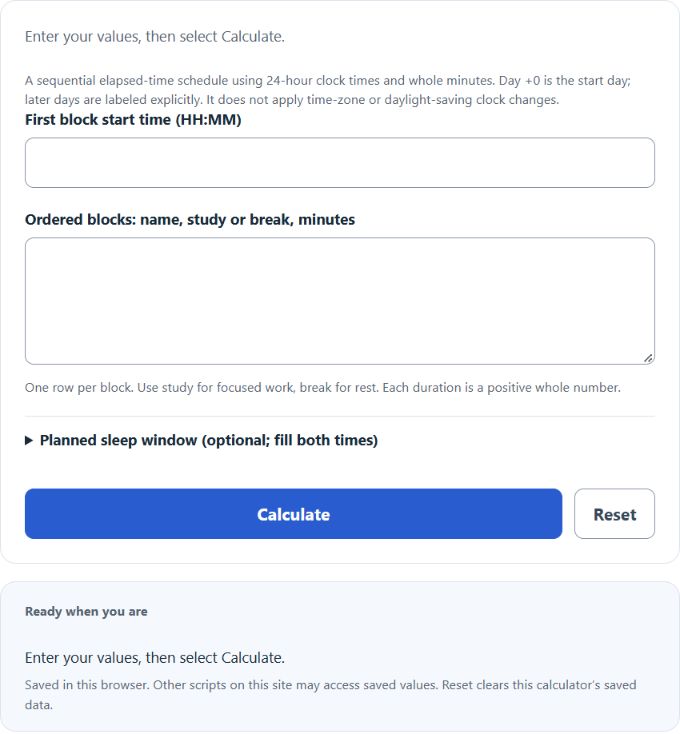
Turn an ordered list of study and break durations into a clock schedule. Each block’s start and end are shown, including explicit day labels when the schedule crosses midnight.
Schedule arithmetic
A block’s start is the preceding block’s end. Each end time equals the initial clock time plus all durations through that block. One day is 1,440 minutes.
Example
Starting at 23:00, a 60-minute study block ends at Day +1 00:00. A 15-minute break ends at 00:15, and a 45-minute study block ends at 01:00. Total study is 105 minutes and breaks total 15 minutes.
Frequently asked questions
Can the schedule exceed one day?
Yes. Day +0 is the initial day, and later day labels keep long schedules unambiguous. Durations are whole minutes; the total is limited to 100,000 minutes.
How is the optional sleep window chosen?
Sleep starts at its first clock occurrence at or after the schedule start. Wake time is its next occurrence after sleep start. Available sleep runs from the later of the final block end or planned sleep start through wake time.
Do clock changes affect the result?
This is elapsed-minute arithmetic using fixed 24-hour days. It does not apply daylight-saving changes, time zones or recommendations about how long to sleep.
Reference: NIST minute, hour and day definitions.