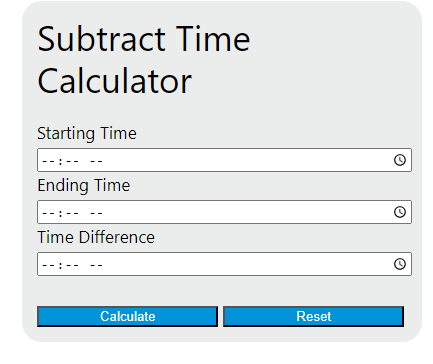
Subtract Time Calculator for duration math, elapsed clock time, and clock offsets with midnight handling, total seconds, minutes, and decimal hours.
Related Calculators
- Cycles to ms Calculator
- Hours to Decimal Calculator
- Deduct Time Calculator
- Decimals to Time Calculator
- Fraction of an Hour Calculator
- Tenth of an Hour Calculator
- All Unit Converters
Subtract Time Formula
Subtracting time means finding the elapsed duration between a starting time and an ending time. The most reliable method is to express both values in the same base unit, subtract them, and then convert the result back into days, hours, minutes, and seconds.
When time is entered as days, hours, minutes, and seconds, convert each full timestamp to total seconds first.
After subtraction, normalize the result back into standard time parts.
If you know any two of the three values, you can solve for the missing one.
Unit Relationships
These conversions are the basis of manual time subtraction and borrowing.
| Conversion | Why It Matters |
|---|---|
60 s = 1 min |
Use when the ending seconds are smaller than the starting seconds and you need to borrow from the minutes column. |
60 min = 1 h |
Use when the ending minutes are smaller than the starting minutes and you need to borrow from the hours column. |
24 h = 1 d |
Use when working across whole days or when the calculation spans midnight. |
86400 s = 1 d |
Useful when converting everything to total seconds before subtracting. |
How to Calculate Time Difference
- Write the starting time and ending time in the same format.
- If the values are split into days, hours, minutes, and seconds, either subtract by columns or convert both times to total seconds.
- Subtract the starting value from the ending value.
- Normalize the result so seconds and minutes stay between 0 and 59, and hours stay between 0 and 23 when days are included.
- If the event crossed midnight, place the ending time on the next day before subtracting.
Borrowing Rules When Subtracting by Hand
- If ending seconds are less than starting seconds, borrow 1 minute and add 60 to the ending seconds.
- If ending minutes are less than starting minutes, borrow 1 hour and add 60 to the ending minutes.
- If ending hours are less than starting hours, borrow 1 day and add 24 to the ending hours.
- Always borrow from the next larger unit before completing the subtraction in the current unit.
Examples
Example 1: Same-day clock time. From 10:30 AM to 2:45 PM:
Example 2: Days, hours, minutes, and seconds. Start = 1 day 3 hours 15 minutes 20 seconds, End = 2 days 6 hours 5 minutes 50 seconds.
Example 3: Crossing midnight. From 10:45 PM to 1:10 AM the next day, move the ending time onto the next day before subtracting.
Where Time Subtraction Is Useful
- Finding elapsed time between a start and finish
- Checking labor, payroll, and shift durations
- Measuring travel, delivery, or wait times
- Comparing timestamps in logs, experiments, or process tracking
- Calculating countdowns and remaining time intervals
Common Mistakes
- Mixing AM/PM time with 24-hour time in the same calculation
- Forgetting to account for the next day when the ending clock time is earlier
- Subtracting columns directly without borrowing
- Ignoring seconds in one timestamp but including them in the other
- Treating a duration as though it were a clock time
Subtract Time FAQ
What if the ending time is earlier than the starting time? If both times are on the same timeline, the result is negative. If the event passed midnight, add the correct day offset before subtracting.
Why convert everything to seconds first? Converting to a single unit removes borrowing errors and makes the subtraction easier to verify.
What is a normalized answer? A normalized time difference keeps seconds and minutes in the range 0 to 59, and hours in the range 0 to 23 when days are part of the result.
Can this method be used with only hours and minutes? Yes. The same subtraction process works with any consistent unit set, as long as both times use the same format.