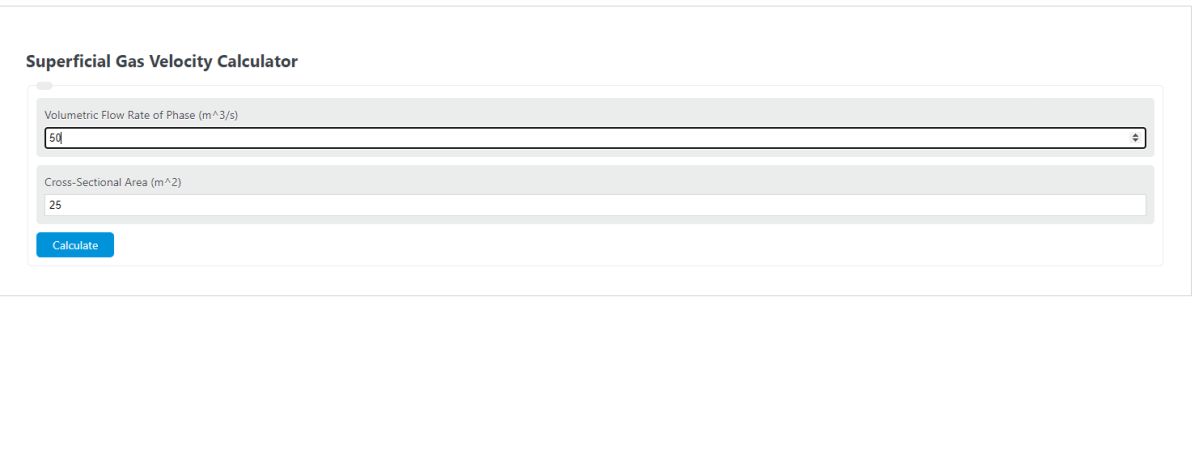
Calculate superficial gas velocity, volumetric flow rate, or cross-sectional area from any two values in m³/s, ft³/s, cfm, m², or ft².
- All Physics Calculators
- All Velocity Calculators
- Velocity Calculator
- Volumetric Flow Rate Calculator
Superficial Gas Velocity Formula
Superficial gas velocity is the apparent gas speed through a column, bed, duct, or vessel cross section. It is called superficial because it assumes the gas occupies the entire cross-sectional area, even when internals, packing, particles, or void spaces are present.
- Us = superficial gas velocity
- Q = volumetric gas flow rate
- A = cross-sectional area normal to flow
If you need to solve for a different variable, the same relationship can be rearranged:
Variable Reference
| Variable | Description | Common Units |
|---|---|---|
| Us | Superficial gas velocity | m/s, ft/s |
| Q | Volumetric flow rate of the gas phase | m³/s, ft³/s, cfm |
| A | Internal cross-sectional area available to the flow calculation | m², ft² |
What Superficial Gas Velocity Means
This value is most useful as a quick loading metric. In an empty tube, superficial velocity is the same as the average bulk velocity. In a packed bed or porous medium, it is lower than the true gas speed through the open void space because solids and internals occupy part of the area.
When void fraction is important, the actual interstitial gas velocity can be estimated from:
Here, ε is the void fraction of the bed or medium. This distinction matters in packed columns, fluidized beds, filters, membrane modules, and gas distributors.
How to Calculate Superficial Gas Velocity
- Determine the gas volumetric flow rate at the operating conditions of interest.
- Measure or calculate the cross-sectional area perpendicular to the gas flow.
- Divide the flow rate by the area.
- Report the result in velocity units such as m/s or ft/s.
Example
If a gas stream has a volumetric flow rate of 50 m³/s and passes through an area of 25 m², then:
The superficial gas velocity is 2 m/s.
How to Use the Calculator
- Enter the volumetric flow rate of the gas phase.
- Enter the cross-sectional area of the equipment or medium.
- Choose matching units for each field.
- Calculate to obtain the superficial gas velocity instantly.
If you already know the superficial velocity and need the required flow rate or area, enter the other two values and solve for the missing term using the same relationship.
Finding the Cross-Sectional Area
If the area is not known directly, it can often be computed from the equipment geometry.
For a circular pipe, column, or vessel:
For a rectangular duct or channel:
- D = internal diameter
- W = internal width
- H = internal height
If You Only Know Mass Flow Rate
Some systems report gas flow as mass flow instead of volumetric flow. In that case, convert mass flow to volumetric flow first using gas density:
- ṁ = mass flow rate
- ρ = gas density at the same temperature and pressure
Because gas density changes with operating conditions, always use a density value consistent with the actual process temperature and pressure.
Why This Calculation Is Useful
- Compares gas loading across vessels of different sizes.
- Supports preliminary sizing of columns, beds, and gas-contact equipment.
- Helps evaluate residence time trends and gas throughput.
- Provides a common basis for discussing pressure drop and flow regime behavior.
- Offers a fast screening parameter before detailed design calculations.
Common Mistakes to Avoid
- Mixing unit systems: pair SI inputs with SI area units, or imperial inputs with imperial area units.
- Using the wrong area: use the internal cross-sectional area normal to flow, not outside dimensions.
- Ignoring operating conditions: volumetric flow rate should match the actual gas state in the equipment.
- Confusing superficial and actual velocity: packed or porous systems usually have a higher true gas velocity than the superficial value.
- Using local restrictions instead of full section area: superficial velocity is based on the selected overall flow section unless a different definition is intended for the analysis.
Practical Interpretation
A larger volumetric flow rate increases superficial gas velocity, while a larger cross-sectional area decreases it. This simple inverse relationship makes the metric especially useful when comparing design options: increasing diameter lowers gas velocity, while increasing throughput raises it. For systems containing packing or particles, superficial velocity is best treated as an overall process indicator rather than the exact speed experienced inside the void spaces.