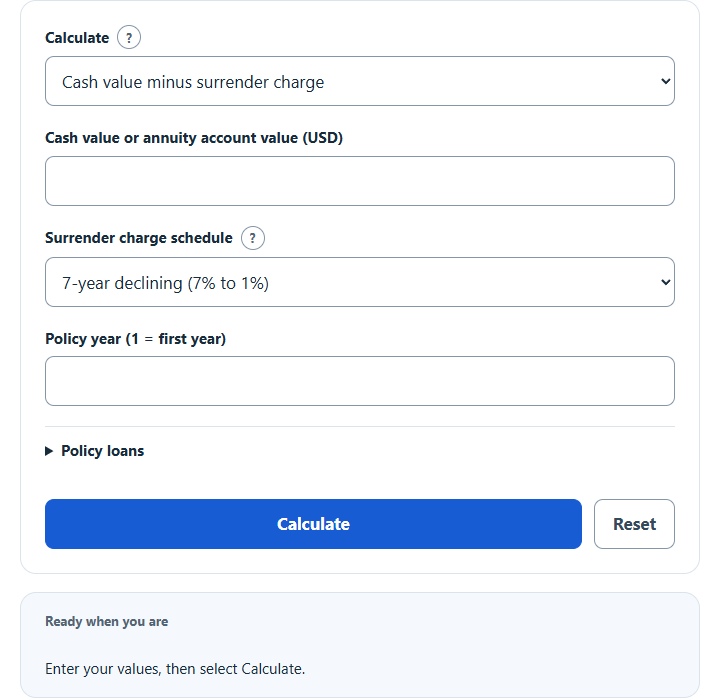
Calculate the surrender value of a life insurance policy or annuity: cash value minus the surrender charge for your policy year, or premiums × a factor.
Surrender Value Formula
The following simplified model uses the policy-specific eligible premium base and factor. It is not a universal insurance or annuity formula or a substitute for an insurer’s quote. The bonus input is its surrender cash value after any separate bonus factor; see the distinct premium and bonus surrender factors in the LIC Jeevan Lakshya policy brochure as one policy-specific example.
Variables:
- SV is the estimated surrender value (USD), after the zero floor.
- EP is the eligible premium base (USD): annual base premium × (full years paid − 0 or 1 excluded first year).
- F is the policy surrender factor (%); B is bonus surrender cash value (USD); C is a fixed dollar deduction (USD).
Raw value R = EP × F ÷ 100 + B − C. The surrender value is the larger of R and $0. Blank bonus and deduction mean $0. Money inputs accept cents; exact decimal arithmetic rounds each displayed money amount once, with half-cent ties away from zero. No currency conversion is performed.
What is a Surrender Value?
A policy’s cash surrender value is the cash amount available when it is surrendered under its contract. Eligibility, surrender factors and charges depend on the policy. Unentered loans, taxes and other adjustments are excluded from this calculator. The result can be above or below premiums paid and does not establish the amount an insurer will actually pay.
How to Calculate Surrender Value?
Use the actual policy’s eligibility basis, surrender factor and bonus cash-value terms. A positive target has one algebraic factor when that factor is nonnegative. A zero target has all factors from 0% through 100 × (deduction − bonus cash value) ÷ eligible premiums when deduction exceeds bonus, only 0% when they are equal, and no nonnegative solution when bonus exceeds deduction. A zero eligible premium base is unsupported.
- For a cash value or annuity, enter the value, pick a surrender charge schedule and enter the policy year. For a factor-based policy, first enter the annual base premium and full years paid. Choose whether the policy excludes the first-year premium to establish a positive eligible premium base.
- Next, enter the policy surrender factor as a percentage, the already-factor-adjusted bonus surrender cash value and the fixed deduction in USD. The model allows factors above 100%, but the actual contract controls whether they are meaningful.
- Next, use SV = max(0, eligible premiums × factor ÷ 100 + bonus cash value − fixed deduction).
- Finally, calculate the estimated surrender value in USD. For a positive target, reverse solving uses factor (%) = 100 × (target + fixed deduction − bonus cash value) ÷ eligible premiums.
- Check the exact inputs, policy assumptions, raw value, recovery ratio and difference from premiums paid in Calculation details. Targets refer to the unrounded model value; displayed rounding is not fed back into inverse solving.
Example Problem :
Use the following variables as an example problem to test your knowledge.
Annual base premium = $2,000; full years paid = 5; exclude the first-year premium. Total premiums paid are $10,000 and eligible premiums are $8,000.
Policy factor = 30%; bonus surrender cash value = $100; fixed deduction = $200. Estimated surrender value = max($0, $8,000 × 30% + $100 − $200) = $2,300.00. Premium recovery is 23%, with a difference of −$7,700.00 from premiums paid.