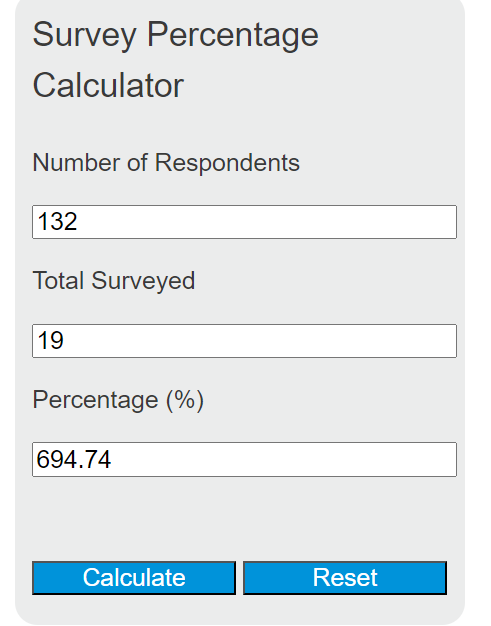
Calculate survey response, completion, or answer-choice percentages, or solve the required responses and total surveyed from any two known values.
Related Calculators
- Frequency Percentage Calculator
- Completion Rate Calculator
- Drop-Off Rate Calculator
- Cronbach Alpha Calculator
- All Statistics Calculators
Survey Percentage Formula
The survey percentage calculator finds the share of people who responded out of the total number surveyed. In practical use, this is the survey response rate. It is a simple but important metric for polls, questionnaires, feedback forms, academic research, market research, employee surveys, and customer satisfaction studies because it shows how much of the sampled group actually participated.
Where:
- P = survey percentage or response percentage
- NR = number of respondents
- TS = total number surveyed
For a standard survey, the inputs usually follow this condition:
Rearranged Forms
If you already know the percentage and need to solve for a missing count, the same relationship can be rewritten in these forms:
These rearrangements are useful when you want to estimate how many responses were received from a known response rate, or when you know the number of respondents and the response percentage and need to infer the surveyed total.
How to Calculate Survey Percentage
- Identify the number of respondents who completed or submitted the survey.
- Identify the total number surveyed, such as invitations sent or people asked to participate.
- Divide respondents by the total surveyed.
- Multiply the result by 100 to convert the decimal into a percentage.
- Round the final answer only if needed for display or reporting.
Example
If 250 people responded out of 500 surveyed, the calculation is:
A result of 50% means half of the surveyed group responded.
How to Interpret the Result
| Survey Percentage | Interpretation |
|---|---|
| 0% | No one in the surveyed group responded. |
| 25% | About 1 out of every 4 surveyed people responded. |
| 50% | About 1 out of every 2 surveyed people responded. |
| 75% | About 3 out of every 4 surveyed people responded. |
| 100% | Everyone surveyed responded. |
In general, a higher response percentage means the survey results are based on more of the original sample, while a lower percentage means more of the target group did not participate.
Survey Percentage vs. Answer Percentage
This calculator measures response percentage, not the percentage of respondents who selected a particular answer choice. If you want the share of respondents who chose one option, use the option count divided by the total number of respondents.
Where:
- A% = percentage for a specific answer choice
- AC = answer choice count
- NR = total respondents
This distinction matters because a survey can have a low response percentage overall, while one answer option still represents a large share of the people who did respond.
Common Input Mistakes
- Using percentages instead of counts: enter raw respondent totals for NR and TS, not already-converted percentages.
- Entering zero for total surveyed: if TS = 0, the calculation is undefined because division by zero is not possible.
- Mixing time periods: make sure both values come from the same survey wave, campaign, or reporting window.
- Mixing completed and partial responses: decide whether NR means completed responses only or all submissions, then stay consistent.
- Rounding too early: keep the intermediate decimal value and round only the final percentage.
Useful Companion Metric
Sometimes it is helpful to also calculate the percentage of people who did not respond:
Where NP is the non-response percentage. This gives quick context for how much of the original surveyed group is missing from the response set.
When This Calculator Is Useful
- Customer satisfaction and post-purchase feedback surveys
- Employee engagement and internal pulse surveys
- Email campaign questionnaires and follow-up forms
- Academic research and classroom survey reporting
- Event feedback and registration follow-up
- Community polls, market research, and opinion surveys
Quick Reference
| If You Know | Use This To Solve |
|---|---|
| Respondents and total surveyed | Find the survey percentage |
| Survey percentage and total surveyed | Find the number of respondents |
| Survey percentage and respondents | Find the total surveyed |
Use the calculator above by entering any two known values. The remaining value can then be calculated immediately, making it easier to analyze survey participation, compare response rates across campaigns, and report results clearly.