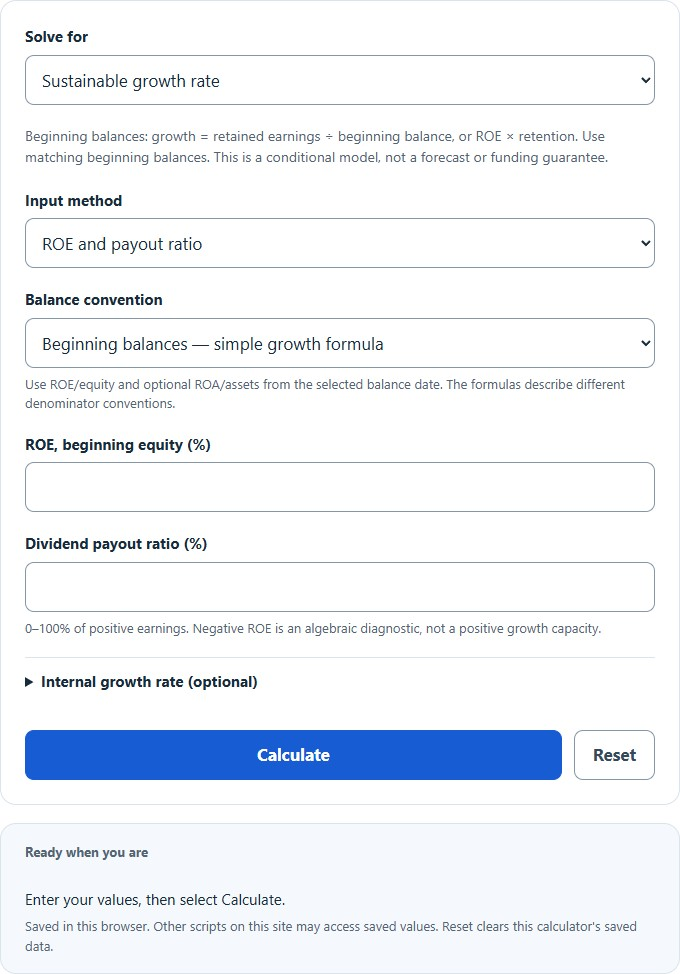
Model sustainable growth from ROE and payout or statement figures, using an explicit beginning/ending balance convention. Solve for ROE or a payout boundary for an exact target; optional inputs add an internal growth model.
Sustainable Growth Rate Formula
SGR = ROE * (1 - p)
- SGR is a conditional sustainable-growth model under unchanged operating ratios and debt-to-equity policy, without new shares; it is not a forecast or a guarantee of available funding (%)
- ROE is net income divided by shareholders’ equity from the selected balance date; the default simple formula uses beginning equity (%)
- p is dividends divided by positive net income; b = 1 - p is the retention ratio. With nonpositive net income these ratios are not meaningful; statement mode instead uses net income minus dividends directly.
The default beginning-balance convention applies the simple formula directly. Use beginning-equity ROE, or enter net income, dividends and positive beginning equity in statement mode. The direct retained balance is net income minus dividends, so loss periods and distributions above income can be shown as contraction diagnostics without dividing by net income. The Government of Canada derivation and NYU Stern discussion of growth determinants explain the beginning-equity convention.
For the beginning-balance convention, the two other modes rearrange the same equation. Given an exact growth target g and payout p, the required return on equity is:
Required ROE = g / (1 - p)
For positive ROE, the exact-target payout is also the maximum payout meeting at least that target. With negative ROE it is instead a minimum algebraic boundary, not a positive-earnings funding recommendation. Payout is restricted to 0–100% in the ratio and inverse modes:
Maximum Payout Ratio = 1 - (g / ROE)
Select ending balances only when ROE or the equity amount uses ending equity. With decimal rates, let x = ending-equity ROE × b, or retained balance ÷ ending equity. The equivalent beginning-equity change is x ÷ (1 - x). This requires x below 1 and is not a general precision upgrade to beginning-equity ROE:
SGR = (ROE * b) / (1 - ROE * b)
The optional internal growth model assumes no new debt or equity. Use ROA or positive assets from the same beginning/ending convention selected above. Beginning assets use retained balance ÷ beginning assets, or ROA × b. Ending assets use the transformed equation below, as in the publisher’s financial-planning formulas. An ending-asset denominator of zero or less makes IGR unavailable while a valid SGR remains visible:
IGR = (ROA * b) / (1 - ROA * b)
Reading the Gap Between Actual Growth and SGR
A consistently measured SGR can be compared with actual growth as a conditional planning benchmark. A gap suggests questions about funding, operating ratios and payout policy; it does not by itself measure a cash shortfall or surplus. The following table describes model implications under stable assumptions.
| Situation | What it means | Typical response |
|---|---|---|
| Actual growth well above SGR | Growth is outrunning internal funding; a financing gap opens every year | Borrow more, issue shares, cut the dividend, or lift margins and asset turnover |
| Actual growth roughly equal to SGR | Growth is fully funded by retained earnings at constant leverage | Maintain current financial policy |
| Actual growth below SGR | The company generates more capital than its growth absorbs | Raise the dividend, buy back stock, pay down debt, or acquire |
| SGR zero or negative | Zero growth may mean zero ROE or all positive earnings distributed. A negative retained balance may reflect losses or distributions above income; inspect the figures. | Separate zero retention from losses and overdistribution before interpreting growth capacity |
The table below contains hypothetical arithmetic scenarios using the simple beginning-equity formula. Sector names are illustrative labels, not measured sector averages, forecasts or recommended payout policies. SGR displays are rounded to one decimal place where needed.
| Illustrative sector label | Assumed beginning ROE | Assumed payout ratio | Implied SGR |
|---|---|---|---|
| Utilities | 10% | 65% | 3.5% |
| Large banks | 11% | 35% | 7.2% |
| Consumer staples | 18% | 55% | 8.1% |
| Healthcare | 15% | 35% | 9.8% |
| Software and technology | 20% | 10% | 18% |
Sustainable Growth Rate Example Problems
Example 1. With beginning-equity ROE of 15% and payout of 40%, retention is 0.60 and the simple growth model gives 9% per year. If instead the entered 15% is an ending-equity ROE, the ending-balance transform gives 0.09 / (1 - 0.09) ≈ 9.89%. These calculations use different denominator conventions; applying the transform to a beginning-equity ROE is not a more precise version of the same input.
Example 2. Net income of $2,000,000 less dividends of $500,000 leaves $1,500,000 retained. With positive beginning equity of $12,500,000, ROE is 16%, payout is 25% and simple growth is 12% per year. If $12,500,000 is instead ending equity, select ending balances; x = 1,500,000 / 12,500,000 = 0.12, and growth is 0.12 / 0.88 ≈ 13.64%. Enter matching dates and flows in statement mode.
Sustainable Growth Rate FAQ
What happens if a company grows faster than its sustainable growth rate?
Nothing breaks immediately, but the growth must be financed somehow. The company either borrows, which raises its debt-to-equity ratio, issues new shares, which dilutes existing owners, or draws down cash. Sustained growth above the SGR with rising leverage is a common early warning sign of financial strain, so check whether the borrowing is a deliberate policy or a symptom.
What is the difference between the sustainable growth rate and the internal growth rate?
IGR models growth without new debt or equity, while SGR permits proportional debt under constant leverage. With consistent positive balances, positive retained earnings and compatible asset/equity measures, that borrowing allowance can make SGR larger. No universal ordering is asserted for losses, overdistribution or inconsistent inputs. Use the optional IGR section and the same beginning/ending convention to compare the model results.
Why are there two versions of the SGR formula?
The simple formula uses beginning-equity ROE. If ROE uses ending equity instead, x = ROE × b measures retained earnings relative to ending equity, and x / (1 - x) converts it to growth relative to the implied beginning equity. The denominator must be positive. Neither convention is universally more precise; match the numerator flow and denominator date. Inverse modes follow the selected convention. At 100% payout and zero target, any finite ROE solves the identity; zero ROE and zero target allow every payout from 0% to 100%. Nonzero targets in those zero-retention or zero-ROE cases have no finite solution.