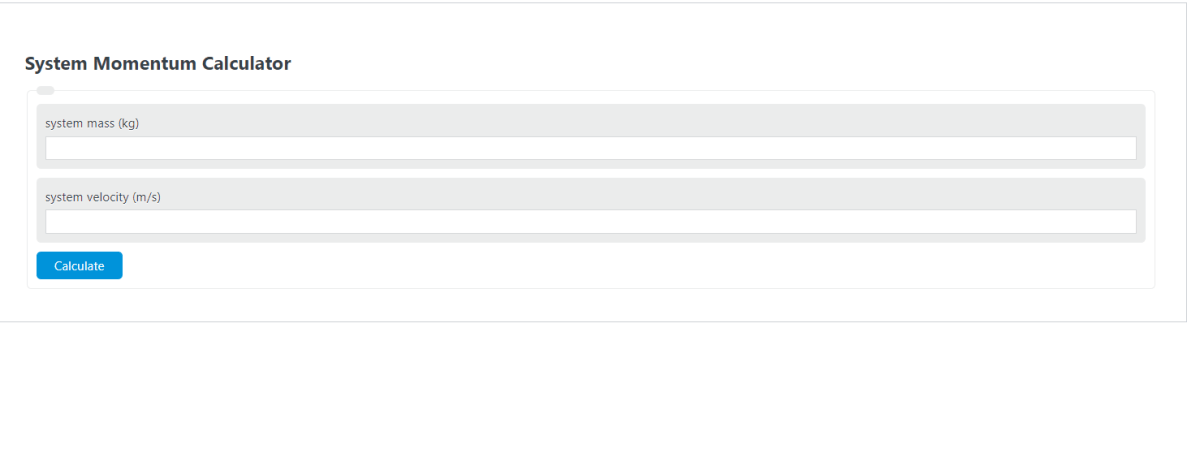
Calculate momentum, mass, or velocity from any two values with kg/lb and m/s, ft/s, or mph unit conversions for physics calculations.
System Momentum Formula
Use this calculator when an entire system can be modeled as one combined mass moving with one velocity.
pₛ = mₛ × vₛ
| Symbol | Meaning | Common Unit | Practical Note |
|---|---|---|---|
| ps | System momentum | kg·m/s | Direction matters; use sign when needed. |
| ms | Total system mass | kg | Add masses only if they are part of the same modeled system. |
| vs | System velocity | m/s | Use a negative value for motion opposite your chosen positive direction. |
Rearranged Equations
If you know any two values, solve for the third with the matching form below.
| Find | Equation |
|---|---|
| Momentum | pₛ = mₛ × vₛ |
| Mass | mₛ = (pₛ) / (vₛ) |
| Velocity | vₛ = (pₛ) / (mₛ) |
When This Calculator Is Appropriate
- Use it for a single object or a combined system moving together at one velocity.
- If different parts of the system move at different velocities, total momentum must be added by parts.
psystem = Σᵢ₌₁ⁿ mᵢ vᵢ
How to Calculate System Momentum
- Determine the total mass of the system.
- Determine the system velocity in a consistent unit set.
- Multiply mass by velocity.
- Report the result with units and direction/sign if applicable.
Unit Guide
| Mass Unit | Velocity Unit | Momentum Unit |
|---|---|---|
| kg | m/s | kg·m/s |
| lb | ft/s | lb·ft/s |
| lb | mph | lb·mph |
For clean comparisons, keep all inputs in one consistent unit system before interpreting the result.
Quick Example
A 9 kg system moving at 5 m/s has:
pₛ = 9 × 5 = 45 kg × m / s
Common Mistakes
- Ignoring direction and treating opposite velocities as the same.
- Using total mass with a single velocity when the parts are actually moving differently.
- Mixing SI and imperial units without conversion.
- Forgetting that if velocity is zero, momentum is zero.
Helpful Notes
| Situation | What to Do |
|---|---|
| Object speeds up | Momentum increases if mass stays constant. |
| Object changes direction | Momentum sign changes with the chosen axis. |
| Two objects move in opposite directions | Net system momentum may partially or fully cancel. |
| System moves together after combining | Use total mass and the shared final velocity. |