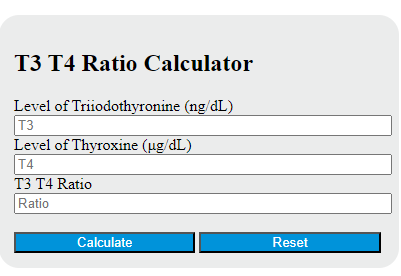
Calculate total or free T3-to-T4 ratio, or solve for either hormone value, with conventional and SI thyroid lab unit conversions.
- All Health and Medical Calculators
- Reverse T3 Ratio Calculator
- Free Androgen Index Calculator
- TSH Calculator
T3 T4 Ratio Formula
The following formula is used to calculate the T3:T4 ratio (index).
Variables:
- R is the T3:T4 ratio (an index; units depend on which lab units are used)
- T3 is the level of total triiodothyronine in the blood (commonly ng/dL; sometimes nmol/L)
- T4 is the level of total thyroxine in the blood (commonly μg/dL; sometimes nmol/L)
To calculate the total T3:T4 index used by many labs, divide total T3 (ng/dL) by total T4 (μg/dL). Because these conventional units differ (ng vs μg), the result is best thought of as a unit-based index (ng/dL per μg/dL), not a true dimensionless ratio. For free hormones, the analogous calculation is FT3/FT4 (often pg/mL per ng/dL). Clinically, T3/T4 ratios are usually interpreted only as a supporting data point in context; thyroid disorders are typically evaluated primarily with TSH and free T4 (and sometimes free T3), along with symptoms and medical history.
What is a T3 T4 Ratio?
A T3:T4 ratio is a calculated value derived from thyroid blood test results for triiodothyronine (T3) and thyroxine (T4). Depending on the context, it may be computed using total hormone measurements (total T3 and total T4) or free hormone measurements (free T3 and free T4). The ratio can sometimes help describe whether T3 is relatively high or low compared with T4, but it is not typically used by itself to diagnose hyperthyroidism or hypothyroidism.
How to Calculate T3 T4 Ratio?
The following steps outline how to calculate the T3 T4 Ratio.
- First, decide whether you are calculating a total ratio (total T3 and total T4) or a free ratio (free T3 and free T4).
- Next, determine the level of total triiodothyronine in the blood (T3), commonly reported in ng/dL (or nmol/L).
- Next, determine the level of total thyroxine in the blood (T4), commonly reported in μg/dL (or nmol/L).
- Next, gather the formula from above: R = T3 / T4 (for free hormones, use R = FT3 / FT4).
- Finally, divide to calculate the ratio, then check your answer with the calculator above.
Example Problem :
Use the following variables as an example problem to test your knowledge.
Level of triiodothyronine in the blood (T3) = 120 ng/dL
Level of thyroxine in the blood (T4) = 8.6 μg/dL → R = 120 / 8.6 = 13.9535